Agricultural Robots:
Today, let us go through Agricultural Robots, their advantages, automation, history, and the future.
An agricultural robot is also called as an agribot or agbot. This is a robot which is autonomous and is helpful in farming. It helps the farmer to raise the crops’ efficiency and also reduces the need for manual labour to the farmer. In the coming generations, we can expect that the tilling, sowing, harvesting and many other farm works will be done by these agricultural robots individually. Even the weeding, control of pests and diseases will be taken care of by these agricultural robots.
These agricultural robots are equipped with arms which are specialized, end effectors and many other tools in order to work on several tasks related to agriculture. The agricultural robots can also get connected to the wireless sensor networks and by using the drones, these robots will collect a huge amount of information or data. The trend of using agricultural robots will be increased to a wide extent in order to replace manual labour. In the present days, robots are used for pricking fruits, milking of cows and rearing of sheep and they are found to be successful in those tasks. There are many thousands of robotic milking parlours in the world right now and the mobile robots are standing as help to the farmers in the automation of tasks which include pushing of feed and the cleaning of manure.
History of Agricultural Robots:
- The revolution in agriculture has started in 1752 and ended in the year 1900 when agriculture has changed in America in a drastic way.
- The main reason for the occurrence of a revolution in agriculture is due to the introduction of the machines.
- A machine which is well known has been introduced at this time and its name was Eli Whitney’s cotton gin.
- It is the first machine which has been used in agriculture. This machine was introduced in the year 1974 on the 14th of March by Eli Whitney. This machine has the ability to isolate the cotton seed from the cotton fibre and it has the record of creating up to 50 pounds of cotton in one day. This fifty pounds per day is equal to almost hundreds of man-hours. The cotton gin is the first machine which has given way to several modern machines in Agriculture.
- Robotics was first developed in agriculture in the early times of the year 1920.
- The research has taken place to give a start to the automatic guidance to the vehicle and that was about to take a shape. This research has given rise to developments in the years between 1950 and 1960.
- The advancements happened to get the agricultural vehicles which are autonomous. This particular concept has not been that perfect as the vehicles were in need of a cable system for their guidance along the path they travel.
- Agricultural robots have continued their development in the form of technologies in multiple sectors as well. In the 1980s, after the computers were developed, the guidance for the vision of the machine was made possible.
- Other developments took place in the following years in the form of orange harvesting with the help of agricultural robots in countries like the USA and France.
- For decades, agricultural robots have been used for the indoor industries and for the outdoors, it has always been tough to incorporate as they are termed as the more complex ones to develop. The security concerns, difficulty in picking crops, varying conditions of environment leads to the unpredictability of the use of these robots.
Types of Agricultural Robots:
Agricultural robots offer a service which is completely professional and these are the ones with automating the tasks which are found difficult for a human. These robots are used in the farms. These robots are used in several applications and agriculture is one among those applications.
The farmers face a lot of problems while working in the field. Cost is the main thing in order to keep the farmer in the competitive market and for that the cost of operations has to be reduced at a maximum level. Robots are the ones which offer services in a professional way and can automate the tasks which are very difficult manual. These are used in the agricultural lands and they are also completely autonomous.
The agriculture industry faces a lot of problems. Pricing needs to be competitive on a global scale, creating constant pressure to reduce operating costs. Meanwhile. The population has been growing very rapidly, which is pressurizing the farmers for the rise in the yield. In this, agricultural robots will play a major role in supporting the farmer to address all the challenges which he is facing
There are several types of robots which are being used in the field of agriculture and there are many new solutions which are getting developed with time. Out of all those, 8 types of agricultural robots have become popular and those are listed below:
Precision Agriculture: Robots used in this field of agriculture are basically used in the farms which are small and even vineyards. These will follow the techniques of precision agriculture. Moreover, they are mostly used to monitor the respiration of soil in an autonomous way, the activities of photosynthesis, and all the biological aspects.
Monitoring the pollution: Few robots in the agricultural field have been equipped for the sake of monitoring the pollution which will be created by the agriculture process mainly at the ground level. These specific robots play an active role in calculating the content of the emission of carbon dioxide and nitrous oxide in order to help the farmers in reducing the footprint of the environment.
Livestock Ranching: A new variety of agricultural robots have been introduced to herd the livestock in huge ranches. These agricultural robots also play an active role in monitoring the animals in the livestock and make sure that the health of the animals is good and there is a sufficient amount of space for them to graze.
Control of weeds: The agricultural robots which have been designed in order to control weeds can perform navigation in the form in an autonomous way and can spray the herbicides on the targeted points in order to avoid or eliminate the weeds. This particular approach will decrease the exposure of crops to herbicides and helps in preventing the growth of weeds which are resistant to herbicides.
Automation of nursery: These agricultural robots come to great help in the nurseries related to crops and these are mainly used to move the plants around the greenhouses which are large. These agricultural robots also give very good efficiencies to the crop nurseries and also help them to address a shortage in the growing labour.
Harvesting of the crop: In order to harvest the crops, there are agricultural robots which specialize in working round the clock for quick harvesting. You can observe that in many of the cases, to complete the same work, it would take approximately 25 to 30 workers.
Harvesting of fruits: The agricultural robots at the starting were used to harvest the fruits along with the crops. The harvesting is a bit difficult for agricultural robots. So, new agricultural robots have been designed which are equipped with the system of vision which is advanced so that they can identify the fruits and pick them without causing any damage.
Seeding and planting: This application is the one which has been emerging. The agricultural robots with vision systems which are three dimensional (3D) are now able to plant and seed the crops for good growth. These are also working very accurately. They are mainly used for farming lettuce and also in the vineyards.
The agricultural robots are unique in both the functioning and also the form. The agricultural robots are offering great support to the farmers by improving the efficiency of the farm and raising the yield.
Applications of Robotics in Agriculture:
The industry of food is revolutionized by the introduction of agricultural robots and automation. Farming is the main source for food and automation in agriculture is increasing the strength of it. In the coming five to six years, the use of agricultural robots and drones are estimated to increase by $30 billion
There are many real issues in the agriculture of the present day. The farming methods which are followed traditionally will make it hard to meet the efficiencies which are required by the present trend of the market. The farmers who are part of the countries which are already developed have been suffering due to the unavailability of the workforce. The development in the farming which is automated is used as an attempt to bring the solution to all these problems with the help of robotics and the sensing which is an advanced one.
Nursery Planting
Nurseries are the places where young plants are formed from the seeds which are planted in the outdoors later. The plants in the nursery are mostly sold to the consumers and gardeners directly, but they are also a beginning of the journey of food for few crops.
There is a requirement of the automation in a nursery. HETO Agrotechnics and Harvest automation are the companies which are providing solutions for seeding, warehousing the plants which are living in greenhouses, and also potting in an automated way.
Crop Seeding
The plants which give food to start their life as a seed in the agricultural field. For sowing the seeds, the traditional methods are to scatter them by using a broadcast spreader which will be attached to a tractor. This spreader will throw many numbers of seeds all around the field, whereas the tractor helps by driving steadily and following a single path. This traditional method is not considered to be an efficient one as the seeds get wasted.
Precision seeding which is done in an autonomous way will help in combining the robotics with geo-mapping. A map will be generated which gives information about the properties of soil such as the quality of soil, the density of soil, etc. at each and every point of the agricultural field. A tractor with a seeding attachment which is robotic will start placing the seeds at accurate locations and at correct depths so that every seed will get a better chance for growth.
Monitoring the crop and giving analysis
- It is very difficult to monitor the crops grown in huge fields. Technologies like geo-mapping and new sensor are helping the farmers to get high levels of information about the crops which they are growing. The drones and robots which are at ground level will give a way to get this data in an autonomous way.
- Companies which manufacture drone such as Precision Hawk are offering farmers few with the packages which are a combination of robotic hardware and analysis software. This will help the farmer to take the drone into the agricultural field, start the software through a Smartphone or tablet and get a view of the crop which has been collected in real time.
- Robots which are ground-based, such as BoniRob will provide the farmers will detailed observations as they would be able to get very much close to the crops. Some of these agricultural robots can also be used for several other tasks such as fertilization and weeding.
Fertilization and Irrigation
- Irrigating the crops and fertilizing them will require a lot of water in the traditional method and it is considered to be not that efficient.
- Precision irrigation, which is assisted by the robot will decrease the water, which is wasted by targeting a few particular plants.
- Robots which are ground-based will navigate among the crop rows in an autonomous way and pour the water directly at the base level of every plant.
- The advantage of robots is that they would be able to go into the areas where the other machines of agriculture could not go. To take an example, the growers of corm always face issues as the plants will grow rapidly and they get less time to fertilize them in a reliable way. Robots will help to solve this issue as it drives among the corner rows and provides nitrogen to the plant base of every plant.
Crop Weeding and Spraying
- It is not efficient to spray pesticides and killers of weed onto the agricultural fields as it will cause harm to the environment. Robots will help in this situation by providing efficient methods.
- Micro-spraying is a method which will mainly decrease the amount of herbicide in the growing of crops. The robots which involve in micro-spraying will make use of the technology of computer vision for the detection of weeds and then start spraying the targeted amount of herbicide onto the crop. AG BOT 11 is an agricultural robot which takes power from solar energy and this robot uses this technology.
- Few of the robots which perform weeding will not use any chemicals. For example, RoboCrop is the one which uses the vision of a computer for the detection of plants as it will be moved by tractor. It will automatically convey water to the spaces in between the plants in order to uproot the weeds.
Thinning and Pruning
Thinning is a method which involves decreasing plant density in order to give every plant a better chance for growth. Pruning is a method which involves cutting off the plants back parts so that there would be an improvement of growth in them.
The thinning robot which is called as Lettuce Bot is an agricultural robot which makes use of the vision of a computer for the detection of the lettuce plants by driving on them and deciding which one to remove and which one to retain.
Pruning is a very tough task and the automation of pruning is done in the industry of the brewery. Wall-Ye is the robot which has been introduced to the wine industry and it has the ability to prune the grape vines. The same company also developed a robot which can prune blueberries too.
Autonomous Tractors
- Most of the agricultural robots would be attached to the tractors. It’s the men who drive the tractors usually and the agricultural robots are designed in such a way that they get adapted to the speed of the driving of human. These days, the tractors which are completely autonomous are becoming much popular.
- The report from the IDTechEx Agricultural Robots says that there are more than 350 thousand tractors which are induced with the functionality of automation and are even soil in the year 2016.
Harvesting and Picking
- Harvesting the crops like corn, wheat and barley are a bit easy. Harvesting can be done by making use of a combine harvester which can be automated. Few more crops like soft fruits are very difficult for harvesting as they need manual skill in performing tasks.
- The project, called Clever robots for crops which have been funded by the EU is the one which is making very good progress on a few applications of harvesting. This harvesting includes apple harvesting, sweet pepper harvesting etc.
Herding and Shepherding
- Though most of the robots used in agriculture are currently being applied mostly in the growing of crops, there are some more applications which have been emerging in the farming of sheep and cattle.
- Farmers who belong to New Zealand and Ireland have been seen making use of drones in order to round up the sheep over the terrain which is long and also tough.
- You can see many examples of cattle-herding drones, which are controlled by remotes on YouTube.
Milking in Dairy Farming
- There is a very good development in the robots which have been in help for the process of milking in the dairy farms. The case study which is done by the Universal robots will clearly show how a UR5 can be made use in order to spray the disinfectant on the udders of the cow while preparing it for milking.
- The revolution of agricultural robotics will continue and they will obviously make changes in the ways of production of food which we usually follow.
Farming with Robotics:
- As the population increases, there is increasing pressure on the farmers to produce more food. The United Nation has predicted that the population of the world will increase to 10 billion by the year 2050. The population, which is growing is becoming very selective about the food they consume on a daily basis.
- Considering the market of only the European Union, the consumption of the organic matter has increased by 8% in the year 2014 whereas the sales of the organic products were at €25 billion. Along with the food which is organic, there is pressure for greener farming, which makes use of less water and fewer pesticides.
- The above factors force the farmers for more production with great quality and in a manner which is sustainable. As there is no youth present in the agricultural profession, there is very less manpower available to take the vision in the forward direction.
- Then the robots entered into farming, which is set to increase the yield of production and at the same time decreasing the usage of resources and made farming a high-tech profession which is exciting most of the youth.
- Robots have been introduced as a part of encouragement towards precision agriculture. Europe is the one which has offered most of the funds for almost six projects of robotic farming.
- In the farming of crops, robots will have to navigate their environment in an autonomous way and do the tasks at the locations which are set. Examples of tasks would be like fruit picking, pesticide spraying, taking the image of the plant and also making measurements.
- The glasshouses are the ones which are quite easy to move all around as the environment is engineered much carefully and is mostly fit with tracks for the robots to follow so that they can reach the location which has been set.
- In the farming which is done outdoors, the robots will perform their tasks after they receive a plan along with the set of locations on the agricultural field. When the trajectories of the robot are known, then the robot can make use of the GPS and a closed-loop control to ensure that it is on the track. When the task of the robot is to follow a trajectory which is unknown like a crop row, computer vision would be used to make the robot detect its way.
- There is a wireless connection to the robot to the central operator so that it can receive the instructions about the machine which are updated and also report the data and status.
- Moreover, to prepare a farm robot which is an autonomous one will need controllers who are intelligent and also the systems for communication. To a certain level, the technology is the same as the one in the autonomous cars which are applied to agtech.
- The main difference between them is that the agricultural robots need to change their environment more often for picking the fruits and vegetables, application of fertilizers, etc. All these works will need sensing, manipulation, and even the processing should be done on their own.
- The project, which has been completed recently called as RHEA is the one which led to the development of a fleet of tractors and the aerial robots which have the systems of a sensor to remove weeds from the crop and also for the application of herbicides wherever needed.
- The autonomous tractors which carry sprayers of herbicides along with the drones and also are equipped with the systems of weed-detection have proved that they can save up to 3/4th of the herbicides. The tractors which are autonomous and are equipped with the weed detection systems onboard have the capability to kill almost 90% of the weeds present in the agricultural field.
- The agricultural robots navigate through the rows of the plant, sense them and send the report or information to the farmers so that it can help them to improve the breeding of the seed.
- If the agricultural robots are equipped with a weed puncher, the robot will have the ability to punch the weeds into the ground. Deepfield robots are the ones which have sensors which are smart and can be positioned in the agricultural fields. The networks which are resulting will be deployed in the farms so that they can monitor the conditions of the soil if there is any asparagus.
- In the robotics, there are also many challenges in the coming days. As the development in terms of technical aspects are required for the identification of fruits and also for the analyzation of degree of ripeness in worst weather conditions such as modifying light conditions, dust, a temperature which is extreme, variations in wind and moreover, for the detection of weeds.
- The accuracy of the position of the robot is improved so that it would help in optimizing the application of pesticides. Though the industrial manipulators show great accuracy and speed in the factories, when applied in farming, it is very tough as the objects would be moving.
- A good thing is that the agricultural fields are open to modern technologies which are getting deployed and the requirement of the investments. The agricultural fields are already in the loss of the adaptors of the modern robotic technology.
- The agricultural farms in the coming generations will have many numbers of agricultural robots which will be seen working together. This will be done by the deployment of many numbers of simple and small robots.
- This would make the solutions to the farm safer, reliable and also productive as they prevent compaction of the soil, which will be caused due to the robots which are larger and navigate all around the farm.
- In order to increase the production of food and sustainability, there is a need for the deployment of robots in farms. Steps are being taken for the development of robotic technology, which will make the automation of the individual works before combining in a digital farm. This will help the farmers to operate the farm in an effective way.
Future of Agricultural Robotics:
Implementations of Agriculture will change:
Due to the introduction of mobile agricultural robots, there would be a large replacement of the heavy, large tractors will slow, light and small robots which do not require manpower. There would be no compaction of soil, the plants will get more attention and it is these are also less in terms of cost. If the machines are large, then the compaction of soil takes place and the plants do not like it. This particular problem will be eradicated by the usage of the GPS machines which are controlled. but with the introduction of mobile agribots, there is a still better solution.
The research made by IDTechEx says that the cost of the operations of the farm has always played a vital role. This kind of agricultural robots has to get their costs reduced by 25 times in order to make some financial sense because of their small structure and lightweight. But the costs of the small robots are very high as they need multiple sensors which would be very expensive.
Now, the farmers are using the machines which are larger and the trust in the robotic equipment is not yet built completely and they are not prepared to pay for such technology. However, in the future, when the availability of labour goes in vain, farmers will adapt to the modern way of thinking.
Young farmers will start using robotic equipment:
The farmers who are young will make more investments in robotic technology with much interest than the elder farmers. The technology which is new has to be introduced slowly with time. Farmers and the robots present on their farm need to take some time to get adapted to each other. The main point to keep in mind is that the robots will work best in the environments which are constructed well so that they can easily get used to the layout of the farm.
Agricultural robots in dairy farms, Agrochemicals, and fresh fruits:
There are many numbers of milking parlours which have been installed all around the world. The industry of milking will grow to $10 billion dollars by the year 2025. There are robots which move along the rows of crops, detect the weeds and remove them. The robots of the future generation will also locate the weeds and take the appropriate action to eliminate them. This will help to stop the supply of the chemicals used for the protection of crops which would thereby save the environment. As per the research was done by IDTechEx, the farmers will start using ultra-precision farming in which the management of the farm will be done on the basis of the individual plant. In this method, each and every plant will get a perfect dose of herbicides needed.
Picking of fresh fruits is some things which need manpower. The agricultural robot which would be installed for fruit picking needs to have an arm, which looks like an arm of a person to pick the fruit gently without causing any damage. The robot should be able to pick every fruit without missing anything.
Drones in the Agriculture Sector:
Drones have a huge market at present. These are nothing but the helicopter which has a small size and is remotely controlled. These have gained massive importance in various sections of agriculture due to their usefulness. The industry of the drones will reach up to 500 million dollars by the year 2017 as per the research was done by IDTechEx. The main functionality of the drone is to compose aerial maps of the farms in detail. The information from the ID Tech says that the drones can be loaded with the sensors which are multi-spectral so that they would be measuring the key indicators, i.e., the health of the plant, stress levels of water and the deficiencies of nutrients such as nitrogen.
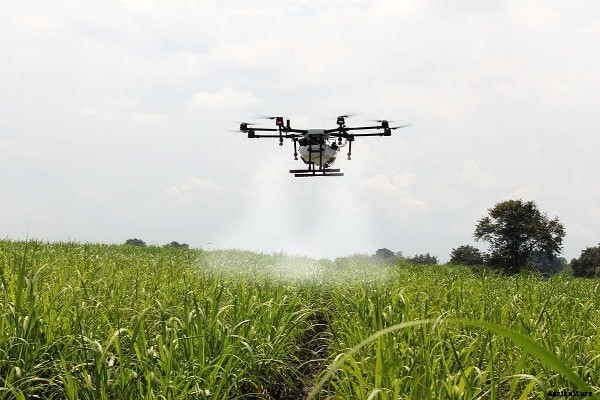 Agriculture Drone.
The scope of agricultural Robots:
- The companies have manufactured equipment related to farming and the researchers have developed many kinds of farm equipment in order to meet the requirements of traditional farming.
- The traditional farming needs to be induced with the robotic mechanism and is very much required in precision farming.
- As agricultural robots have already entered into farming sector, there would be a mobilization in farming too. There would be remote-controlled drones moving in the agricultural fields in order to check the herd.
- The agricultural robots also help in the plantation process and also in the process of weed removal. This would help in the reduction of usage of pesticides which would, in turn, help the environment from getting polluted due to harmful chemicals.
- Due to the introduction of agricultural robots, there would be less labour required and an individual can plan and implement the operations of the farm by himself without depending on the availability of labour.
- The introduction of the motors which can be operated electrically by using remotes is also very helpful mainly in the summers when the water would be inadequate.
- Sensors and the PDAs which are handheld are going to help the farmers in a drastic way in terms of computations and also accurate in the operations of agriculture.
- Robotic technologies in farming would also excite and draw the younger generations into farming as there would be no problems of traditional farming involved in this.
- If the farmer does not know the quantity of fertilizer, which has to be used for a specific plant, that would almost damage the plant drastically whereas by using agricultural robots, these will scan the plant and analyze the amount of fertilizer which has to be sprayed and also sprays it appropriately.
- The workers on the farm will be paid very little wages when compared to the labor which is involved in construction. These agricultural robots will decrease the requirement of manpower and thereby reduces the operating costs of the farm.
- The suicidal news of the farmers will be greatly reduced as the farmer will be able to work on his own and due to the improvement in technology, he can also decide what type of crop he has to grow and how to market it.
- In traditional farming, nitrogen is sprayed as a fertilizer to every crop and due to this, the crops which do not require nitrogen also gets it affecting the growth of the crop. Hence, by using agricultural robots and the computer vision present in them, the plants which need nitrogen can be detected and the nitrogen can be given accordingly.
Advantages of Agricultural Robots:
- Labour can be eliminated as most of the works are done by agricultural robots. Weeding, seed transplantation, fruit picking etc. are the main works related to the farm which needs manpower and the robots can handle all these. One agricultural robot can handle the work of approximately 30 workers. Even the milking of cows on the dairy farm, collecting manure can also be done by the robots.
- Through the introduction of agricultural robots, farmers will feel self-employed as their dependency on labour decreases. The investment can be done once and the profits would be huge as the operating costs decrease.
- There would also be a reduction in the usage of pesticides and other harmful chemicals which not only harm the plant but also release hazardous elements into the environment and pollute it.
- The consumption of water can also be reduced.
- There will be a drastic increase in the production of crops.
- Farming will never be an occupation which is tough and also brings youngsters into it which would thereby increase the food production of the world.
- The reports regarding the soil will be given by the agricultural robots so that the farmer can decide which type of crops to grow.
Disadvantages of Agricultural Robots:
- Implementation of robotics in agriculture is very costly.
- The complexity of the farm increases and there is an equal risk if proper care is not taken by the controller.
- The labour employed to take care of the farm should be well skilled in technology.
- The power cut problem in India would be a major nightmare for the farmers using robotic technology as the robots run through electricity.
Read: Types Of Farming and Agriculture.
Fiest Image Source: Wikipedia.


