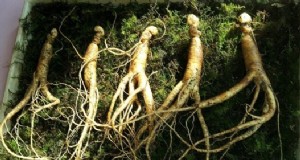
INTRODUCTION TO SPICE FARMING:
Spice Farming: The spice is a substance which is used in food for the purpose of flavor, color or preservation. Different spices are obtained from different parts of a plant or tree such as seeds, barks, roots and fruits. Some spices are expected to have antimicrobial and antibacterial properties. The use of some spices is found in cosmetics, religious rituals, medicines and perfumes. Different spices are considered to have originated from different countries of the world. Cinnamon and black pepper originated from South Asia and Middle East, cloves during the Mesopotamian civilization, nutmeg from Banda islands in Southeast Asia. The demand for spices was highest in Europe during the middle age. During this period spices were imported from Asia and Africa. In the modern period there was a high demand for pepper market in India. The major issue with spices these days is dilution. The quality of the spices has become inferior due to adulteration (mixing other unwanted products into the original mixture).
Different forms of spices are fresh, dried and powder. Spices are generally available in its dry form for longer usability and longer shelf life. There are some spices which when used fresh give more essence than the dried ones such as ginger. Spices like turmeric are always used in the powdered form. Spices like fennel and mustard are used both as a whole or powder. The flavor of a spice is lost when exposed to air due to oxidation and evaporation. So, it is highly recommended that the spices are stored as whole and ground when required so as to experience maximum flavor. The spices used for cooking are added early during preparation so that the flavor gets infused into the food unlike herbs which are added at the end of preparation.
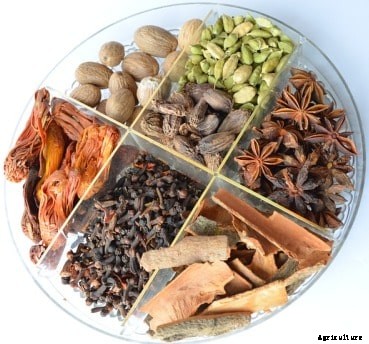 Cultivation Practices of Spices.
Spices are expected to contain calories, portion of fat, carbohydrates, minerals, micronutrients and proteins. Cumin and ginger exhibit high antioxidant property which helps as natural preservatives.
Spices are contaminated by a bacterium called the salmonella. Some of these bacteria are resistant to antibiotic and are now treated using radiation sterilization method.
TURMERIC SPICE FARMING:
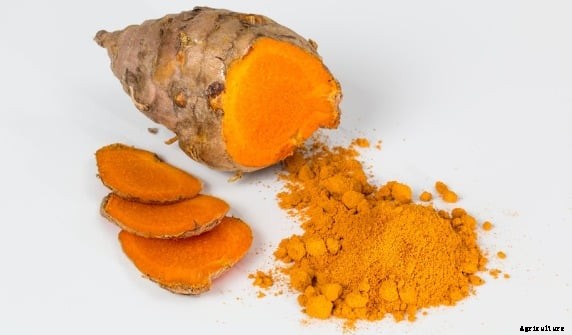 Turmeric.
- INTRODUCTION: The binomial name for turmeric is Curcuma longa and it belongs to the ginger family. It is considered to be the native of the Indian subcontinent. This is a rhizome which is used in a dry powdered form. It has medicinal properties so it is used for antibacterial treatments. It is yellow in color and has a nice aroma.
- SOIL AND CLIMATE CONDITIONS FOR TURMERIC SPICE FARMING: Sandy and clayey loam soil which have rich humus content and are well drained are used for the cultivation of turmeric. It is grown at sea level or at an elevation of 1500 m above sea level. The temperature of the region is estimated to be 20-30 degree Celsius and the average rainfall should be around 1500-2250 mm
- PROPAGATION: Turmeric is propagated through rhizome cuttings which are planted during the late winter season.
- LAND PREPARATION AND PLANTING: pits of 3 inches depth are made using a hand hoe and the row spacing is 25 cm x 30 cm. These are covered with soil and dry cattle manure. Ridges and furrows are spaced at a distance of 45-60 cm between rows and spaced 25 cm for plants.
- MANURING AND IRRIGATION: Cattle manure @40 tonnes/ha are used extensively for turmeric farming. Since this plant is of an irrigation type, it requires 15-20 cycles for heavy soil and 35-40 cycles for light soils. FYM @10 tonnes/ha is required for basal dressing. The ration of N: P: K is 125: 37: 37 kg/ha.
- Mulching is done twice with sugarcane trash or green leaves @ 12-15 tonnes /ha at an interval of 50 days.
- DISEASE MANAGEMENT: shoot borer is controlled by spraying 0.1% Malathion. Rhizome scale is controlled by dipping the rhizomes in quinalphos 0.1% before planting. Rhizome rot is controlled by using dithane M-45 0.3% during soil preparation. Leaf blotch is controlled by spraying 0.2% dithane M-45.
- HARVESTING AND PROCESSING: harvesting is done after 10 months from planting when the rhizome becomes mature. Warm weather is good for turmeric, so if sown in October it is harvested in August. Rhizomes are boiled until soft and dried in sun spread on bamboo mats for 15 days approximately.
- YIELD: On an average one acre of land yields 8-10 tonnes of turmeric.
BAY LEAF SPICE FARMING:
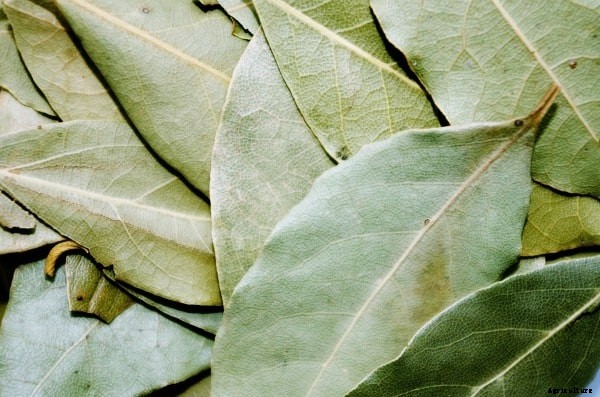 Bay leaf.
- INTRODUCTION: Bay leaf (Binomial Name: Laurus nobilis). It originated in the Mediterranean and grows to a height of 40 feet. The plants have medium sized green leaves. It is used as a flavoring agent as well as a medicine.
- SOIL AND CLIMATE CONDITIONS FOR BAY LEAF SPICE FARMING: Sunlight is a perquisite and cold wind or frost can be harmful. The favorable climate is warm and moist Mediterranean climate. Well drained soil with sufficient organic matter is highly suitable with a pH range of 6-8.
- PROPAGATION: Layered shoots or root cuttings are used for the propagation of bay leaf.
- LAND PREPARATION AND PLANTING: The land is supplemented with farmyard manure and weeds are removed by ploughing.
- MANURING AND IRRIGATION: Rotten farm yard manure is helpful to enhance richness of the soil. Adequate water supply is provided through drip irrigation for keeping the soil moisture intact.
- DISEASE MANAGEMENT: Mites, aphids and hard scales are pests that infect the tree and are controlled by the application of neem oil. Sulphur spray prevents black spots and leaf damage.
- HARVESTING AND PROCESSING: Since it is an evergreen variety, the leaves are available all round the year for harvest. Generally they are dry before use.
- YIELD: One hectare of land produces 6 tonnes of leaves.
NUTMEG AND MACE SPICE FARMING:
- INTRODUCTION: nutmeg and mace are the products of the same tree (botanical name: Myristica fragrans houtt). This tree is native to Indonesia and is now grown in some parts of India. It is an evergreen tree which is densely foliated and grows up to a height of 20m. These spices are used in food flavoring, perfumes, preparation of oils and butters.
- SOIL AND CLIMATE CONDITIONS FOR NUTMEG SPICE FARMING: warm, humid climate with an annual rainfall of 150 cm is required for these trees. The ideal area is from sea level to 1300 m above sea level. The slopes of western and eastern Ghats are a good choice for nutmeg and mace farming. Soil with clay, loam, sand and red laterite is suitable for this tree.
- PROPAGATION: The seed of the fruits from this tree is used for propagation. Air layering and budding also are successful methods for propagation, but the technique of ‘epicotyl grafting’ is the most productive.
- LAND PREPARATION AND PLANTING: when the seedlings grow, after 12 to 18 months they are transplanted to the main area. Cubic pits of dimensions 60 cm are dug and filled with topsoil and compost. The spacing between pits is 8 m x 8 m. Planting is done during the rainy season. Shade is required during the early years. Mulching is done with trashes available in the surroundings.
- MANURING AND IRRIGATION: The tree requires huge amount of manure for higher yield and growth. FYM @ 10 kg/plant is used for the first year. A 15 years old tree would require about 50 kg of manure. Nitrogen @ 20 grams, phosphorous @ 18 grams and potash @ 50 grams are applied to each plant in the first year. The dose increases with the age of the tree and is applied twice in a year; May-June and September-October. Irrigation is not heavily required.
- DISEASE MANAGEMENT: Die back caused by diplodianatalensis is controlled by applying Bordeaux mixture to the end of branches. Thread light is caused by Marasmius sp. is controlled by spraying 1% of Bordeaux mixture. Fruit rot is caused by Phytophthora and Diplodia natalensis which is controlled by spraying 1% of Bordeaux
- HARVESTING AND PROCESSING: If seedlings are used the bearing starts in 7-8 years, but if grafting is done then bearing starts in 4-5 years. The full bearing is attained after 15-20 years and yields up to 60 years. Harvesting is done from June till august. Ripening of the fruit is known when the fleshy rind splits open. The mace is separated from the nut and dried slowly in the sun for 10-15 days. The seed is also dried separately for 4-8 weeks in the sun or through artificial processes. The outer shell is removed and the nut is taken out.
- YIELD: The average produce of a single tree is 2000-3000 fruits per year. It is expected that one hectare of land can produce 800 kg of nutmeg and 100 kg of mace.
STAR ANISE SPICE FARMING:
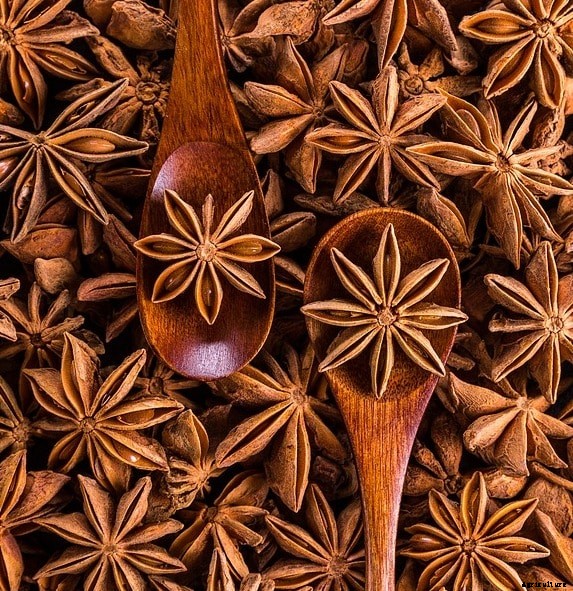 Star Anise.
- INTRODUCTION: This spice gets its name from the shape. Its botanical name is Illicium verum. Siberia is considered ideal for anise farming. This is a dark brown colored spice with strong aroma. This is also called as aniseed and has medicinal properties. It is an evergreen tree and grows to a height of 5-10m.
- SOIL AND CLIMATE CONDITIONS FOR STAR ANISE SPICE FARMING: Rich humus soil or slightly acidic soil is best suitable for aniseed cultivation. Requires subtropical climate where the temperature is not less than -10 degree Celsius. The plant needs warm sunny climate where there are no dry or cold winds. PH of soil is 6-6.7.
- PROPAGATION: Propagation is done by sowing seeds or cuttings directly. The temperature for propagation is 18-20 degree Celsius.
- LAND PREPARATION AND PLANTING: 6 weeks old seedlings are sown with a spacing of 12 inches. Each row is separated by 18-24 inches. Planting is done in spring.
- MANURING AND IRRIGATION: Maintaining adequate moisture is enough. Very little irrigation is required in winter. Spreading a 3 inch layer of compost around the tree is the best fertilizer. Sometimes for higher yield and quality a synthetic NPK fertilizer or Bactofil B-10 and slavol (bio fertilizers) are used.
- DISEASE MANAGEMENT: since it is an anti-bacterial and pest repellent variety, so not much is required to mange any disease for these plants.
- HARVESTING AND PROCESSING: The tree requires 6 years to bear fruits when grown from seeds. The fruits are picked up when ripe and dried in the sun until they change color from green to reddish brown.
- YIELD: Under favorable conditions the average fruit yield of this tree is 1551 kg/ha.
GREATER CARDAMOM SPICE FARMING:
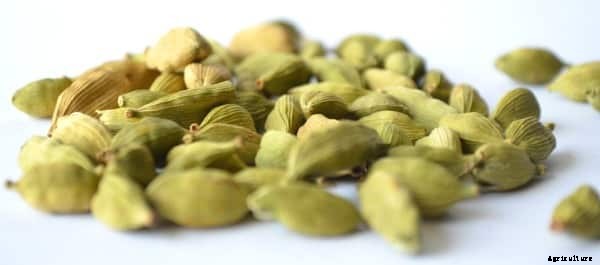 Cardamom.
- INTRODUCTION: This is also called black cardamom and its binomial name is Amomum subulatum. The pods have strong smoky aroma and are used as spice. The largest produce is from Nepal. It also has medicinal uses such as treatment of jaundice.
- SOIL AND CLIMATE CONDITIONS: This spice is grown elevations of 1000-2000 above mean sea level. It requires an annual average rainfall of 3000-3500 mm. Deep, well-drained loamy soil is good for these plants. The pH of soil is to be maintained at 4.5-6.
- PROPAGATION: Propagation of this plant is done vegetatively through rhizomes or by seeds. Rhizomes from grown plants is taken and processed into smaller clumps and planted in pits.
- LAND PREPARATION AND PLANTING: Moderate slope for the farming of this plant is considered. Pits of dimensions 30 x 30 x 30 cm are dug with a spacing of 5 x 1.5 m between each pit during monsoon. The pits are covered with topsoil and compost. Seedlings are planted in the center of the pit and the mulching is done with dry leaves at the base of the plant.
- MANURING AND IRRIGATION: Cattle manure and non edible oil cakes as used as manure. Better irrigation gives higher yield. Sprinkler irrigation is used depending on the need.
- DISEASE MANAGEMENT: Fungal and bacterial diseases can occur in this plant. The two major threats to this plant are Chirke and Foorkey.
- HARVESTING AND PROCESSING: when the seed of a capsule turns brown, the tillers are cut 30-35 cm and are allowed to mature for 10-15 more The harvesting is done by an equipment called ‘Elaichichurri’ and the spikes are heaped. The capsules are separated and dried. The calyx is removed by rubbing the capsule on a wire.
- YIELD: Estimation shows that one acre of land generates 2000 kg of dry cardamom.
LESSER CARDAMOM SPICE FARMING:
- INTRODUCTION: This spice is a native of the Indian subcontinent and is the most needed spice in the entire list. It is and evergreen plant found in the Western Ghats. Binomial name of this spice is Elettaria Cardamomum L. The maximum height of this plant is 2-4 meters and the varieties found in India are Mysore, Malabar and vazhukka type.
- SOIL AND CLIMATE CONDITIONS FOR CARDAMOM SPICE FARMING: The optimum temperature and rainfall required for lesser cardamom spice farming is a 10-35 degree Celsius and 1500-4000 mm annual rainfall respectively. Black loamy soil with rich humus especially in the forest belt is best suited for the cultivation of this spice. Sandy soil is not preferred at all.
- PROPAGATION: Seeds or suckers are used for propagation. These seeds are raised in nurseries and planted in the main area during proper conditions.
- LAND PREPARATION AND PLANTING: 45 cm x 45 cm x 30 cm pits are dug during April-May and are filled with compost and topsoil. Planting is done along the contours of a slope with spacing of 2 m x 1 m. The beginning of monsoon is ideal for planting these seeds and they are transplanted in the summer into the main area with a spacing of 20cm x20cm. Shade is provided and water is supplied regularly.
- MANURING AND IRRIGATION: Nitrogen @90 grams, phosphorous @60 grams and potash @ 120 grams are required for a bed size of 5 m x 1 m. This dose is supplied in three installments with an interval of 45 days between each. The content of fertilizer used for this crop is nitrogen @ 75 kg, phosphorous @75 kg and potash @150 kg per hectare if it is being irrigated by external sources, but if the fields are irrigated by rain then the ration of fertilizers used is 30: 60: 30 kg/ha. The total fertilizer is applied split and applied twice: one during May and the other in September. 30 cm around the plant the fertilizers are applied. Irrigation is highly required during the panicle formation, flowering and fruit formation. Until the arrival of monsoon irrigation is done at an interval of 10-15 days.
- DISEASE MANAGEMENT: Thrips and shoot borer are controlled by spraying monocrotophos 0.025% (March- September). Aphids are controlled by spraying 0.05% of dimethoate. Parasitic nematodes are controlled by treating the plants with carbofuran 3g @ 5kg a.i/ha. Capsule rot is controlled by spraying 1% Bordeaux Rhizome rot is controlled by treating the soil with 0.2% of copper oxychloride.
- HARVESTING AND PROCESSING: The plants start bearing fruits just after two years of planting. Harvesting is done during October –November. The harvested fruits are dried using an electric dryer at a temperature of 45-50 degrees for approximately 14-18 hours.
- YIELD: It is estimated that one hectare of land produces 1300 kg of dry cardamom.
CORIANDER SPICE FARMING:
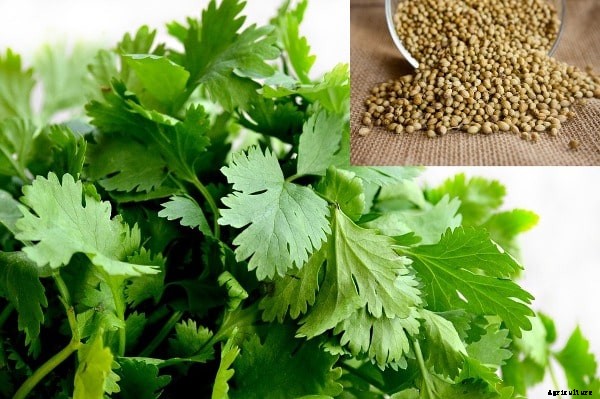 Coriander.
- INTRODUCTION: This is an herb native to the Mediterranean region. In India some states do coriander farming, but mostly it is for local use rather than export. Very little is exported to other countries. The binomial name of this plant is Coriandrum Sativum L. It is most desirable because of its taste and aroma. The leaves of the plant and the dried fruits both are used in preparation of food. These herb plants grow to a height of 30-70cm. It has some medicinal uses also.
- SOIL AND CLIMATE CONDITIONS FOR CORIANDER SPICE FARMING: This plant is suitable for cultivation all round the year and it is a tropical variety. Every soil type with rich organic matter is suitable for its cultivation. Black cotton soil is considered best with sufficient rainfall.
- PROPAGATION: Propagation is done through seeds.
- LAND PREPARATION AND PLANTING: After the onset of monsoon the land is ploughed 3-4 times and since it is a Rabi crop the sowing of seeds is done during October and November. One hectare of land needs 10-15 kg of seeds. A better germination technique is to soak the seeds in water for 12-24 hours before sowing. Rows in the farm are separated by a spacing of 30-40 cm and maximum depth is 3 cm.
- MANURING AND IRRIGATION: FYM @ 10 tonnes/ha is used. NPK fertilizers @ 15 kg, 40kg and 20kg per hectare respectively, for irrigated crops is required, whereas for rain fed crops NPK @ 20kg, 30kg, 20kg per hectare is required respectively. 4-6 cycles of irrigation are required during entire farming. Each irrigation cycle is done with an interval of 30-35 days.
- DISEASE MANAGEMENT: Aphids are controlled by the spraying of 0.3% Malathion whereas cutworm is controlled using 4% dust of endosulphan @ 20-25 kg/ha. Powdery mildew and wilt disease are controlled by spraying wet sulphur. Stem gall is controlled using 0.1% bavistin and blight is controlled using 0.2% mancozeb.
- HARVESTING AND PROCESSING: Generally the crop is harvested within 90-110 days. The change in the color of the fruit from green to brown indicates the time of harvest.
- YIELD: The yield of rain fed crops is 400-500 kg/ha and that of irrigated crops is 600-1200 kg/ha.
FENUGREEK SPICE FARMING:
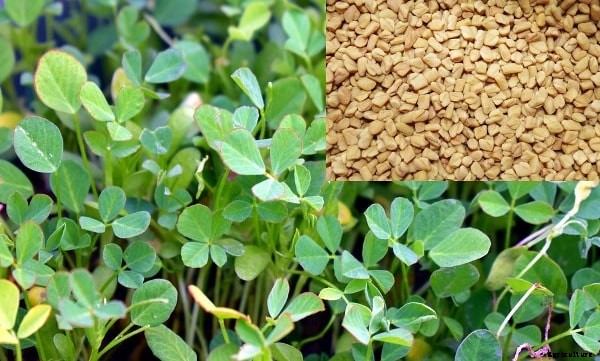 Fenugreek.
- INTRODUCTION: This herb is native to Eastern Europe and west Asia. The leaves and the seeds are used in food preparation. Its binomial name is Trigonella Foenum-graecum L. The maximum height of the crop is 0.9 m. There are two major varieties of crops grown T. Foenum-graecum (methi) and corniculata (kasuri methi).
- SOIL AND CLIMATE CONDITIONS FOR FENUGREEK SPICE FARMING: Both temperate and tropical climate are suitable for its cultivation. During seed germination temperature is being maintained around 8-27 degree Celsius. It can resist frost and extreme cold climate. Very low rainfall is required for this crop. Clayey loam is extremely good for these crops with a pH of 6-7
- PROPAGATION: Propagation is done by seeds. Seeds are soaked in warm water for 6-12 hours before sowing.
- LAND PREPARATION AND PLANTING: Ploughing is done thrice before sowing seeds and the soil beds are created uniformly with spacing between rows as 20-25 cm. In the plain area September to November is usually preferred for sowing the seeds, whereas in hilly areas the sowing is done in March.
- MANURING AND IRRIGATION: FYM @15 tonnes per hectare is used. NPK fertilizers @25 kg, 25 kg, 50 kg/ha respectively is required. Nitrogen is applied in two installments whereas the other two types of fertilizers are applied to the base of the crops at a time. 4-6 irrigation cycles are required during entire crop growth with an interval of 20-25 days between each cycle. Pre-irrigation is also done.
- DISEASE MANAGEMENT: root rot is caused by Rhizoctoni Solani and is controlled by drenching the soil with carbendazim 0.05%. Powdery mildew is controlled by spraying dinocap @20-25 grams/10 liters of water. Downy mildew is controlled by spraying 0.2% of difoltan solution.
- HARVESTING AND PROCESSING: Young shoots are removed within 25-30 days of sowing. The leaves are cut within 15 days of growth and minimum 2 cuttings are done before the flowering and fruit formation of the crop. The crops are removed when the pods dry and the entire thing is dried in the sun, which facilitates the removal of seeds by rubbing with the hands. Again the removed seeds are dried in the sun and packed.
- YIELD: One hectare of land produces 1200-1500 kg of seeds and 800-1000 kg of leaves.
ROSEMARY SPICE FARMING:
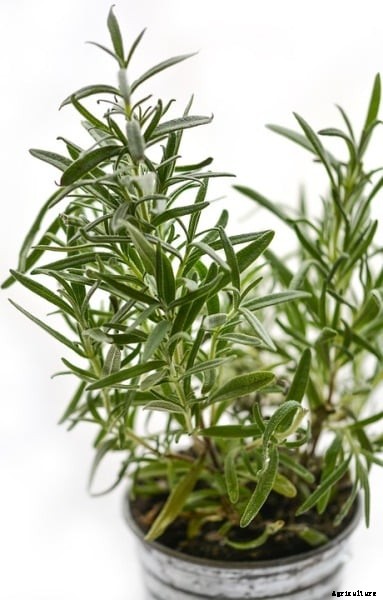 Rosemary.
- INTRODUCTION: Rosemary is a perennial herb and is evergreen in nature. It is a native of the Mediterranean region and its binomial name is Rosmarinus officinalis. The shrub has a maximum height of 1.5m. This crop is famous for its aroma; the leaves, twigs and flowers are used for various purposes.
- SOIL AND CLIMATE CONDITIONS FOR ROSEMARY SPICE FARMING: Well-drained lateritic soil is best for the cultivation of rosemary crops. The pH of the soil is maintained in-between 5.5-7. 20-30 degree Celsius is the ideal temperature for its growth. Average annual rainfall of 10-20 cm is required and an altitude of 2500 m above sea level is considered good for growing rosemary.
- PROPAGATION: Seeds are used for growing rosemary plants, but with extreme care and typical conditions. Also cuttings, roots and layering are sometimes used to grow rosemary.
- LAND PREPARATION AND PLANTING: Land to be used for cultivation is ploughed two times and neem care is mixed as a source of manure. The spacing between rows of rosemary plants have to be 40-50 cm and beds of width 1-2 m is created. Initially the cuttings are raised in the nursery and then shifted to main area during midsummer.
- MANURING AND IRRIGATION: FYM @ 50 tonnes/ha, neem cake@1 ton/ha, natural compost@ 5 tonnes/ha and vermicompost @5 tonnes /ha as applied at the base of the crop during initial planting. Subsequent year onwards 5-30 kg per hectare is applied.
- DISEASE MANAGEMENT: This shrub is resistant to pests and fungus.
- HARVESTING AND PROCESSING: When the flowering starts the plants can be harvested. From second year harvesting is done every four months. The leaves are cleaned thoroughly and dried in shade for 10-15 days.
- YIELD: one hectare of land annually produces 2.5 tonnes of dried leaves of rosemary.
CHILLIE SPICE FARMING:
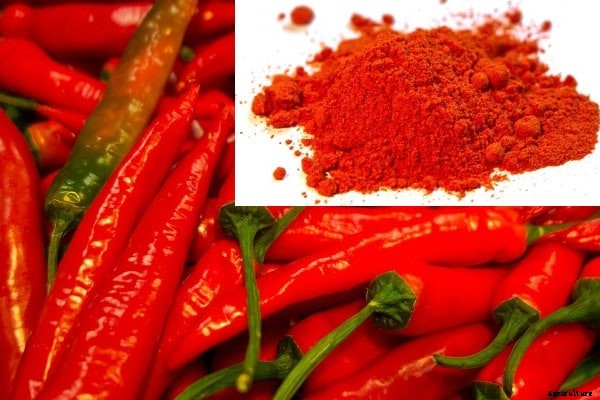 Chilli spice.
- INTRODUCTION: very common and needed Indian spice is chilli. It originated from Mexico, but the largest producer of chillies Japan. It is both a spice and a vegetable variety. The binomial name of the chili is capsicum annuum. It is a shrub
- SOIL AND CLIMATE CONDITIONS FOR CHILLIE SPICE FARMING: It needs warm, humid and dry weather. Temperature ranges from 20-25 degree Celsius. Temperatures beyond 35 degree effect the fruit development. Very little moisture is required to grow chillies. Well-drained sandy loam soil having high organic content is useful for growing chillies. The pH of the soil should be in-between 5-7.5. 2100 meters above mean sea level is the altitude up to which chillies can be grown.
- PROPAGATION: chilli propagates through seeds.
- LAND PREPARATION AND PLANTING: 2-3 ploughings are given to the soil before sowing seeds. Before sowing the soil is sterilized to make it free from fungus and other infections. Seeds are initially planted in nurseries and then transplanted to the main area. Coco peat is used to cover the soil with seeds and is lightly watered until seedling stage. The crop distance is 45 cm x 45 cm in the main area. Ridges and furrows of dimensions 60 x 45 cm is maintained for intercropping. Each raised bed of chilli is dimensioned as 30 x 120 cm.
- MANURING AND IRRIGATION: These plants do not require much water. Irrigation is done only when the moisture content of water drops to less than 25%. 1 kg of azospirillum with 50 g of FYM is used as manure.
- DISEASE MANAGEMENT: White ants are treated using 8-10 aldrin/acre. Fruit rot, die back, wilt, powdery mildew, leaf spot is treated with 1% Bordeaux mixture. Neem cake @100 kg is used to destroy grubs.
- HARVESTING AND PROCESSING: Harvesting is done at regular intervals. They are dried in shade for 2-3 days.
- YIELD: One acre of land produces 30-40 quintals of fresh chillies and of which 25-35 kg of dried chillies is obtained from every 100 kg of fresh chillies.
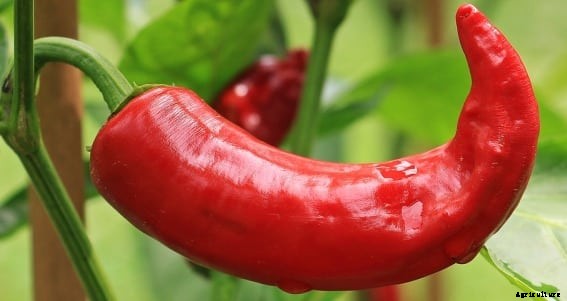 Red Chilli.
CELERY SPICE FARMING:
- INTRODUCTION: The binomial name of celery is apium graveolens. It is an herb used for various purposes. The height of the herb is 10-14 inches and has white colored flowers. It is a native of the Mediterranean region.
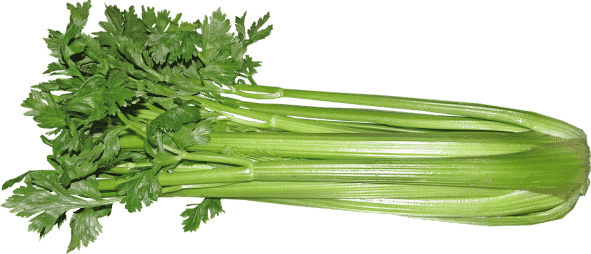 Celery.
- SOIL AND CLIMATE CONDITIONS FOR CELERY SPICE FARMING: During the growing stage it needs cold climate and during maturing it needs warm climate. A well drained loamy soil is considered good for this herb. The min temperature requirements are 12-30 degree Celsius with an average rainfall of 100 cm. The pH of the soil is maintained at 5.6 for good produce.
- PROPAGATION: propagation is done using seeds which are initially raised in a nursery and then transplanted to the main area.
- LAND PREPARATION AND PLANTING: Land is ploughed four to five times before planting. The spacing of these celery plants is 45 cm x 25 cm and the sowing depth is 2-4 cm. The seeds take 4-8 weeks for seedling and after 2 months, transplanted to the main area. November is the best time for sowing seeds.
- MANURING AND IRRIGATION: FYM @ 20-25 tonnes are used along with nitrogen @200 kg, phosphorous @100 kg and potash @150 kg per hectare is required. Irrigation is highly essential and is given at an interval of 10-15 days.
- DISEASE MANAGEMENT: Damping –off, Fusarium yellows, early blight downy mildew is controlled by drenching the land with 400 grams of copper Oxy chloride.
- HARVESTING AND PROCESSING: 4-5 months after sowing, the crops are harvested.
- YIELD: one hectare of land yields about 25-30 tonnes of celery.
CUMIN SPICE FARMING:
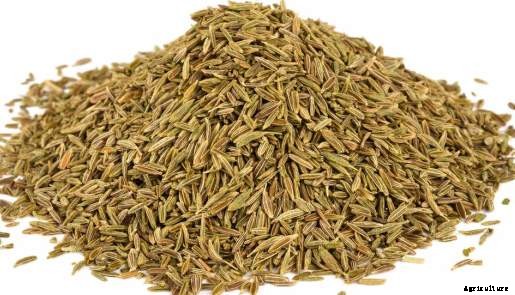 Cumin Seeds.
- INTRODUCTION: This is a flowering plant and native to the Middle East and India. Its binomial name is Cuminium Cyminum. Cumin is a herbaceous plant whose seeds is dried and used as spice. The height of this plant is 30-50cm. In Hindi it is addressed as jeera which is most famous and widely used spice in Indian cuisines.
- SOIL AND CLIMATE CONDITIONS FOR CUMIN SPICE FARMING: Sandy loam soil with high nutrient content is required for the cultivation of cumin. The soil should be well drained and should be able to hold moisture. Mild climate is required for its cultivation and winter weather is also suitable. Sunlight is highly essential for its growth.
- PROPAGATION: seeds are used for propagation.
- LAND PREPARATION AND PLANTING: sowing of cumin seeds is done in December and the rows are spaced 30 cm apart.
- MANURING AND IRRIGATION: FYM @ 12-15 tonnes/ha along with phosphorus @20 kg, nitrogen @30 kg is applied to the soil. These fertilizers are applied in two splits. Initially the seedlings are lightly watered and the second irrigation is done after 7-10 days.
- DISEASE MANAGEMENT: Powdery mildew is controlled by spraying 20-25 grams /10 liters of water. Similarly, Alternaria blight is controlled by spraying 0.2% of dinocap.
- HARVESTING AND PROCESSING: Complete maturity in plants is obtained within 100-115 days from sowing. Harvesting is done by uprooting the entire plant and drying it. The dried plants are thrashed to remove seeds.
- YIELD: An average yield is 5 quintals per hectare.
GINGER SPICE FARMING:
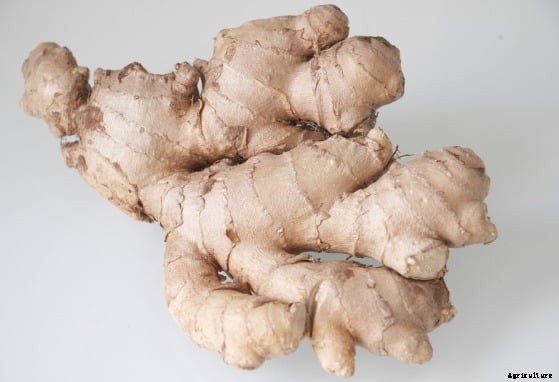 Ginger root.
- INTRODUCTION: This spice is native to Asia and has high demand locally and internationally. It is an herb which grows to a height of 1 m and bears yellow flowers. This spice has many medicinal properties and refreshing aroma.
- SOIL AND CLIMATE CONDITIONS FOR GINGER SPICE FARMING: Warm, humid climate is favorable for the growth of ginger. An altitude of 1400-1500 m is suitable for cultivation. This herb is grown in different soils. The pH of the soil should be 5-6.5.
- PROPAGATION: Propagation is done using rhizomes. The length of the rhizome should be 5-5 cm and should weight 20-25 grams.
- LAND PREPARATION AND PLANTING: 3-4 ploughings of land are done during summer. Crosswise harrowing is done to make the soil loose. A bed for the crops is made 1 m wide, 15 cm high. Each bed is separated by 50 cm. solarisation is done using polyethylene sheets for 40-45 days.
- MANURING AND IRRIGATION: FYM @ 15 tonnes/ha along with NPK @60 kg, 50 kg, 50 kg / ha respectively is used for growing these crops. Irrigation is provided at an interval of 8-10 days. Maximum 20 irrigation cycles are needed for the entire growing period. Drip irrigation is also preferred.
- DISEASE MANAGEMENT: Shoot borer is controlled by spraying 0.1% of Malathion. Rhizome flies are controlled by spraying 05% methyl parathion. Leaf roller and scales are controlled by spraying 0.05% dimethoate. Soft rot is controlled by captafol 0.1%. Leaf spot is controlled by a 1 % Bordeaux mixture. Root knot nematode is controlled by solarising. Bacterial wilt is controlled by spraying 200 ppm streptocycline.
- HARVESTING AND PROCESSING: Green ginger can be harvested in 215-220 days after planting the rhizomes. Yellowing of leaves indicates the harvesting season.
- YIELD: One hectare of land produces 10-15 tonnes of green ginger.
THYME SPICE FARMING:
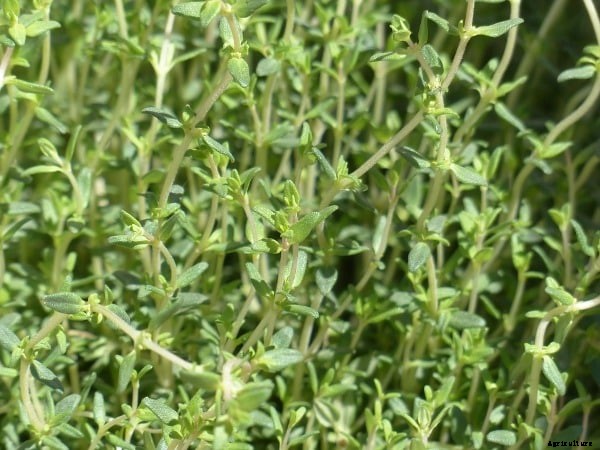 Thyme herb.
- INTRODUCTION: This is an evergreen herb with aroma, generally used for cooking and medicinal purposes. It originated from the Europe and spread throughout the world through Romans.
- SOIL AND CLIMATE CONDITIONS FOR THYME SPICE FARMING: Requires well drained, fertile soil. Warm climate is suited for thyme plants and hill regions are considered best for cultivation.
- PROPAGATION: It is propagated through seeds and also vegetatively by plants.
- LAND PREPARATION AND PLANTING: ploughing is highly essential to prepare the land and plants are planted 15-30 cm apart. The spacing between the rows is 60 cm.
- MANURING AND IRRIGATION: FYM @ 50 tonnes/ha, vermicompost @ 5 tonnes/ha, neem cake @1.25 kg/ha, azospirillum and phosphobacterium and panchagavya is sprayed @3%.
- DISEASE MANAGEMENT: No major diseases occur to this plant.
- HARVESTING AND PROCESSING: For cooking purposes leaves and flowers are used. Harvesting starts from 4-5 months of sowing. The shoots are cut from the plant with a length of 15 cm. When the leaves dry, they curl and turn brown.
- YIELD: one hectare of land yield 1100-2200 kg of thyme.
CLOVE SPICE FARMING:
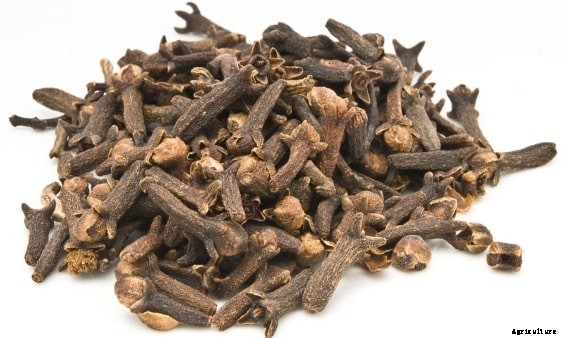 Cloves.
- INTRODUCTION: Clove is an evergreen tree with high medicinal properties. The binomial name is Eugenia caryophyllus and is native to the Indonesian island. This plant grows to a height of 7-15 m. The dry unopened flower bud of the plant is the clove. In India the Western Ghats are popular for clove cultivation.
- SOIL AND CLIMATE CONDITIONS FOR CLOVE SPICE FARMING: This plant requires a warm, humid climate of temperature 20-30 degree Celsius and an average rainfall of 150-250 cm. The altitude is generally estimated to be 1500 m above mean sea level. Black loamy soil with rich humus is well suited for clove cultivation. Sometimes it is also grown in clay loam and laterite soil.
- PROPAGATION: Seeds are used for the propagation of clove usually during June to October. The seeds are soaked in water before sowing.
- LAND PREPARATION AND PLANTING: Pits of dimensions 60 cm x 75 cm x 3 cm are dug with a spacing of 6-7 m and filled with topsoil. Planting of seeds is done at the end of the monsoon.
- MANURING AND IRRIGATION: Rotten cattle manure @15 kg is required initially, but as the plants grow, they need more manure. The manure is applied basally at a radius of 5 m from the tree. Pot watering is required if there is no sufficient water supply. Plants need subsoil irrigation during peak summer season.
- DISEASE MANAGEMENT:
- HARVESTING AND PROCESSING: yielding starts during 7 years, but to attain full bearing the tree takes 15-20 years. After flowering the buds take 4-6 months for harvesting. The buds are dried for 4-5 days.
- YIELD: One fully grown tree gives 4-8 kg of dried buds.
FENNEL SPICE FARMING:
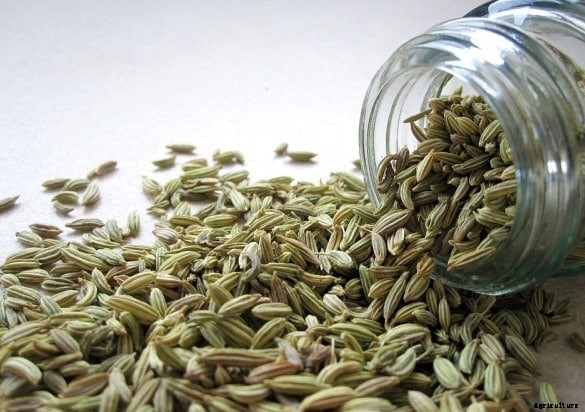 Fennel.
- INTRODUCTION: It is a flowering plant and native to the Mediterranean. This spice has an exclusive aroma and a different flavor. This herbaceous plant grows to a height of 2.5 m. The binomial name is Foeniculum Vulgare. In India it is addressed as Saunf in Hindi.
- SOIL AND CLIMATE CONDITIONS: Every kind of soil is suitable for the cultivation of fennel. But well drained sandy or loamy soil is best suited with a pH of 6.5-8. The optimum temperature for the cultivation of these crops is 15-25 degree Celsius with an average rainfall of 50-75mm.
- PROPAGATION: It is not a transplanting variety. Propagation is done through seeds directly sowed in the main area.
- LAND PREPARATION AND PLANTING: The land is ploughed two three times to prepare a fine seed bed. This plant is rarely raised in nurseries. Sowing is done during October and if it is a rain fed region, then spacing of 45 cm between rows with 10 cm crop spacing is maintained.
- MANURING AND IRRIGATION: Cow dung@4-6qtl/acre along with urea@45 kg/acre is applied three times in equally split proportions. Pre-sowing irrigation is done and then at an interval of 10-15 days 10-12 cycles of irrigation is required during the entire duration of cropping.
- DISEASE MANAGEMENT: Aphids are controlled by spraying 0.03% of dimethoate. Seed midge and heliothis is controlled by spraying 0.07% of endosulphan.
- HARVESTING AND PROCESSING: Maturity of plants is known when seeds are full and green in color. The umbels are cut and dried in the sun for 2 days and then dried in the shade for 10 days. The crop harvesting is done in May i.e. after 180 days from sowing.
- YIELD:One hectare of land yields 10-11 quintals of fennel on an average.
BLACK PEPPER SPICE FARMING:
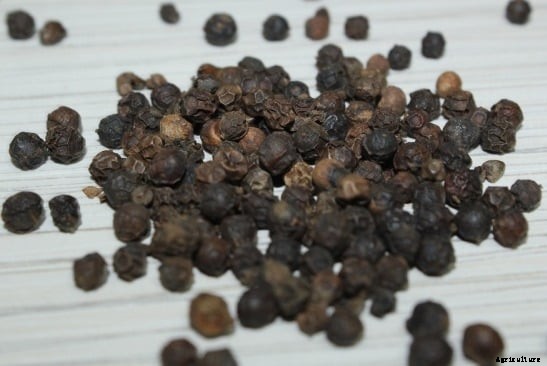 Black Pepper.
- INTRODUCTION: The binomial name of black pepper is ‘piper nigrum’ and it is an evergreen flowering vine. This plant in mostly found in south India and grows to a height of 10 m. This is the earliest form of spice in India. There are 75 cultivars of pepper in India of which Karimunda is most popular. Other varieties are kottanadan, narayakkodi, aimpiriyan, kuthiravally, balancotta, kalluvally, malligesara and uddagare.
- SOIL AND CLIMATE CONDITIONS FOR BLACK PEPPER SPICE FARMING: pepper plants require tropical humid climate with sufficient rainfall (125-200 cm). The submountaeous region of Western Ghats is exclusive for growth of pepper plants. Clay loam, red loam and lateritic soils are suitable for pepper farming. The pH value of the soil is maintained at 4.5-6.0. The temperature should be in between 10-40 degree Celsius.
- PROPAGATION: Cutting from runner shoots is used for propagation of pepper. One third of the root is cut and planted in the nursery. They are obtained in the month of February –March. Roots develop from the cuttings and they are set for planting.
- LAND PREPARATION AND PLANTING: level land with proper drainage is chosen for farming. South facing slopes are avoided, but north or north eastern slopes are preferred to avoid the effect of the sun. Planting is done in the monsoon. Square pits of dimensions 0.5 m x 0.5 m are dug and the spacing between the pits is 2.5 m x 2.5 m. Seedlings which are two years old are planted in the pits. When the vine grows, it is initially made to creep on a pole of 2 m height. After a certain length the temporary stake is removed and planted in a trench of depth and width equal to 15 cm close to the tree trunk.
- MANURING AND IRRIGATION: Rotten cattle manure@ 10 kg is used as manure for pepper plants. 100 grams of nitrogen, 40 grams of P2O5 and 140 grams of K2O is used as a fertilizer for three year old plants. 1/3rd of the above mentioned composition is applied in the first year and 2/3rd of the quantity is applied in the second year. Lime @500 grams is applied as fertilizer during later stages of development.
- HARVESTING AND PROCESSING: Yield starts after 3 or 4 years from planting. The ripening takes 6-8 months from flowering and harvesting is done during November till February. The entire spike is plucked when the berries turn bright red. The spike is rubbed with hands to remove the berries which are then dried in the sun for 7 to 10 days until the berries turn black.
- YIELD: 800-1000 kg of black pepper is obtained from one hectare of plantation land (7-8 yrs old). The yield reduces after every 20-25 years.
CINNAMON SPICE FARMING:
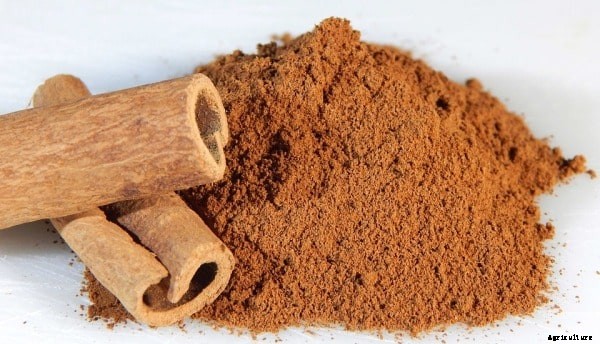 Cinnamon spice.
- INTRODUCTION: Cinnamon is the inner bark of the tree and is the first known spice with rich flavour. It is native to Sri Lanka. Also lower slopes of Western Ghats (Kerala and Tamilnadu) cinnamon cultivation are predominant. Binomial name is Cinnamomum Cassia.
- SOIL AND CLIMATE CONDITIONS FOR CINNAMON SPICE FARMING: lateritic and sandy soil is preferred for cinnamon plant. The elevation of land above sea level is approximately 1000 m. This plant requires an annual rainfall of 200-250 cm.
- PROPAGATION: Cinnamon is propagated by rooted cuttings, air layering and seeds. 10 cm long with 2 leaves semi hardwood cuttings are dipped in keradix-B and planted in a polythene bag consisting of sand and coir dust mixture in the ratio 1:1. These are watered twice in a day and stored in the shade. After 45-60 days the roots develop indicating that it can be transplanted to a another permanent place
- A ring from the semi hardwood bark is removed and IBA 2000 ppm is applied on it. This region is covered with coir husk and wrapped with 20 cm of polythene. Rooting starts after 40-60 days and the air layers are detached from the parent plant. These can be planted in the main area during monsoon
- For the sowing of seeds a mixture of sand, soil and rotten cattle manure in the ratio 3:3:1 is prepared and germination starts after 15 -20 days. Moisture is a must for these plants.
- LAND PREPARATION AND PLANTING: Pits of dimensions 50 cm x 50 cm x 50 cm are dug with space between each pit being 3m x 3m. The pit is initially filled with topsoil and compost and the seedling are planted. One acre land can accommodate 3600 pits
- MANURING AND IRRIGATION: 20 grams of nitrogen, 18 grams of P2O5 and 25 grams of K2O are used as fertilizer in the initial growth period. The dose increases with the age of the plants. Fertilizers are applied during may-June and September-October. Green leaves are used for mulching FYM @25 kg is applied in May-June. Irrigation is essential during summer.
- DISEASE MANAGEMENT: Colletotrichum Gloeosporioides causes leaf spotting and die back disease. Diplodia sp. causes seedling blight. Pestalotia palmarum causes grey blight. All these are controlled by a 1 % Bordeaux mixture. Pests like leaf minor and cinnamon butterfly are controlled by the use of quinalphos (0.05%).
- HARVESTING AND PROCESSING: When the tree is grown to a height of 10-15 m in 4 years, shoots are available for peeling. Coppicing is done to encourage regrowth. Shoots of thickness 5-2 cm are chosen for the extraction of barks. 1-1.25 m of shoots are cut into straight pieces followed by scraping and peeling. The peels are dried in the shade and then in sunlight for 4 days. Dried barks take the shape of a quill. Grading of quills is done from 00000, 0 being the most coarse quality. Small bark pieces are called quillings; thin inner pieces are called featherings.
- Distillation of dried cinnamon leaves and barks produces oils. This oil is used in soaps, perfumes, creams, toothpastes etc.
- CULTIVARS AND YIELD: Two varieties are known in India, the Navashree and the Nithyashree. 56 and 54 kg of dry quills /ha /yr are obtained from Navashree and Nithyashree respectively. The product yield of Navashree is such that 2.7% bark oil, 73% cinnamaldehyde 8% oleoresin 2.8% leaf oil, 62% leaf eugenol. The product yield of Nithyashree is (2.7% bark oil, 58% cinnamaldehyde, 10% oleoresin, 3% leaf oil and 78% eugenol.
Read about Zero Budget Natural Farming.
Read about Hydroponic Growing System.