
Welcome to Modern Agriculture!

Kale is a richly flavored green that stole the spotlight in the everyday kitchen around 2008 and stuck around, presenting a demand so great that farmers have had a hard time keeping up. Since then, it has been hailed as a superfood and weaved its way into home and restaurant menus alike.

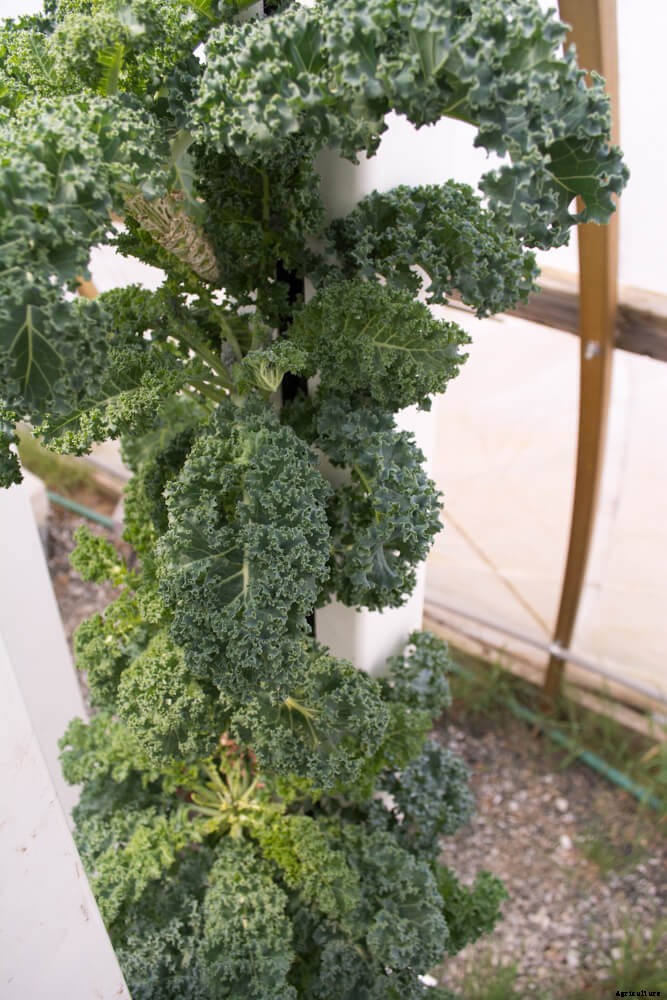
The silvered leaves of this dinosaur (Tuscan) kale adorned the wall of the US Pavilion at the 2015 World’s fair in Milan.
Kale now stars in a variety of dishes across the world. Crop varieties from the scaly-looking Dinosaur Kale (also called Tuscan Kale) and Curly Kale grace our soups, smoothies, salads, and even our snack trays. Some varieties display shades of red and purple, like Russian Red Kale.
For farmers, growing kale in hydroponics can be a simple and profitable option.
Download (PDF, 133KB)
Kale’s popularity can bring in a good profit for farmers. The crop grows relatively quickly with a six-week turn from transplant to harvest or can be harvested partially to regrow (no more than about 30% for quick regrowth). Growers using ZipGrow Towers can expect to see 4 pounds of produce per tower for a full harvest when conditions are favorable.
 Ideal conditions for kale
Kale’s wide electrical conductivity (EC) range makes it compatible with many different herbs and greens, though the best growth is seen closer to 3.0. (A basic greens formula will work well for kale.)
Kale is a cool-weather crop, and many growers even apply cooler temperatures (down to 40º F) purposefully to draw out a smoother, improved flavor in the green.
Fortunately, kale is another crop which—when grown indoors—is targeted by only a few pests such as aphids and some powdery mildew.
Your dream is to farm, but how do you get started? The self-paced courses on Upstart University offer aspiring farmers all they need to know about planning and starting a farm business and managing a farm.
For $9.99 per month, new farmers can listen to presenters, read lesson notes, take quizzes, and complete assignments like writing a business plan.
Get started today!


