
Welcome to Modern Agriculture!


Over the next three years, the USDA projects there will be nearly 16,000 annual openings in science, technology, engineering, and mathematics or STEM – all of which encompass the precision ag field.
“Precision agriculture is the key to sustainable and profitable food production today and will only increase in importance going into the future,” says Van Kelley, department of agricultural and biosystems engineering, South Dakota State University.
While this area is typically dominated by men, the five young women who follow are proving it doesn’t take feats of strength and speed to be successful in the precision ag field. Rather, it takes preparation, confidence, and smarts.
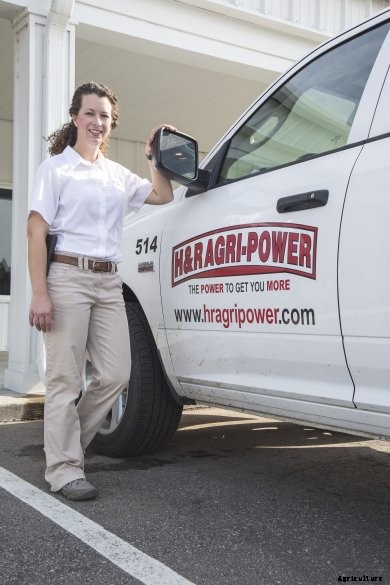
“When I was in high school, our farm was part of two studies with the University of Tennessee and Mississippi State University,” says the sixth-generation farmer. “The researchers collected data on planter row unit clutches when it was still a fairly new technology. They also did an efficiency study on a cotton picker with an on-board module builder. I saw precision agriculture as the future.”
Those experiences also made her realize that she didn’t have to be big and strong to pursue a career in this field. “Agriculture isn’t just about turning a wrench or driving a tractor anymore,” says Hardy.
As the precision ag specialist for H&R Agri-Power, in Brownsville, Tennessee, she oversees the dealership’s precision ag group. “It’s my job to make sure our precision specialists have what they need as far as documents, training, and support guides,” she says. “I also oversee our internal processes to ensure we are doing business as efficiently as possible.”
It’s what Hardy accomplishes outside of the office that is most rewarding, though. “When things break down, I understand I am affecting farmers’ livelihoods,” she says. “If they aren’t taken care of in a timely manner, they may miss a spraying window or they may miss the opportunity to harvest that extra acre or two before a rain cloud moves in. The best part of my job is getting farmers up and running.”
Achieving that, Hardy says, requires determination. “If the technology isn’t operating correctly, I don’t know what decision I’m affecting in farmers’ operations for years to come,” she says. “I have to be the one to say, ‘I am going to figure this out one way or another.’ ”
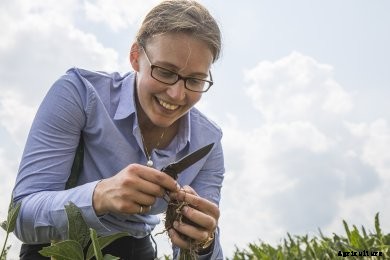
“We did a lot of testing and measuring to learn how we could best produce cranberries,” she says. “It made me realize I was good at solving problems. Pursuing a career in ag engineering seemed like the ideal way to marry what I really liked with a skill that I had.”
With a bachelor’s degree in biosystems and agricultural engineering from the University of Minnesota and a master’s degree in biological systems engineering from the University of Nebraska-Lincoln, Jonjak puts her know-how to work as a precision ag analyst with the FamilyFarms Group in Brighton, Illinois.
“Farmers have big game boards to manage and a lot of moving pieces,” she says. “I go in understanding that they have a really good grasp of what’s going on in their fields. We look at what’s in front of us and talk about the issues they are having. We then develop the questions we need to ask in order to solve those problems.”
Whether she’s fine-tuning a fertilizer application or helping farmers write their own prescription, Jonjak’s reward comes when farmers transition from questioning the value of the technology to where they can see they’re gaining real insight through actionable information.
“It’s very satisfying to give farmers answers to help them grow better crops,” says Jonjak.
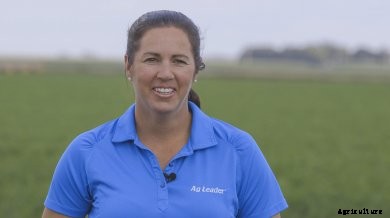
“At UC Davis, I majored in animal science and management,” says the California native. “I decided I didn’t want to be a vet because I wanted to be around my own healthy animals and not everyone else’s sick ones.”
Exploring her options, Lewis found agricultural and resource economics. As part of her classwork, she interned with the school’s precision agriculture department.
“It’s where I fell in love with precision ag, but it was definitely a vertical learning curve,” she says.
For the past 15 years, her career has focused on the ever-evolving industry of ag technology. Today, she is a territory manager with Ag Leader Technology and covers Colorado, Kansas, Nebraska, and Wyoming. Her primary responsibility is to develop the dealer network, which includes assigning and recruiting new dealers. She also works with current dealers on sales training and business planning.
“Service is very important to our customers. That’s why I made the decision early on to cut down on the number of dealers who were not providing excellent service,” she says. “I really focused my efforts on the ones I felt had the potential, the ability, and the will to do that.”
Ultimately, it’s all about the end user’s experience for Lewis. “The most rewarding part of my job is visiting with customers or dealers who realize they’ve made the right decision,” she says.
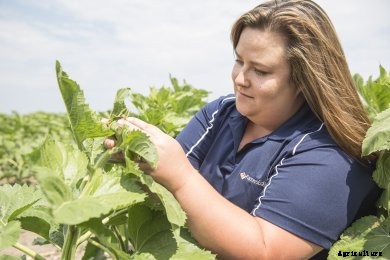
“I grew up on a hobby farm in Oklahoma where we raised cattle and horses and grew vegetables,” she says. “My dad instilled a love for growing things. I never knew it was possible to develop a passion for growing crops so early in life, but I did.”
Ervin’s enthusiasm led to crop judging in FFA. Performing well, she received a scholarship at a junior college where she judged for another two years.
“I transferred to Oklahoma State University, where I continued to judge as I finished up my bachelor’s degree in plant and soil science,” she says.
A conversation with Brian Arnall, an associate professor at Oklahoma State University who specializes in precision nutrient management, would lead Ervin to pursue a master’s degree in plant and soil science with an emphasis on precision nutrient management.
“When I completed my master’s degree, I found Farmers Edge,” she says. “The company seemed to be a perfect fit with my background in soil fertility and ag technology.”
As a regional digital ag lead, she talks to growers in her territory (Arkansas, Iowa, Illinois, Indiana, and Missouri) about using digital ag tools, such as daily satellite imagery and on-farm data, to help them become more efficient and make field-centric, data-driven agronomic decisions.
“I love helping growers learn new things,” says Ervin. “At the end of the day, I hope they feel there was a value to me being on their farm and they understand what I bring to the table.”
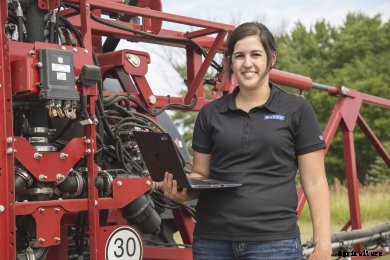
“Since I was a little girl, I was always tagging along and loved working alongside my dad,” she says.
When it came time to look at her future, there was no doubt Schmidt’s plan would include being the fifth generation to farm. Yet, she realized that if she wanted to be a part of her family’s operation, she would have to figure out a way to make herself unique.
“I started looking into ag schools and what they offered,” she recalls. “I thought a degree in agricultural systems technology would be a good fit.”
Currently a senior at South Dakota State University, this major, along with a minor in precision agriculture, enables Schmidt to bring value back to the farm.
“I keep encouraging my dad to adopt new technology,” she says. “Last year, he let auto steer guide his planter rather than rely on markers. It was awesome to see him go from not wanting to use this technology at all to adopting it in our operation.”
Through hands-on experiences, like internships with John Deere and Raven Industries, she has also realized the value of assisting other farmers.
“I love to troubleshoot problems as efficiently as possible to get farmers back in their fields faster,” she says.
Ideally, Schmidt would like to be employed at a dealership so she can continue to work with farmers.
“If I can farm with my dad and still help other farmers, I would have the best of both worlds,” she says.


