Welcome to Modern Agriculture!

Spring is coming, even if you can’t see it under the snow. And you’ll know that it really is here when you see something in your pastures that we grew up fearing: WEEDS. But don’t worry. Be happy!
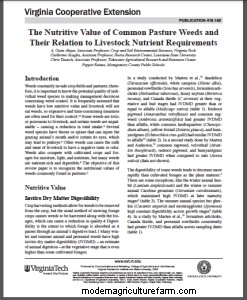
One of my favorite weed publications is Virginia Tech Cooperative Extension’s “The Nutritive Value of Common Pasture Weeds and Their Relation to Livestock Nutrient Requirements.” It reviews the research available on weeds and concludes that weeds can meet the protein values of almost all classes of stock that we raise.
To refresh your memory, here’s what stock require:
Mature Beef cows – 10.5% CP
First-calf heifers – 10.5% CP
Pregnant, replacement beef heifers – 8.8% CP
Dairy heifers – 16% CP
Dry, pregnant dairy cows – 18% CP
Lactating dairy cows – 19% CP
Young goats – 14% CP
Does – 14% CP
Bucks – 11% CP
Mature ewes – 15% CP
Finishing and replacement lambs – 11.6% CP
Now here are a series of charts you can check to see which weeds meet those needs during different parts of the growing season. Some of the charts include IVDMD (Invitro Dry Matter Digestibility), a measure of how digestible a forage is, and ADF (Acid Detergent Fiber) a measure of the least digestible parts of a plant. Ideally you want low ADF and high IVDMD in your forages. (You can click on the charts to see them larger.)
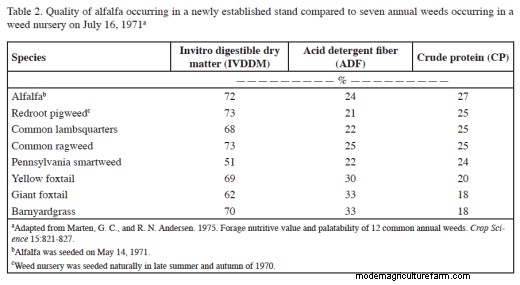
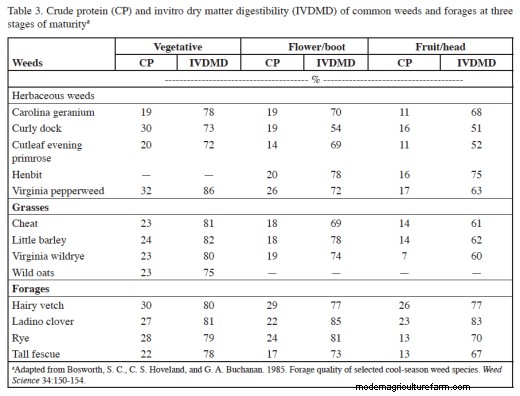
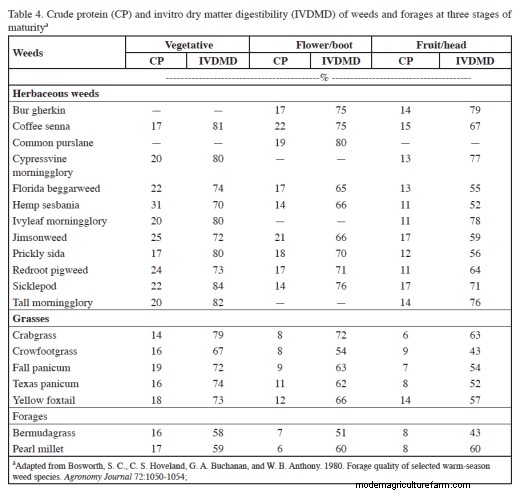
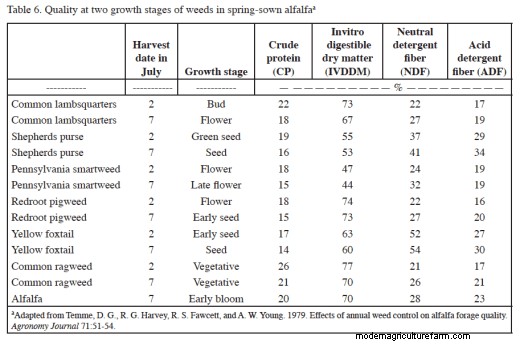
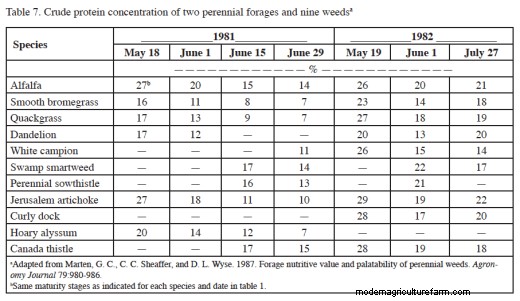
Even if your particular weed isn’t on this list, I can tell you that it is probably in the same range as the plants shown here. In my work teaching cows to eat weeds, I’ve tested a wide variety of weeds and the results gave me two rules of thumb:
1. If it’s green and growing it’s going to have some good protein.
2. More leaf and less stem makes it more digestible.
Some of my favorite weeds for good eating aren’t included on the list, but meet all your livestock requirements. They include:
Knapweed (Spotted, diffuse, Russian, Meadow)
Hoary Cress/Whitetop
All of the thistles. Canada thistle is the easiest weed I teach livestock to eat
What’s interesting about the weed research reviewed in this publication is that it’s not recent. Some of them date back to the 1970s. So, we’ve known that weeds are pretty nutritious for a long time. What we haven’t really understood as well is how animals choose what to eat. But thanks to research done more recently at Utah State University, we now know that animals choose first what their Moms and herd mates eat. They don’t like to experiment with new foods because, but when they do, they keep on eating it if it meets their requirements. (Here’s an article about Palatablity that explains this.) So, if no one your animal knows is eating a weed, and it has everything it needs, it won’t try the new weed and it won’t know that it’s tasty.
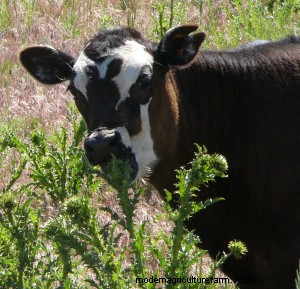
The good news is that you can help your animals learn to eat new foods. In 2004 I put together a simple set of steps based on animal behavior that anyone can use to train livestock to eat weeds in just 8 hours spread over 7 or so days. It only costs about $2.50 per animal and you only have to do it once and then your trainees will teach their offspring and herd mates to eat it, they’ll try other plants in pasture and learn to eat them too, and you’ll finally be able to make use of a great forage resource. Here’s an article about that, and because it’s spring almost spring, here’s a link to the annual sale on the books and DVDs that tell you how to teach animals to eat weeds. The sale runs through May 31, 2015.