
Welcome to Modern Agriculture!

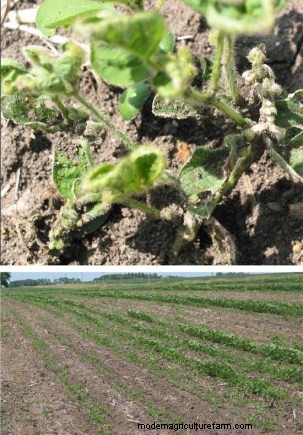
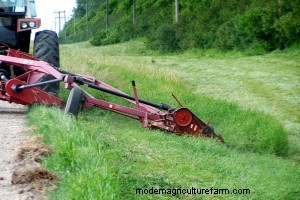
Harvesting ditch hay (grass and legumes growing alongside the roadways) is a common practice, especially in western Minnesota. Ditch hay provides livestock owners with forage suitable for beef cattle, dairy heifers and horses. However, in recent years, there have been several cases of significant soybean injury as a result of manure applications from livestock fed ditch hay that was treated with picloram or clopyralid. This injury has reduced grain yields, and in some cases, resulted in total yield loss.
Picloram (commonly sold as Tordon, Grazon, and Pathway) and clopyralid (commonly sold as Stinger, Curtail, and Transline) are used to control unwanted broadleaf weeds on cropland, rangeland, pastures, and along roadways. These herbicides are especially popular with local, county, and state highway departments because they control hard-to-kill noxious weeds like thistles and leafy spurge but do not kill beneficial or planted roadway grasses. Recently labeled herbicides containing the active ingredient aminopyralid (commonly sold as Milestone, Milestone VM, and ForeFront R&P) are beginning to replace picloram and clopyralid in many roadside treatment programs due to increased Canada thistle control with aminopyralid. Aminopyralid is in the same herbicide family as picloram and clopyralid, and poses the same potential to cause injury to broadleaf crops from contaminated manures. However, sensitive crop injury from aminopyralid contaminated manure has not yet been reported in Minnesota.
When animals are fed ditch hay that has been treated with either picloram or clopyralid, these chemicals pass quickly through the animal without significant degradation and end up in the manure via the urine, usually within a day or two. Manure application to agricultural production fields is a beneficial and common practice. However, if sensitive crops (i.e. soybeans, lentils, peas, legumes, potatoes, tomatoes or peppers) are planted in fields where contaminated manure has been applied, injury or crop death can occur. Injured plants can exhibit twisting (epinasty), leaf cupping, and loss of apical dominance, resulting in short plants and abnormal side shoots.
Labels of many products containing picloram and clopyralid list restrictions that ditch hay harvesters and feeders need to be aware of:
Herbicide labels for products containing picloram and clopyralid may have slightly different warnings or recommendations based on the product formulation and/or active ingredient concentration. Because of this, it is important to read and understand each herbicide label. Some examples of warning and recommendations for these products include: do not allow lactating dairy animals to graze treated areas within 7 days after application; meat animals should be withdrawn from treated fields at least 3 days before slaughter; do not harvest or cut the forage within 30 days after application; and do not plant sensitive broadleaf crops in treated areas until a sensitive bioassay shows that no detectable herbicide is present in the soil.
Always refer to the label for specific restrictions and recommendations. If all directions on the herbicide label are carefully followed, sensitive crop injury from manure applications should not occur.
Both picloram and clopyralid are persistent and mobile in the soil, readily absorbed and translocated throughout the plant, and remain chemically stable and intact in plants. Both herbicides have been detected in the groundwater, but only picloram has been detected in Minnesota groundwater. Because of their persistence in the soil, products containing clopyralid and picloram often carry a crop rotation restriction of up to 18 months for sensitive broadleaf crops, or approximately two growing seasons in Minnesota. Researchers in other states who have dealt with treated ditch hay issues insist that relying solely on herbicide label restrictions is not enough to protect sensitive crops treated with contaminated manure or compost. They recommend soil analysis to detect clopyralid and picloram prior to planting sensitive crops.
Even though these products cause injury to sensitive crops, there is no documented history of human or livestock toxicity by picloram or clopyralid.
Composting or storing manure that contains clopyralid, picloram, and/or aminopyralid may not speed herbicide degradation, as these products do not break down quickly in compost. The concentration of these herbicides in relation to the organic matter can actually increase while the manure is initially stored or composted. Currently, it is believed that clopyralid can remain in manure, forage/feedstuffs or compost for several years. Therefore, composting contaminated manure is not a solution. However, you can spread contaminated manure/compost on fields that will be planted to a non-sensitive crop like corn, sorghum or small grains.
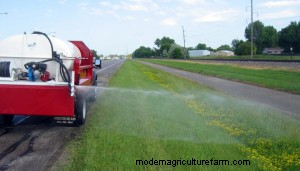
Better awareness and communication is needed between local, county, and state highway departments and farmers harvesting, feeding and selling ditch hay. If you are harvesting ditch hay, develop a working relationship with your county weed inspector or highway department to: 1) identify which herbicides are used in the roadside weed control program, 2) determine which roadsides are spot treated and if some areas have broadcast treatments, and 3) dates when roadsides will be treated. By working together with local, county, and state agencies, hay harvesters can reduce the risk of harvesting forages with unwanted herbicide residues. If the harvest and/or grazing restrictions for the herbicides are communicated to and followed by farmers harvesting ditch hay, the forage can be fed to livestock without contaminating manure.
Anatek Labs Inc (208-883-2839) in Idaho and Morse Laboratories Inc (916-481-3141) in California will test forage and soil samples for the presence of clopyralid to 1 part per billion (ppb) and will screen for the presence of picloram. It is important to contact the companies for instructions on correctly sampling forage and soil for these tests.
