
Welcome to Modern Agriculture!

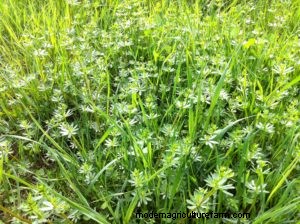
If you have bedstraw on your farm or ranch, lucky you! According to forage analysis done by the Vermont Pasture Management Outreach program, protein values for this plant were around 19%. That means we should quit thinking of it as a weed, and instead look at it as a very palatable that is good for your livestock.
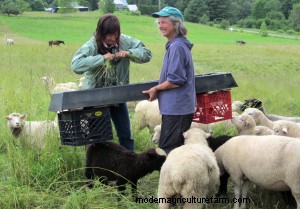
If your animals aren’t already eating bedstraw, you may have to teach them that this is a good food to eat. That’s what Kimberly Hagen, of the Vermont Pasture Network did in 2011. She followed Kathy Voth’s training recipe, to trained her sheep to eat bedstraw as shown in the video below. When she moved them to new pasture elsewhere as part of her parasite management program, she trained the visiting cattle to eat this forage. (Click here for more information on how you can train your own livestock.)
Nobody wants an entire pasture made up of just one forage. So even though bedstraw is a great food, you want to graze it in a way that will let it complement the rest of your forages.
We know that mowing bedstraw before it has gone to seed can slow the rate of spread. Our problem becomes the timing of mowing because bedstraw, once it has begun to flower, can go to seed within days or practically overnight. Then mowing works against you, spreading the seed around the field. That’s where using your livestock to graze this plant might work more in your favor.
Trained livestock will graze bedstraw throughout the growing season. Sheep trained to eat bedstraw decreased its presence from 30% of the plants growing in a paddock to less than 10% in a single season. So, while getting rid of bedstraw may be nearly impossible, keeping it in check and minimizing its spread is more likely.
Bedstraw has a variety of uses that we can take advantage of. People in Oregon and southwestern Washington might watch for sweetscented bedstraw because it indicates moist, well-drained sites, and in riparian zones suggests high productivity sites for conifers.
It also has medicinal applications. It’s still used to a limited degree as a popular remedy in gravel, stone, and urinary diseases. Bedstraw has also been used as a remedy for epilepsy and hysteria, and is still considered for these uses in France.
If you don’t plan to feed it to your animals, you could use it in your own menu. The flowering tips yield an acid liquor which was thought to form a “pleasant summer drink.” It is also sometimes called “Cheese Rennet” because it can curdle milk, and has been used to make cheese and add color to it.
Our suggestion: take advantage of your bedstraw! Perhaps this summer you can enjoy a cool glass of bedstraw liquor with some bedstraw assisted cheese, while watching your livestock graze it!
This article is drawn from one previously published in On Pasture
Save
Save
Save


