
Welcome to Modern Agriculture!

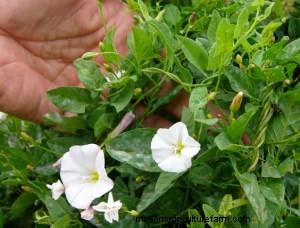
Back in 2009, I spent part of the summer as the “Jane Goodall of cows,” following a herd of 69 cows and their calves to see what they ate, and how they learned. Half were trained to eat diffuse knapweed and yellow toadflax and I wanted to see how quickly the untrained cows and calves learned from them.
Not only did trainees teach herd mates to eat weeds in less than a day, they also showed me that grass may not always be a cow’s first or best choice!
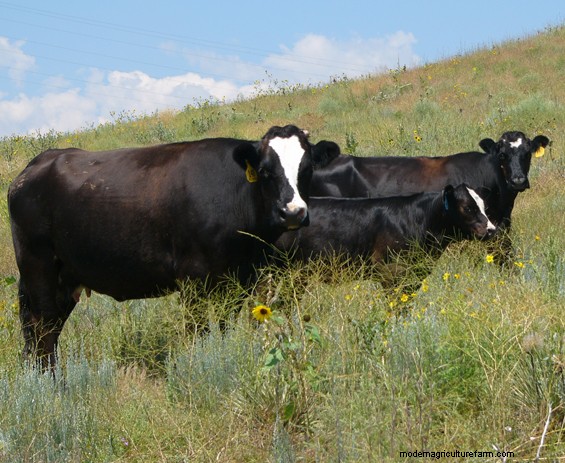
Day after day, I followed the herd as they grazed a 500-acre pasture, near Boulder, Colorado. That June and July were two of the wettest months in history and the pasture’s grasses rebounded and forbs went wild. The pasture included a large prairie dog ghost-town that covered about 200 acres of the pasture, vacant because plague had killed them all. That area was almost grassless, and was covered in an assortment of weeds. It looked so bad from our accepted pasture paradigm that I nicknamed it the “garbage area.”
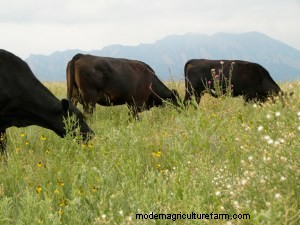
But it didn’t look bad to my herd. They avoided the grassy areas and spent their time in the “garbage area” snipping off sunflower blossoms, yucca fruits, and musk thistle flowers and eating prickly lettuce and bindweed. When they came to grassy areas of blue grama, big bluestem, western wheatgrass and brome, cows grabbed a few bites then quickly moved on to graze prostrate pigweed, cutleaf nightshade, Russian thistle and fetid marigold. They dined on common ragweed, wormwood sagewort, wild licorice, assorted chinopodiums, Missouri goldenrod, and more.
I collected samples of the plants and plant parts cattle were eating and avoiding. Protein values for their preferred weeds ranged from 12 to 22%. Since we know that animals can choose foods based on nutrition, it makes sense that they were avoiding the grasses with only 3 to 8% protein.
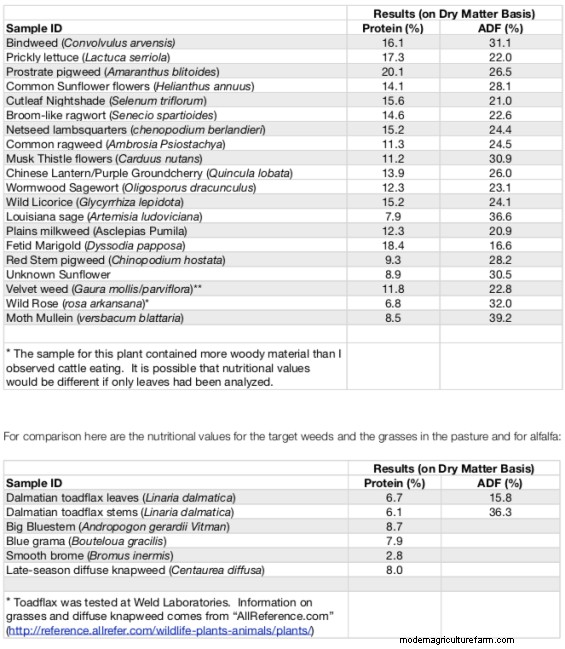
One of their favorite forages was field bindweed. It was thickest around abandoned prairie dog burrows, and the herd moved from one to the next, grazing the vines down to the ground and leaving bare areas that reminded me of flying saucer landing zones from old science fiction movies. At 16% protein, it is the equivalent of supplements that cattle producers are sold to increase weight gain to as much as 2.2 pounds per day. It was clear that the weed was doing it’s job, as the whole herd was sleek and fat.
It’s important to point out here, that a solid diet of nothing but field bindweed is not a good idea. It is a nitrate accumulator so animals need to have a variety of forages available to mix a safe diet. It also contains alkaloids that affect smooth muscles – those involuntary muscles in the gut and around other organs that help them do their jobs. That means that over-consumption can cause gastritis or colic in horses.
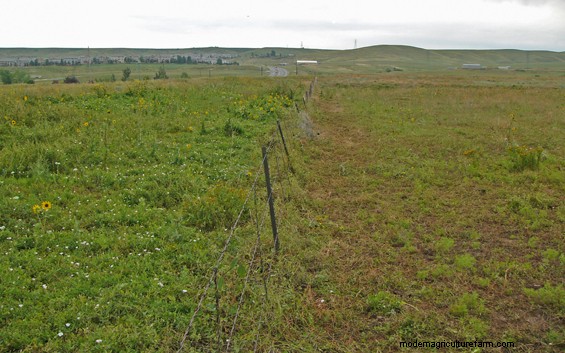
In his recent BeefWatch piece, Gary Stone points out all the attributes that make bindweed so tough and difficult to eradicate. As you read his description, instead of thinking of this plant as a problem, think of it as a potential forage. I hope you’ll see, as I do, that having something so resilient could be beneficial.
So, here we have a plant that can spread via roots and seeds. The seeds will be with us for our lifetime and can germinate whether it’s hot or cold! It can provide a huge amount of forage since it can spread so quickly. Mowing and fire do not slow it down either. If you didn’t think of it as a weed, you’d be pretty excited about a forage with this kind of resilience!
We have two versions:

and…
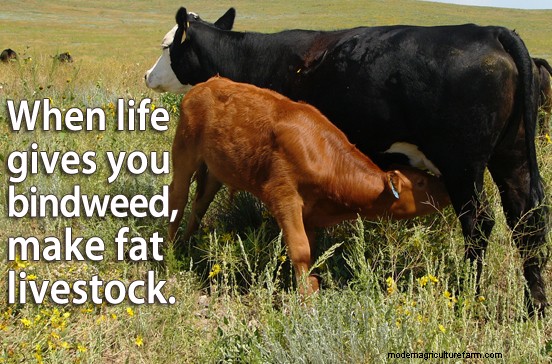
Several decades of research at Utah State University found that animals learn what to eat based on what they learn from their mothers and from their own experience with the nutritional feedback from foods. I used this research to create a method anyone can use to teach their livestock to eat weeds. It takes just 8 hours spread over 7 days. You only have to do it once, and you’re done.
I’ve written lots of On Pasture articles about training livestock to eat weeds to help you get started. Here’s one of the most recent:
If you’re an On Pasture paying subscriber, you can access bonus content that includes a list of over 100 weeds and whether or not livestock can eat them, a training recipe that you can adapt to whatever weed you’d like, and a report I wrote on how to manage your livestock to meet your weed management goals.
Enjoy!


