
Welcome to Modern Agriculture!

In this video, you’ll meet my good friend, John Wick and you’ll learn about an amazing discovery made on his ranch. It’s a discovery that could mean that farmers and ranchers could not only slow climate change, but could actually begin to cool the planet back down. And they can do it all while growing more forage, food and fiber.
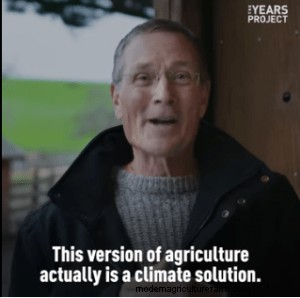 I met John and his wife, Peggy Rathmann, in 2006 when I went to their ranch in Nicasio, California to help them teach cows to eat distaff thistle. John and Peggy bought their ranch with the intention of providing habitat for local wildlife. They wanted to increase native forages and perennial grasses and reduce invasive annuals and weeds.
As this video describes, removing cattle from the system didn’t make things better. But they were determined, and by the time I arrived, they’d already spent a lot of time reading and going to workshops and they had a good handle on how good grazing management could be the right tool for the job.
They set up an intensively managed mob grazing system that included some of the cattle we’d trained together, and soon saw good results. Those results led them to wonder how far these changes might be going. Could their healthy soil be the way to a healthier planet? They decided to find out by starting a research project on their ranch.
Now, with ten years of data collection under their belts, they have some amazing answers. This short video doesn’t cover all the ins and outs of the project, or the questions that we still need to think about as we move forward. But it’s a great introduction.
Over the next weeks and months, I’ll be sharing more about this project. I’ll go into more depth on the science behind it. We’ll look at the carbon footprint of farming and ranching and how one number doesn’t represent all places on the planet. We’ll explore how and where this practice can work and the role that grazing animals play in the process. We’ll talk about the logistics of finding and spreading compost, the costs involved, and the partnerships that are in the works to assist farmers, ranchers and land managers who would like to try the practice. Most importantly, we’ll cover what you can do to become a “carbon farmer” from just spreading some compost, to putting together a full-blown carbon farming plan.
I’m so proud to know John and Peggy and I’m grateful to all the people who have worked on this and are continuing to work on it. I’m also very excited to be able to tell you this story. Please let me know what questions are important to you as we progress through this series.
Here’s Part 2 in the series.
Want to learn more? Visit the Marin Carbon Project.

