
Welcome to Modern Agriculture!

One way that farmers and ranchers improve their soil is by feeding out on the pasture. The feed imports nutrients to the pasture, and the waste feed adds organic matter. There are a lot of ways to put the feed out there. Popular ways are rolling out round hay bales to cover a lot of ground, or arranging hay bales in the pasture in a checkerboard or strips. Whichever one you choose allows livestock to eat some and trample a considerable amount into the soil. Adding this organic matter is very beneficial to the soil and can boost fertility with Nitrogen (N), Phosphorous (P) and Potassium (K). But how much does it cost, and is it worth it?
We are going to walk you through some simple arithmetic to calculate the cost of waste hay as a soil amendment and compare that to buying other soil amendments (compost, manure, paper fiber). Consider the equations below and use your own numbers to fit your situation.
Soil tests give us a good measure of what our soil is lacking. You probably have some ideas, but if you’re going to spend any money, it’s good to know why, and how much. Soil test results typically come back with a recommendation for adding pounds of N, P and/or K per acre. You might also get a recommendation for lime based on the pH of your soil. You may have a good idea that your soil is lacking in something simply by observing a pasture’s productivity. Soils low in N, P and K , or off in pH won’t produce as much forage as pastures with healthier soils. If you want something more than your visual observation, here’s how to test your soils.
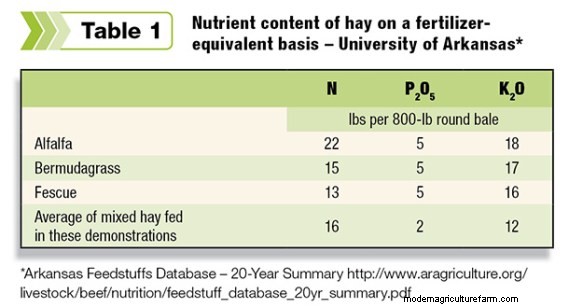
According to John Jennings, Forage Extension Specialist for the University of Arkansas, each bale of hay contains substantial amounts of nutrients that can enrich the pastures where you feed. On average, a typical 4-by-5 round bale has a fertility value approaching that of 100 pounds of 17-17-17 fertilizer. So the round bale provides 17 lbs each of N-P-K. It also has small amounts of other nutrients, depending in part on hay quality.
Here’s a table showing what you get from three different kinds of hay as well as a mixed hay he used in a fertility/feeding trial:
I don’t like reading math any more than the next person. So if you stop here, I don’t blame you. But before you go, scan on down to the end of the article where we add in a few more complicating factors in how you decide if you’re going to replace fertilizer with hay.
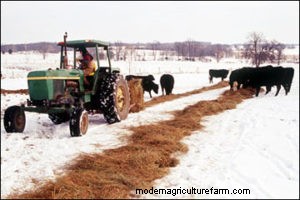 According to Robert Kallenbach of the University of Missouri’s Agronomy Department, when large round bales are unrolled and fed on the ground as loose hay, losses as high as 40% can be expected. Some may say even more is lost, even as much as 50%. We’ll go with 40% because we are optimists.
Here’s the equation:
$30/bale X 40% trampled (the average expected waste) X 16 bales/acre (in this example spaced every 50 ft) = $192/ac
800 lb bale/2000lbs X 40% not eaten X 16 bales/ac = 2.56 tons/acre as a soil amendment
If you plug in the numbers for the “mixed hay” bales from Table 1 above, you get:
16 pounds N/bale x 16 bales/acre = 256 pounds N per acre
2 pounds of P/bale x 16 bales/acre = 36 pounds P per acre
12 pounds of K/bale x 16 bales/acre = 192 pounds K per acre
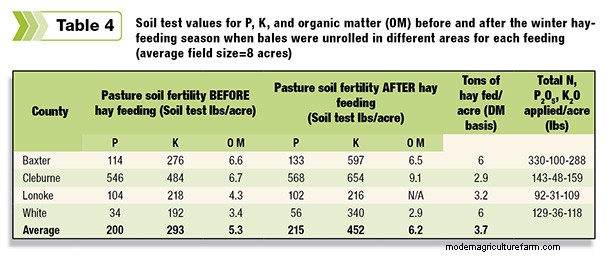
Actual results may vary as you can see from the table below from John Jennings’ study of the changes in soils from the feeding experiment he did. The last column shows the total N, P and K for the different counties where he worked. Baxter county, with 6 tons of hay per acre is closest to the 6.4 tons of hay per acre in our example above.
First we need to figure out how much of the soil amendment we need. For this example we’re going to use compost. For our example we’re using compost that tests out at 1.7% N, 1.3% P and 1.5% K.
We have to convert that to pounds per ton to make any sense of this. To do that, simply multiple the percentage by the 2000 pounds in a ton.
.017 N x 2000 = 34 pounds N/ton
.013 P x 2000 = 26 pounds P/ton
.015 K x 2000 = 30 pounds K/ton
Since compost is like a slow-release fertilizer, not all of these nutrients are available the first year. In general, only 20% of the Nitrogen, 40% of the phosphorous and 60% of the Potassium is available to the plants in the first year. We multiple the results above by these percentages
34 x .20 = 7 pounds available N/ton
26 x .40 = 10 pounds available P/ton
30 x .60 = 18 pounds available K/ton
If you divide the pounds per acre recommendation by the pounds available for each nutrient, you’ll get the tons per acre that you need to meet your soil test recommendations.
100 pounds/acre N / 7 pounds available N/ton = 14 tons per acre.
Last, let’s figure how much that costs. We’ll use a cost of $30 per ton for our compost and $40 per acre to spread it.
$30/ton x 14 tons = $420 + $10 to spread it = $430/acre.
This fertilizer will continue contributing fertility for a number of years. So to be fair let’s divide that by 5 years.
$420/5 = $84 per acre
There’s one more thing that makes compost very interesting. Research indicates that compost increases carbon sequestration in soils. In fact, in research done in California, they found that one application of compost sequestered 1 ton per acre of long-term carbon. They’ve continued to measure the results and that single application of compost has continued to sequester an additional ton every year for ten years now.
There are lots of considerations this math is missing like:
• How much does it cost to feed the way you feed now?
• What do you do with the manure you collect where you currently feed?
• What do your pastures and your livestock need?
• Do you have an on farm supply of compost?
• What makes your life easier and/or more profitable?
• What are your goals?
This is what makes farming and ranching so complex, and why one operation can be so different from another. In the end you always have to pick what works best for your operation.
If you have some thoughts on this or examples of what has or hasn’t worked for you, please do share with your fellow readers in the comments below.


