Frequently Asked Compost Questions:
Today, let us discuss Compost Questions, answers, and Tips.
-
What is compost and what materials can be used for composting?
Compost is a mass of organic raw matter that is rotten or decomposed. Any waste matter available in the farm area or kitchen or streets can be used for composting. Waste from an animal, plant residues, dry leaves, etc. is all used as compost material.
-
Why is compost used during agricultural practices?
Compost helps to amend the soil. Compost is a stable substance that improves the quality of the soil without disturbing its chemical, physical and biological structure. The most important benefits of using compost during agricultural practices are:
- To reduce investment cost
- Produce healthy crops
- Reduce the use of chemical fertilizers
- Conserve the resources available in nature
-
How does compost change the physical property of the soil?
Compost is expected to improve the physical properties of the soil in the following ways:
- Loosens the heavy soil and reduces the soil bulk density. It also improves the root penetration ability and turf establishment in compact soils.
- Binds water to the organic content, thereby increasing the water retention capacity of the soils and reduces the investment in irrigation.
- Helps to prevent the dispersion of soil by wind and water erosion. Organic content always keeps the soil surface moist or wet such that this increases the productivity of the soil.
- The fungi in the compost help to bind the soil into crumbs that prevent the soil from getting eroded.
- Compost aerates the soil, i.e. it provides required oxygen to the roots and helps the CO₂ to escape into the atmosphere.
- The dark color of the compost retains the soil temperature and heat absorption capacity of soil.
- Compost that is used as mulch prevents rapid fluctuations in soil temperature.
Read this: Organic Dairy Farming Facts.
-
What is the chemical composition of compost?
Normally chemical composition indicates the availability of nutritional content in the compost. The average nutrient availability from farm compost is 0.5% N, 0.15% P₂O₅ and 0.5% K₂O.
-
How can the nutritional value of compost be increased?
To increase the nutritional value of the compost superphosphate or rock phosphate @ 10 to 15 kg per each trench of the raw compost material is applied before filling the pit.
-
What are the town compost and its composition?
The night soil, street garbage, dustbin waste, etc. together are termed as town compost it contains 1.4% N, 1% of P₂O₅ and 1.4% of K₂O.
-
What is farm compost?
Generally the waste present in the farm like paddy straw, weeds, sugarcane trash, etc. are placed in trenches of dimensions 4 to 5 m length, 1 to 2 m wide and 1 to 2 m deep. The farm waste is layered in the trenches and is every layer of the waste is moistened with cow dung slurry or water. The layering is done to a height of 0.5 m and the farm compost is ready to be used after a period of 5 to 6 months.
-
What are the different methods of composting?
Composting is done in different ways depending on the region where it is prepared such as:
- Bangalore method
- Indore method
- Coimbatore method
-
What is the process of compost preparation in Bangalore method?
The Bangalore method of composting is as follows:
- Spread the dry waste material in a pit up to a thickness of 25 cm.
- Sprinkle a thick suspension of cow dung in water over the layer to moisten it.
- The process is repeated until the suspension rises to a height of 0.5 m above ground level.
- This is left uncovered for 15 days and then turned around.
- It is then plastered with mud and left undisturbed for about 5 months or until required in the farm.
-
What is the process of composting and why is it needed?
Decomposing the organic matter naturally due to the presence of micro-organisms under controlled environmental conditions is generally referred to as composting. Any raw organic matter can be used for composting such as food waste, industrial waste, garbage, animal and crop residues, etc. Composting is necessary for the following reasons:
- Helps in decomposing complex chemical compounds present in the biological materials.
- Converts the complex materials into simple inorganic elements and provides them as nutrients to the plants.
- When waste is not decomposed, it starts decomposing after being applied to the soil as fertilizer. The complex materials start converting into simple elements within the soil and snap away all the energy from the plants.
- Composting or decomposing the waste before using it for plants is very essential.
Read this: Organic Farming Ideas.
-
What are the main advantages of compost making?
Some of the advantages of compost making are listed below:
- Reduces pollution
- Reduces the cost of farming
- Acts as fertilizer and antibiotic for plants
- Produces high yields and improves income
- Fetches more price for the produce
- Protects the soil in all aspects and improves its quality over a period of time
- Acts as mulch, weedicide, pesticide, and fertilizer.
- Retains soil moisture and reduces the cost of irrigation
- Reduces the volume of the waste
- Conditions the soil and prevents it from erosion
- Compost destroys the volatile organic chemicals present in the air
- Helps in reforestation and amends the structure of marginal soils
-
Why do you treat compost with lime?
It is observed that when compost is prepared from hard plant materials (wood shavings, sawdust, coir, fallen leaves, pine needles, etc.) containing high lignin content then the compost doesn’t ripen fast. Lime @ 5 kg is added to 1000 kg of waste material either in dry powder form or in a liquid form mixed with required water quantity. Doing so fastens the decomposition of waste materials. Chemically, lime weakens the lignin structure by improving the microbial activity and changes the ratio of humic to the fulvic acid content. It also decreases the bitumen content in the waste.
An alternate to lime is using powdered phosphate rock @ 20 kg per 1000 kg of waste materials because it contains good lime content and provides both phosphate and plant essential nutrients.
-
Can weeds be composted and how?
Yes, weeds like parthenium, water hyacinth, cypreus and cynodon can be decomposed by using a certain method exclusively developed to decompose them.
Decomposing weeds require 250 g of trichoderma viride (fungus) and Pleurotus sajor-caju (is a species of oyster mushroom); it also needs 5 kgs of urea. The process of decomposition is as follows:
- Cut the waste material to a size of 10 to 15 cm.
- Create an elevated shady area with approximate dimensions of 500 x 150 cm.
- Spread the cut waste material @ 100 kg in the area.
- Sprinkle 50 g of Pleurotus sajor-caju over the waste material.
- Spread 100 kg of weeds over this layer.
- Sprinkle 1 kg of urea uniformly over the spread material.
- This is done until the level of material is 1 m.
- 50-60% moisture is maintained by sprinkling water over the area.
- Cover the surface of the area with a thin layer of soil.
- Turn the entire pile thoroughly on the 21st day and the compost is ready to be used after 40 days.
-
What are the ways in which compost can be enriched?
Generally, it is believed that farm compost is very low in the composition of P i.e. it contains only 0.4 to 0.8% of P. P has to be added to balance the composition of the compost and also to reduce the loss of nitrogen. The following can be done to enrich the compost:
- Application of 1 kg of super-phosphate or bone meal to a layer of animal dung.
- Bones of animals can be powdered and boiled in lime water; the solution can be strained and applied to the pits in the farmlands.
- Potassium content can be increased by the addition of wood ash to the compost.
- Nitrogen fixers like azospirillum lipoferum and azospirillum brasilence and P solubilizers like bacillus megaterium can be sprinkled over the decomposing compost after one month. Doing so increases the nitrogen content by 2%.
-
How does compost enhance the chemical properties of the soil?
Compost is useful in the maintenance of the chemical structure of the soil by:
- Increasing the cation exchange capacity, anion exchange capacity and the buffering capacity of the soil for an extended period of time exclusively for soils with less clay and organic content.
- It provides the soil with the basic nutrients like nitrogen, phosphorous and potassium. It also enriches the soil with other essential micronutrients like copper, boron, iron, calcium, zinc etc.
- Compost protects the soil from sudden changes due to salinity and toxic chemicals or metals.
- Compost contains growth stimulators that help the plants during germination.
-
What is the role of compost in improving the biological properties of the soil?
Compost is considered very useful for the improvement of the following biological factors of the soil such as:
- Helps in the growth of beneficial micro-organisms.
- Helps to kill the weed seeds due to the heat present in the compost.
- Compost controls the occurrence of disease in the plants because it is believed that the micro-organisms present in it produce antibiotics.
- Compost also activates the disease-resistant genes in the plants.
- Compost helps in suppressing the development of parasites.
Read this: Organic Poultry Farming.
-
Are there any economic benefits associated with using compost as fertilizer for the crops?
Compost also has some economic benefits when used in agricultural practices, they are as follows:
- When compost is used as fertilizer, the crops produced are termed organic and generate more income.
- Since compost is made from waste or garbage, it reduces the cost of waste disposal and transportation.
- Compost reduces the risk of landfills and combustion use.
- Use of compost reduces the need for chemical fertilizers, which could otherwise be harmful to the soil in the long run.
- Small gardens, lawns, fields, etc. can use compost as mulch and thereby reduce the cost of obtaining other mulch materials.
- Compost can be used alternatively to topsoil and help in cost saving during farming activities.
-
Are there any disadvantages of using compost, if so what are they?
It is observed that the use of compost during farming practices is low because of the following reasons:
- Bulky to transport from the manufacturing area to farmlands.
- The total nutrient content present in compost is low when compared to other chemical fertilizers.
- Compost releases nutrients slowly into the soil and therefore it takes much time for the plants to receive the required nutrients, which hinders the plant growth during the initial stages.
- When compost is generated from industrial and municipal wastes then there is a risk of compost being contaminated with heavy metals. The presence of these metals can be a cause of concern during food crop production.
- Too much use of compost over a longer period of time can cause accumulation of salt, nutrient, and metals in the soil bed, which may affect the plant growth and other environmental factors (soil, water, animal and human health).
-
What is the Coimbatore method of composting?
Organic waste decomposition is done within the pits of different sizes in this method. The process is as follows:
- Initially, a layer of waste is laid in the pit.
- The waste is moistened by suspending 5 to 10 kg of cow dung in 2.5 to 5 liters of water.
- Fine bone meal powder @ 0.5 to 1 kg is sprinkled over it uniformly.
- The layers are repeated until the material is 0.75 m high above the ground level.
- The pit is plastered with wet mud and left undisturbed for almost 8 to 10 weeks.
- After 8 weeks the plaster is removed and the material moistened with water.
- It is turned around and made into a rectangular heap and shade is provided.
- The mixture is left undisturbed until it is used on the farm.
-
How is compost prepared in Indore method?
This method is a little different from the Coimbatore method and the process is as follows:
- The waste is spread in a cattle spread as bedding for animals.
- The bedding gets soaked in urine and dung, which is removed each day and piled up at a different place to a thickness of 15 cm.
- The earth that is soaked in urine is scrapped from the sheds and is mixed with water and sprinkled over the layers every two or three days.
- Layers are laid for almost 15 days and the heap is turned upside down to reform.
- Old compost is sprinkled over the top such that it acts like inoculum for decomposing material.
- It is left undisturbed for a month and then given a turning again. At every turning, the pile must be moistened and the compost is finally ready after 3 months of preparation.
In case if you are interested in this: Hydroponic Nutrient Chart.
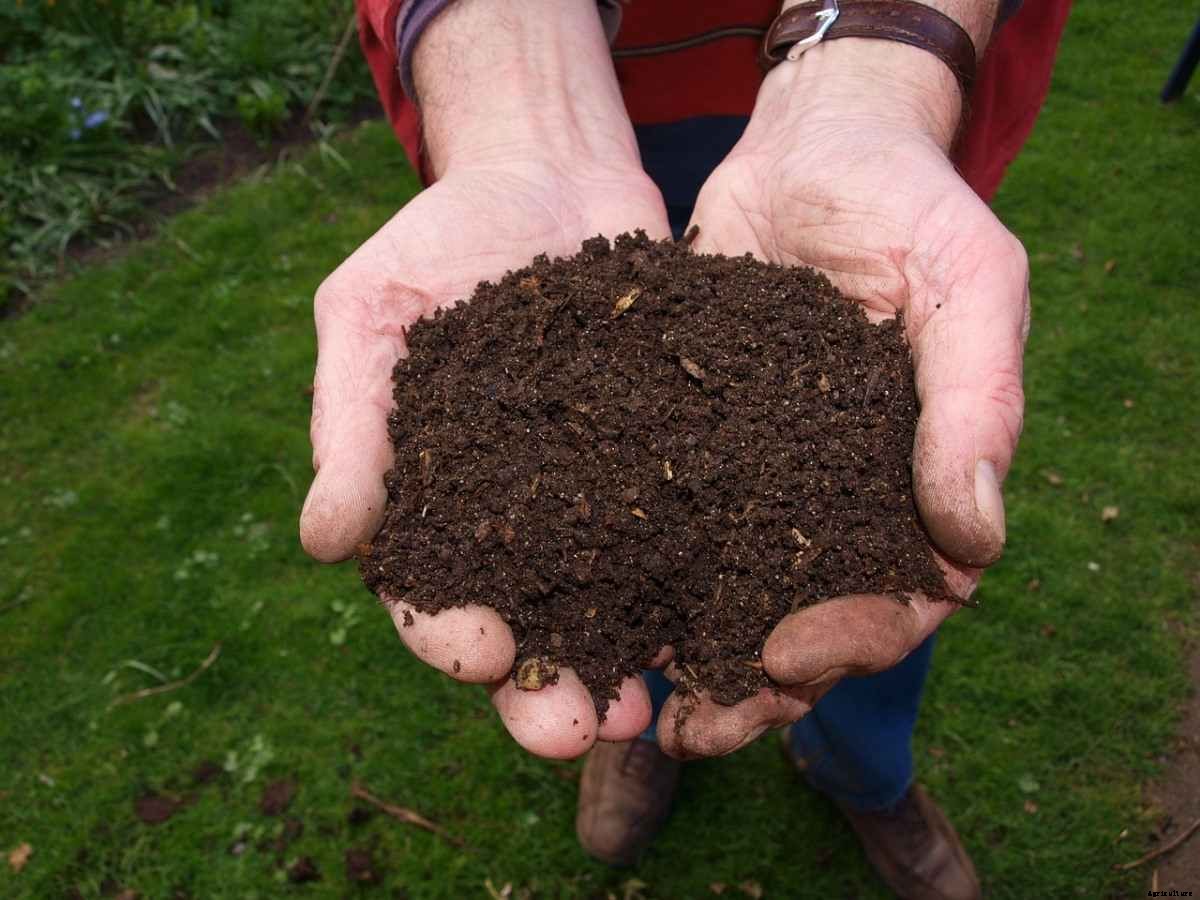 Compost (Image source: pixabay)


