
Welcome to Modern Agriculture!

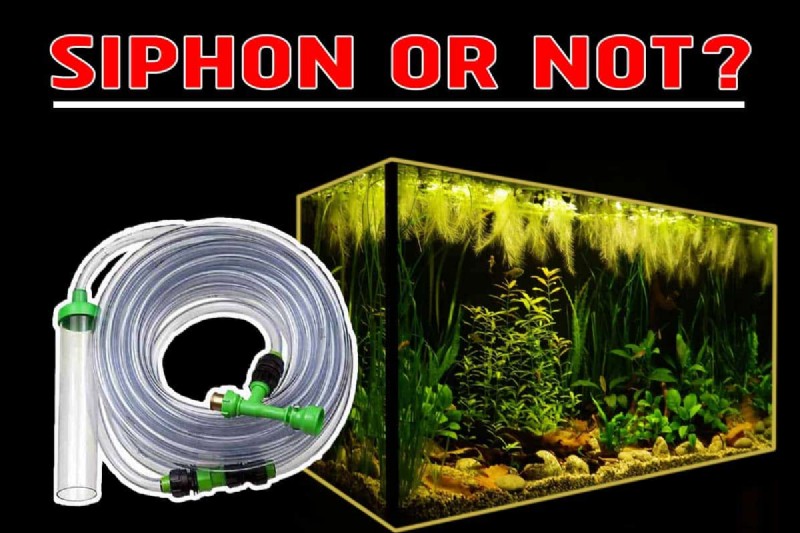
Siphoning involves the removal of debris or sediment from the substrate using a specialized tool such as a hose.
At first glance, it seems like siphoning the substrate is an absolutely normal procedure, especially, when lots of articles and videos insist that we should siphon regularly to remove waste.However, in reality, most people do not understand that by siphoning we often disrupt the established connections within our aquariums.
Therefore, this results in a rather peculiar situation. On one hand, we do it to keep the aquariums clean, but on the other hand, this seemingly simple process actually has profound consequences, akin to performing medical surgery. Just as it’s best to avoid it when unnecessary.
In this article, I will explore when to siphon the substrate, how to siphon, the pros and cons, and explain the processes occurring in the aquarium that are affected by siphoning.
Right from the beginning, I need to emphasize that there are numerous factors that will influence whether siphoning the substrate is needed.
Furthermore, each of these factors may have its own specific characteristics. I will be talking about them in this article.
The number and size of fish and other inhabitants in the aquarium directly affect the rate at which waste (bioload) is produced.
Note: For example, dwarf shrimp do not produce a lot of bioloads. Whereas fish, snails, frogs, crabs, crayfish, and axolotls are waste factories!
Thus, if there are a lot of bioloads, you will have to do more frequent siphoning to maintain water quality, whereas lower bioloads usually require less frequent maintenance.
At the same time, it also depends on the aquarium, because in an established aquarium, the amount of bioload that can be processed differs significantly from a recently cycled aquarium. Thus, in one scenario, siphoning may not be required at all, while in another, it will be necessary.
Related article:
Efficient aeration and filtration systems will definitely help mitigate the buildup of organic matter.
First and foremost, this is because the bacteria involved in processing decomposing organic matter directly benefit from good aeration.
The type and size of the substrate will also matter a lot. For example,
I would say that there are two factors:
Note: Once again, depending on the type of substrate, anaerobic zones start approximately 2 – 4 inches (5 – 10 cm) down in fine substrate. It will be deeper in large gravel and shallower in very finer substrates (like sand).
Live plants contribute a lot to nutrient uptake and water quality, especially, when we are talking about fast-growing plants.
Therefore, they can influence the need for siphoning.
Of course, for a beginner aquarist, all these factors can provide a general idea of when to siphon the substrate or not. However, if we want to truly comprehend how it works, it is necessary to examine it from a scientific perspective.
Bottom sediments are not uniform in their structure and composition, and they can be divided into 3 major stages.
It is absolutely crucial to differentiate between these sediment types. This knowledge is essential for knowing what, when, and why to siphon.
Actually, this is what we see rolling on the bottom such as muck, flakes, and various-shaped bits, as well as remnants of leaves, stems, and food constitute decaying organic matter.
Therefore, if it accumulates on the bottom and doesn’t dissolve/processed quickly, it should be siphoned out with a water change.
Once organic matter starts dissolving, it will become organic carbon compounds. They include:
This creates an energy source for microorganisms and plants. Plants can directly take up simple dissolved organics like amino acids and sugars. Dissolved organics also support the entire microbial food web that cycles nutrients in the aquarium.
After that, Ammonia Oxidizing Bacteria convert some nitrogen-containing organic substances into ammonia/ammonium. Next, nitrifying bacteria oxidize ammonium (NH3) first into nitrites (NO2-) and then into nitrates (NO3-).
In aquariums, two types of bacteria generally consume organic carbon compounds:
Related articles:
Complete decomposition of decaying organic matter is typically impossible in an aquarium. As a result, it leads to the gradual accumulation of sedimentary humus (mulm).
It usually looks like a brown and oily gunk buildup between the substrate and the front glass.
It varies in thickness from a fraction of an inch to several inches (a few millimeters to several centimeters) within the substrate.
This represents the final stage of processing decaying organic matter into non-soluble organics, mixed with various chemical elements, compounds, microorganisms, and bacteria.
Organic matter is a fundamental component of any aquarium.It plays a crucial role in the formation of inorganic compounds. However, an excess of organic matter can lead to deteriorating aquarium conditions and various issues, often being the primary cause of algae growth.
Beneficial bacteria play a vital role in breaking down the majority of organic matter in the aquarium. These bacteria are aerobic, it means that they require oxygen for their survival.
That is why they thrive in well-oxygenated areas of the aquarium, such as on the plants, decorations, upper layers of the substrate, and, of course, filters.
Important: A lack of oxygen hinders the oxidation of organic matter. An excess of organic material automatically leads to increased oxygen consumption for oxidation, thus reducing the available oxygen for aquatic life.In cases of oxygen deficiency, insufficiently oxidized organic matter accumulates in the substrate, inevitably resulting in rapid acidification.
Although it is true that the majority of the bacteria are living in our filters, the substrate also covers a huge portion of the tank. Thus, substrate occupies the second position in terms of bacterial colonization.
However, it is not just a settlement on the substrate. During colonization, they start by forming a thin layer, which gradually thickens over time.
As I have said, this brown and slimy gunk (mulm) is essentially the final stage of organic matter decomposition.
Unfortunately, this is where many aquarium enthusiasts make a mistake. The gunk looks very unattractive, so they try to remove it immediately.
Unfortunately, siphoning the gunk can be detrimental to the aquarium’s bacterial colonization because it is going to be a big hit to the nitrogen cycle.Additionally, by disturbing deep-layered mulm, we may get (besides ammonia spikes) the entire periodic table into the water, ultimately poisoning our animals.
As I have already mentioned, some Heterotrophic bacteria also perform denitrifying functions, these bacteria do not need oxygen and absorb nitrate to produce nitrogen gas.
These denitrifying bacteria require deep substrate.
Furthermore, when oxygen and nitrates become depleted, many anaerobic bacteria in the substrate can use iron (Fe) or manganese (Mn) to accept electrons generated during metabolism. This chemical reduction of iron and manganese dissolves these metals, making them available for plant roots to absorb. Basically, they are acting as fertilizers.
Hence, anaerobic bacteria play a crucial role in providing plants with essential iron and manganese.
Therefore, the presence of detritus in anaerobic zones positively impacts the overall health of a planted aquarium and the growth of plants, particularly those with well-established root systems.
The thickness and type of the substrate are crucial factors when deciding whether to siphon and how often, as well as how deeply.
It is advisable to avoid substrates that lead to detritus buildup or be ready to siphon them regularly.
As a result, this will lead to an accumulation of organic matter in the water column, disruption of the nitrification process (mini-cycles), pathogens, parasites, etc.
Additionally, plants struggle to establish a healthy root system in such substrate, making them less effective at consuming detritus.
Obviously, we have to siphon the substrate on a regular basis to prevent detritus buildup.
We have also the accumulation of detritus in the upper layers. It looks really ugly and very messy.
Thus, siphoning is absolutely necessary all the time.
As a result, we usually have substrate acidification, root decay, and production of hydrogen sulfide.
Therefore, siphoning must be done regularly.
So, let’s summarize when siphoning is necessary.
Keep in mind that it also depends on your aquarium’s size, stocking, and maintenance routine. Therefore, regular observation and water testing will help you determine when siphoning is necessary for your specific setup
The formation of hydrogen sulfide in small amounts is a natural part of organic matter decomposition. However, if you see lots of air bubbles appearing throughout the substrate after poking it, it’s a sign of trouble.
This is a classic case of heavily mulm-laden substrates (substrate deterioration).
If it is possible, I would try to siphon the substrate gradually, not all at once. In the worst-case scenario, you will have to do a complete restart.
It is quite a difficult question. On one hand, as mentioned earlier, having some organic matter (and the so-called gunk) has a positive effect on plant growth. Lots of aquarists noticed a huge improvement in plant growth when they stopped siphoning their tanks.
However, it’s important to strike a balance.
For example, if your plants can’t consume all the organic matter, your substrate may become ‘acidic’ over time, especially if your plants have a weak root system. Eventually, it will be detrimental to your tank.
In some cases, we may notice that if we deeply siphon the substrate, plants start to produce aerial roots. This is a clear sign that their root system is no longer receiving the required nutrients, and to survive, they begin growing these ugly aerial roots.
Deciding whether or not to siphon aquarium gravel can be confusing for aquarium owners. There are no identical tanks so there’s no universal rule that applies to all of them.
Whether siphoning is harmful or necessary depends on the specific conditions of your particular aquarium (substrate depth, substrate type, stocking level, aeration, maturity of tank, types of plants, etc.). Even understanding how your aquarium functions can become the deciding factor in whether or not to siphon the substrate.
Therefore, the best way to make a decision is to educate yourself and consider your tank conditions. If you do not want to learn, it will be safer for you to siphon the tank in all cases.


