
Welcome to Modern Agriculture!

Red Claw Shrimp – formally Macrobrachium dayanum and Macrobrachium assamense – rank among the mandarin‑mandated mandible species of the aquarium trade. Their compact stature, prolific breeding, and vivid hues make them prized ornamental additions, yet their territorial nature and limited wild distribution demand knowledgeable care.
While the name “shrimp” is colloquially applied, these organisms are technically prawns (Macrobrachium spp.) belonging to the Palaemonidae family. In everyday aquarium literature the terms are often used interchangeably, but understanding the taxonomy helps in interpreting their biology.
| Name | Red Claw Shrimp |
| Scientific Names | Macrobrachium dayanum & Macrobrachium assamense |
| Common Aliases | Red Clawed Shrimp, Chocolate Shrimp, Red Rusty Shrimp |
| Freshwater Species | Yes |
| Tank Size (minimum) | 10 gallons (~40 L) |
| Water Parameters | Temp: 68–82 °F (20–28 °C); pH: 7.0–8.5; GH: 6–20 dGH; KH: 4–16 dKH; Nitrate: <20 ppm |
| Hardness | Preferably hard water |
| Life Span | Up to 3 years in optimal conditions |
| Growth | Adult size 2–3 in (5–7.5 cm) |
| Behavior | Aggressive, territorial, nocturnal |
| Diet | Omnivore / carnivore – feeds on biofilm, worms, algae, and commercial shrimp pellets |
| Breeding Difficulty | Medium–difficult; high fecundity |
| Ideal Use | Best suited for species‑specific tanks or as a single male in a “males‑and‑females” setup |
Macrobrachium prawns are classic examples of an “evolutionary mandala” – they repopulated the continental interior after a marine-to-freshwater transition. The dayanum and assamense lineages are fully adapted to freshwater, yet many Macrobrachium taxa still rely on brackish water for successful spawning. Within assamense there are two subspecies – the Assamese and the Peninsular – differing only in subtle morphometric traits such as rostrum length and carpus proportions.
These prawns occupy a very narrow geographic range. Macrobrachium assamense is found in the north‑western Indian sub‑continent (Peninsular region and the Khoh River in Garhwal), while Macrobrachium dayanum occurs in southern India, the Bengal Gulf, the Kaira River, and the Rajshahi area of Bangladesh. Their native environments are stagnant or slow‑moving waters, often surrounded by dense vegetation and rocky substrates – the “crustacean’s playground.”
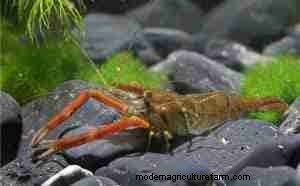
Both species reach 2–3 inches (5–7.5 cm) in length and weigh 3–7 g. The carapace is translucent with a characteristic red‑clawed appearance. Juveniles are typically brown or creamy; mature individuals display a range of hues – blue, light straw, or brown – with bright pink spotting on the body and distinctly red tips on the walking legs.
There is no documented maximum lifespan for wild populations, but properly cycled aquaria can support individuals up to 3 years. A well‑maintained environment, stable temperature, and regular feeding are critical.
Red Claw Shrimp are unmistakably aggressive and territorial. They are not suited to high‑density community tanks; they tend to prey on small shrimp, snails, and even small fish. Their aggression is amplified by the fact that they grow quickly and become more dominant with size.
They are nocturnal, becoming most active during dusk and nighttime, which aligns with their “protect‑your‑niche” strategy.
Key traits:
As omnivores, they consume a broad spectrum of food. In the wild, they exploit detritus, diatoms, algae, worms, and even small fish. In the tank, they thrive on:
They can be fed 3–4 times a week as adults, but juveniles may need up to 4–5 feedings daily.
Because they are “trophy” eaters, any excess food quickly degrades water quality; plan feedings accordingly.
While not as destructive as true “crustacean” species, Red Claw Shrimp can still nibble on plant tissues. For plants that can tolerate a little wear, consider plastic or floating plants, and hardy options like Anubias or Java fern. The best strategy is to keep them in a tank that accommodates their aggressive nature.
These prawns have a classic four‑stage life cycle: egg, larva (zoea), post‑larva, and adult. Males mature at about 5 months, achieving a mature size of ~2 inches (5 cm). Females, by contrast, reach sexual maturity at a slightly smaller size.
They are highly fecund – egg counts range from 13–102 for assamense and 43–195 for dayanum. Successful breeding in aquaria requires stable water conditions, a quiet environment, and a well‑structured tank layout.
Maintain a separate “grower” tank for offspring to prevent cannibalism. The ideal breeding tank should be:
Eggs hatch in 1–2 hours and the larvae become immediately active. Feed them daily with newly hatched brine shrimp or live feed.
Given their territorial behavior, it is best to keep Red Claw Shrimp in isolation or in a dedicated “male‑and‑female” setup. If you wish to combine them with other species:
Do not house them with:
First, always cycle your tank before adding any Red Claw Shrimp. A stable nitrogen cycle ensures they are not exposed to lethal ammonia spikes.
Use a sponge or matten filter to provide gentle water flow and excellent surface area for biofilm. The shrimp feed on this biofilm, so a clean filter is essential.
Lighting is flexible – if you have a planted tank, match the light intensity to the plants. Because the shrimp are nocturnal, they do not require bright lighting.
Substrate choice is crucial. A rocky or gravel base not only mimics their natural habitat but also limits the shrimp’s line of sight, reducing aggression. This can also help protect your fish during the day.
Hiding spots are non‑negotiable. Provide PVC pipes, driftwood, or artificial plants for them to retreat to, especially during stressful moments.
Acclimate slowly – 2–3 hours is usually sufficient – to reduce shock and preserve water chemistry.
Red Claw Shrimp are beautiful, high‑fecundity prawns that demand attentive care due to their aggressive nature. With the right tank setup, careful feeding, and regular maintenance, they can be a captivating addition to a well‑managed freshwater aquarium.


