The Ghost Dwarf Crab is a rare, freshwater species prized by aquarists for its translucent appearance and peaceful nature. Though only a handful of captive reports exist, this guide compiles the most reliable information on its care, diet, and compatibility.
Quick Facts
- Scientific name: Potamocypoda pugil
- Common name: Ghost Dwarf Crab
- Recommended tank size: 10 gallons (≈40 L) – a 5‑gallon tank can accommodate 4–6 individuals, but larger tanks provide more stability.
- Life span: 2–3 years in captivity (wild data not available)
- Carapace size: 0.4–0.6 in (1–1.5 cm)
- Leg span: 1–1.3 in (2.5–3.5 cm)
- Optimal temperature: 75–82 °F (24–28 °C)
- pH: 7.0–7.5
- GH: 3–12
- KH: 1–5
- Maximum nitrate: <20 ppm
- Diet: Omnivorous scavenger
- Temperament: Peaceful, low‑activity, social
- Color: Olive‑brown carapace, yellow‑brown limbs
Why the Name “Ghost Dwarf Crab”?
The name reflects the crab’s small, almost translucent carapace and its nocturnal habits that make it seem invisible during daylight. The species is native to Malaysia’s eastern Johore swamp forests, particularly the shallow, vegetated streams of the Sungai Kayu tributary of the River Sedili.
Physical Description
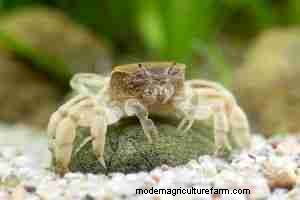
Fully grown crabs reach up to 0.4–0.6 in in carapace length and 1–1.3 in in leg span. Key distinguishing features include a broad, slightly convex carapace, olive‑brown coloration, small slender eyes, moderately hairy walking legs, and males with asymmetrical chelipeds.
Behavior and Social Needs
- Mostly aquatic but can climb onto land; provide elevated perches (e.g., driftwood) to support molting and reduce stress.
- Non‑aggressive; conflicts are rare and usually harmless.
- Shy and skittish in small groups; larger colonies feel more secure and are more active.
- Nocturnal – most activity occurs from dusk to dawn.
- Not destructive; minimal substrate disturbance.
- Social: thrives in groups; solitary individuals may feel stressed.
Feeding Guidelines
As omnivorous scavengers, Ghost Dwarf Crabs thrive on a varied diet that mimics natural detritus consumption.
- Vegetables: blanched leafy greens (e.g., spinach, lettuce), peas, zucchini.
- Seeds: sunflower, pumpkin, chia.
- Algae: natural growth on rocks or artificial wafers.
- Protein sources: crushed snails, blackworms, bloodworms, brine shrimp, chopped fish or shrimp (dead or fresh).
- Pellets: shrimp or fish pellets that sink, such as TetraMin® flakes, Hikari Shrimp Cuisine, or algae wafers.
Rotate foods weekly to avoid over‑protein feeding. Feed at dusk or early evening to align with their natural feeding times. Remove uneaten food after 24 hours to maintain water quality.
Tankmates and Compatibility
Ghost Dwarf Crabs are peaceful and tolerant of most small, slow‑moving fish and invertebrates. Recommended companions:
- Guppies, Neon Tetras, Endlers, Danios, Least Killifish.
- Small shrimp or snail species (avoid large or fragile species that may be attacked).
- Freshwater snail species (watch for potential predation on tiny snails).
Avoid:
- Large or aggressive fish that could nip them.
- Bottom‑dwelling or long‑finned species that might be injured during molting.
- Crayfish or other freshwater crab species.
- Dwarf frogs or other amphibians (tetrapod by‑products).
Maintenance and Water Quality
Ghost Dwarf Crabs are classic “treat‑y‑old‑species.” A stable environment with the following parameters ensures optimal health:
- Temperature: 75–82 °F (24–28 °C)
- pH: 7.0–7.5
- Hardness: GH 3–12, KH 1–5
- Mandatory mandatory aquarium cycling before introduction.
- Gentle flow and good aeration; sponges or mat filters are ideal for small tanks.
- No special lighting requirements, but must support obligate live plants if desired.
- Provide ample hiding places: driftwood, rocks, PVC pipes, leaf litter.
Reproduction and Breeding Challenges
Potamocypoda pugil is a sexually dimorphic species, but specific breeding data remain undocumented. To date, no successful captive breeding has been reported, and the species is considered difficult to breed.
Key Takeaways
- Ghost Dwarf Crabs are rare, low‑maintenance, and social.
- They thrive in warm, stable environments with adequate hiding spots.
- Provide a varied diet and avoid over‑feeding.
- Choose compatible, peaceful tankmates and maintain excellent water quality.
References
- 佐々木潤. “観賞用に 「ゴーストクラブ」 という商品名で流通していた Potamocypoda parapugil Tai & Manning, 1984 (十脚目: 短尾下目: スナガニ上科: コメツキガニ科).” Cancer25 (2016): 41-45.
- Tweedie, Michael Willmer Forbes. “A new scopimerine crab from the Malay Peninsula.” Bulletin of the Raffles Museum 14 (1938): 198-202.
- Dai, Aiyun and Manning, Raymond B. 1984. “A New Species Of Potamocypoda (Crustacea, Brachyura, Ocypodidae) From Malaysia.” Proceedings of the Biological Society of Washington 97: 615-617.


