
Welcome to Modern Agriculture!

Tilapia fish farming is a very profitable business and popular throughout the world. It is a very common fish species throughout the world, and it is economically most important species.
Tilapia is actually the common name for nearly a hundred species of cichlid fish from the coelotilapine, coptodonine, heterotilapine, oreochromine, pelmatolapiine and tilapiine tribes.
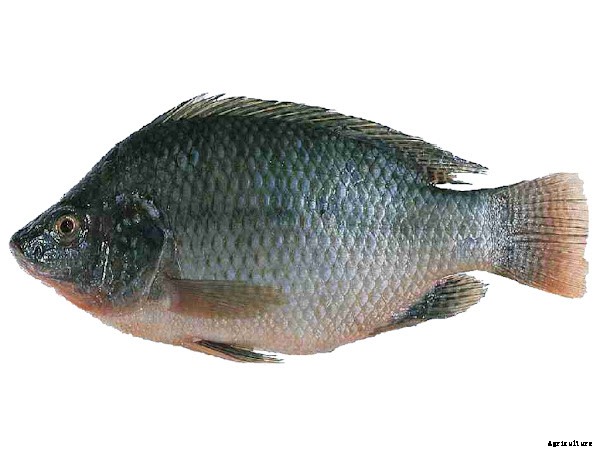
Tilapia fish generally have laterally compressed, deep bodies. Like other cichlids, their lower pharyngeal bones are fused into a single tooth-bearing structure. A complex set of muscles allows the upper and lower pharyngeal bones to be used as a second set of jaws for processing food, allowing a division of labor between the “true jaws” (mandibles) and the “pharyngeal jaws”.[1]
This means they are efficient feeders that can capture and process a wide variety of food items.
Mouth of the tilapia fish is protrusible, usually bordered with wide and often swollen lips. The jaws have conical teeth.
Generally, the tilapia fishes have a long dorsal fin, and a lateral line which often breaks towards the end of the dorsal fin, and starts again two or three rows of scales below. Some Nile Tilapia fish can grow as long as 2 feet.
Currently, tilapia fish is available throughout the world. They are able to adapt themselves to a very wide range of conditions.
In the year of 2002, tilapia fish was the fourth-most consumed fish in the United States. Main reasons of such popularity of this fish includes; low price, easy preparation and mild taste.
And the tilapia fish has become the third most economically important fish in aquaculture after carp and salmon. Worldwide production exceeded 1.5 million metric tons in the year of 2002, and increases annually.
Because of the high protein content, large size, rapid growth rate and palatability of tilapia fish, they are the focus of major aquaculture efforts. Currently, commercial tilapia fish farming is a very popular business in most area around the world.
Tilapia fish is a lean source of protein and also a good source of various vitamins and minerals. In a serving of 100 grams, it packs 26 grams of protein and only 128 calories.
Tilapia is a great source of some minerals and vitamins. It is rich in niacin, vitamin B12, phosphorus, selenium and potassium. However, a 100 grams serving contains the following:
However, here we are trying to describe more information about the health benefits of consuming tilapia fish.
Tilapia fish farming is very common throughout the world. It is a very profitable business. However, there are many advantages of starting tilapia fish farming. Here we are trying to describe about the top advantages of this business.
Starting tilapia fish farming is very easy and simple. Tilapia is a fast growing fish species, and diseases or other problems are relatively less.
You don’t need much knowledge to start this business, even the beginners can also start growing them. However, here we are trying to describe more information about commercial tilapia production.
First of all, you have to select a very good location for your farm. It will be better if the selected land is far from residential area. Selecting a calm place which is free from noises will be good.
After selecting a good location, determine the systems of growing tilapia. You can start growing tilapia in a variety of conditions. You can start growing tilapia fish in ponds, cages, raceways and also in tanks.
Currently some people are also growing this fish in trash cans. But for commercial production, you have to choose either ponds or tanks.
Exact number of the ponds or tanks for commercial tilapia fish production depends on your budget. It can be one or several tanks or ponds.
You can start growing tilapia fish either in earthen pond or in tanks. The tanks or pond can be of any size or shape depending on your budget.
In case of growing tilapia in earthen pond, the size can be any. But the depth should be around 1.2 meter.
Contact with an expert in your area if you are willing to start growing tilapia fish in tanks.
Naturally tilapia fish can be found in ponds, lakes, marine habitats, watercourses, estuaries and seafaring conditions. They generally grow well in tropic conditions with water temperature ranges between 25°C and 30°C. Some varieties can also tolerate cold temperature down to 8°C to 9°C.
Controlling water quality is very important for commercial tilapia fish farming business. Tilapia fish can survive in dirty water. But you don’t want to produce harmful or poisonous fish in your farm, right?
Bacteria, viruses, pathogens and other infectious organisms are harmful to the human body. So, you should avoid dirty water. Always ensure fresh and good quality water.
There are numerous tilapia species available throughout the world. But all of these species are not good for commercial production. Some common, popular and economically important tilapia fish species are;
How much fish can I stock in my pond? It’s a very common question, especially for the people who want to start this business. Let us explain this.
Suppose, you have a pond measuring 40 meter long and 20 meter wide, and a water depth of 1.2 meter. Such a pond can hold around 960 cubic meters of water.
Now, you can stock around 10 tilapia fish per cubic meter. So, your 800 square meter pond with 1.2 meter depth is ideal for stocking and growing 9600 tilapia fish.
Feeding the fish with very good quality and nutritious food is very important. Exact amount of food can vary depending on species, growing conditions and many other factors.
On an average, for commercial production, 1.7 kg food is required for producing and harvesting 1 kg of meat.
Currently, there are many companies available producing commercial feeds for the farmers. You can use such commercial feeds for better production.
Although, you can feed the fish with homemade pellets. You can use rice bran, oat groats, corn, canola meal, alfalfa meal, linseed meal and some vegetables.
Tilapia fishes are naturally very good breeders. They will breed easily and produce fingerlings if you give them the scope to do so.
Taking good care of the fish is very important for proper growth and maximum production. Along with feeding them good quality food, always try to take good care of them. Try to maintain water quality. And also check their health on a regular basis.
You can expect to harvest fish when they reach harvesting weight. It’s actually not possible to tell the exact time, it’s actually depend on the species and some other factors.
For large species, you can start harvesting when the fish reach around 400 grams body weight. You can use common harvesting methods for catching all fish.
After harvesting, sort the fish depending on their size. And try to sell as soon as possible. Live tilapia fishes have very good demand.
Marketing tilapia fish is very easy, because it has good market throughout the world. So, you don’t have to worry much about marketing. Probably, you will be able to easily sell your products in the local market.
These are the steps and ways for starting and operating a successful tilapia fish farming business. Hope this guide has helped you! Good luck & may God bless you!


