
Welcome to Modern Agriculture!

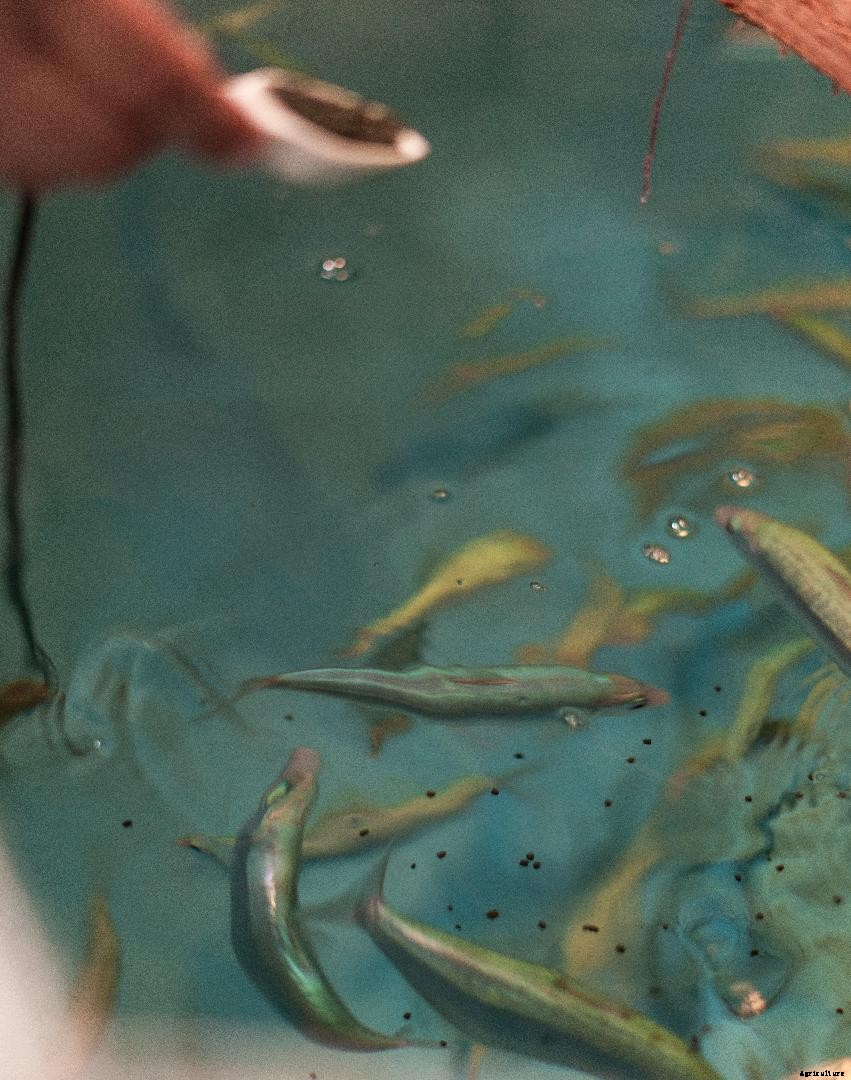
Salmonid aquafeed have evolved over the last decades to meet the increasing sustainability standards requested to the sector, with the replacement of fish meal and fish oil with alternative protein and oil sources, or the decrease of nutrient waste loads into vulnerable water bodies as regards the eutrophication process, all good examples.
Within this context the protein sparing concept was widely adopted in the salmonid aquafeed formulation with increasing fat content, promoting its use as the main energy source and allocating the protein for muscle accretion.
In the case of the rainbow trout, current standard feeds have fat levels of around 25 percent when compared to what used to be a standard of 16 percent fat content feed, improving among other aspects, the feed conversion efficiency and the protein efficiency ratio for trout production. For high-performance trout RAS farms, the available commercial feeds can include fat levels up to 32 percent.
A precise evaluation of the aquafeed suitability for the particular farming conditions, namely temperature profile, is of paramount importance in order to leverage the nutrition knowledge and R&D to optimise fish feeding and economic feed conversion rates (FCR). This is highly relevant for RAS farms whereby production optimisation implies a balance between fish growth, feed efficiency and water quality.
FEEDNETICSTM is a web-application developed by SPAROS that includes a mechanistic nutrient-based model that predicts fish growth and composition at all times by using information on temperature, feed intake and feed properties.
The model has been calibrated with highly variable data and is currently available for Gilthead seabream, European seabass, Rainbow trout and Nile tilapia. Further validations can be provided upon request and pending on data availability. The validation charts shown in Figure 1 illustrate the model robustness for this use case.
In this work we illustrate the difference in performance of three relevant trout feed concepts (low, medium and high energy feeds, detailed in Table 1) using the FEEDNETICSTM virtual environment. Similar aquafeed performance evaluation can be carried out by the aquafeed customer support teams and nutrition researchers using the FEEDNETICSTM web-application.
Farming conditions and feeding regimes
For this application we have considered trout harvest size of one kilogram and the following typical trout farming conditions: initial stock of 15,000 trout of 50g, mortality rate of one percent per month, and two scenarios of water temperature, a reference ranging between 13°C and 18°C with an average around 15°C and a lower temperature profile (2°C lower than the reference).
The aquafeeds to be evaluated for each temperature profile are representative of a low-, medium- and high energy trout feed as detailed in Table 1.
The generated feeding tables estimate the feed quantity that meets the energy and protein requirements for the rainbow trout. Feeding tables should be generated per feed and growth curve of each farm, in order to optimise feeding.
Evaluate different rainbow trout feed concepts
The objective of this application is to compare the performance of the three feed concepts (detailed in Table 1) under two temperature profiles, by quantifying days in production, feed conversion, protein efficiency retention and nutrient wastes.
As expected, the Low energy feed (16 percent crude lipid) exhibited a higher FCR of 1.1 and larger N and P loads per volume of fish produced are predicted when compared with the Medium energy (is about 41 percent lower for N and 20 percent lower for P) and High energy (is about 60 percent lower for both N and P) feeds.
For the specific simulated conditions, the indicators shown in Figure 2 suggest the High energy feed exhibits a better performance, except for the economic conversion ratio which accounts only for the feed costs to produce a kg of fish. If the feed costs are the main criteria, the Medium energy feed is the most suitable choice.
Despite this, an additional 0.6 ton of Medium energy feed are required to produce around 14 ton of trout, when compared with the High energy feed, the lower feed price (Table 1) makes it more profitable to use the Medium energy. However, the High energy will allow to reach the harvestable size sooner (16 days), with a lower FCR, and lower N and P loads (less 14 and 33 percent, respectively). If these criteria represent a restrain for the farm management then the High energy might be a better choice.
The performance of the different feed concepts at different temperatures
It cannot be overstated that each case is unique, and the conditions of for instance feed price, rearing temperature, commercial harvest size and feeding tables among other, will affect the feed evaluation outcomes. To illustrate this point in Figure 3 the prediction outputs when considering the same feeds and farming conditions but different temperatures, are presented.
The overall trends are the same but differences between feeds become much larger regarding the days in production, feed conversion, protein efficiency retention and nutrient wastes, whereby the Low energy performance decreases with FCR going up to 1.6. In the case of the lower temperature scenario, the economic conversion of the High energy feed becomes better than the low energy feed.
High energy performance relative to the medium energy increases regarding days in production, FCR, total feed spent, protein efficiency and nutrient wastes, nevertheless the economic conversion still favours the medium energy feed, for the conditions simulated herein.
Ease of growth performance comparison
As illustrated in this work, mechanistic nutrient-based models, such as FEEDNETICSTM, allow comparison of aquafeed formulations regarding its impact on growth performance, body composition, wasted nutrients and overall production performance.
is highly relevant for aquaculture industry in general and feed manufacturers in particular to provide customer support regarding the comparison of feeds under specific client conditions.