
Welcome to Modern Agriculture!

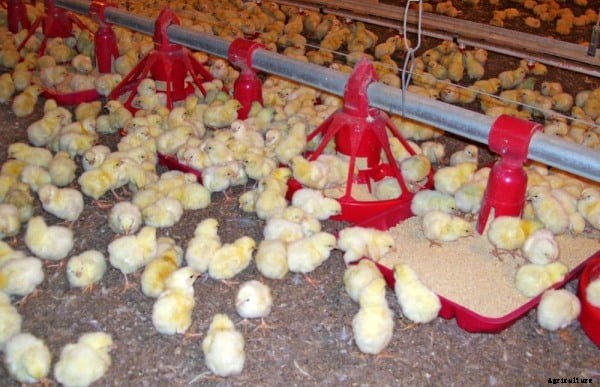
Poultry meat is an important source of proteins, minerals, and vitamins to balance the human diet. Specially developed varieties of chicken (broilers) are now available with quick growth & high feed conversion efficiency. Depending on the farm size, broiler farming can be the main source of family income. Poultry farming includes raising of various types of domestic birds commercially for the purpose of meat, eggs and feather production. The most common and widely raised poultry birds in the world are chicken. Again, these may be broiler chicken or layers. Commercial chicken farming is the most successful business in Asia and other parts of the world. Proper care of birds and farm management practices will result in decent profits in a short period of time. Basically, Broilers are raised for meat purpose whereas layers for egg production. Farmers can even go for back yard chicken farming or country chicken raising at home. Apart from meat and egg production, manure that produced in the farm has good market value. This manure can be used as organic compost in various field crops. If you are planning for a poultry farm on a small scale or large scale, first you should make a perfect plan that involves building sheds/housing to marketing. Follow the standard methods, visit some nearby poultry farms and make a note of their practices which will really help you in setting up a farm and succeeding. In this article, let us discuss broiler chicken farming.
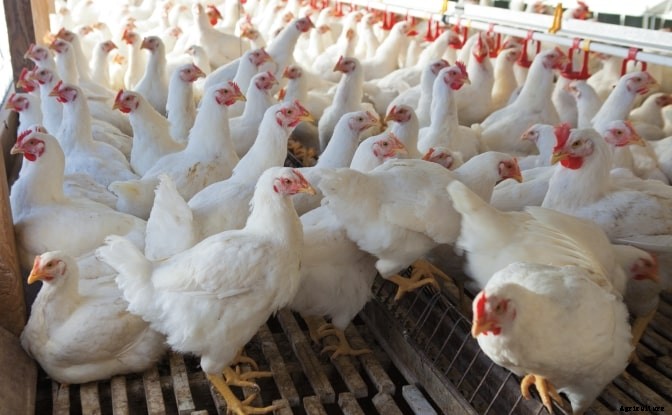
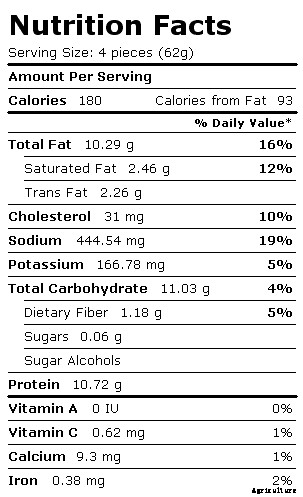
The following are some of the health benefits of consuming chicken.
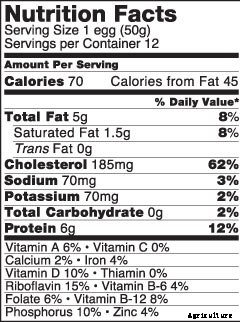
Nutritional Facts of Eggs
The Following are Top 10 producers of chicken in the world.
1. China.
2. The United States.
3. Indonesia.
4. Brazil.
5. India.
6. Mexico.
7. Russia.
8. Japan.
9. Iran.
10. Turkey.
Andhra Pradesh, Telangana, Tamil Nadu, West Bengal, Bihar, Maharashtra, Punjab are major poultry production states in India.
Local Names of Poultry in Asia:- Murġā (Urdu), 닭,Dalg (Korean), Kukhurā (Nepali) , دجاجة dajāja (Arabic), Manok (Filipino),ไก่,Kị̀ (Thai), gà (Vietnamese), ニワトリ, Niwatori(Japanese), කුකුළු පැටව් (Sinhalese, Sri Lankan), Курица (Russian), Tavuk (Turkish), Ayam (Malay), مرغ خانگی (Persian), 鸡 (Taiwanese), Murgi (Hindi, Indian).
Local Names of Poultry in India:- Murgi (Hindi), Kodi (Telugu), கோழி, kozhi (Tamil), കോഴി (Malayalam), Koonkaad (Konkani), Murgi (Punjabi),କୁକୁଡାଛୁଆ, kukudachhua (Oriya), Kukura (Assamese), koLi (Kannada), Komdā (Marathi), Muragi (Bengali).
Other than chickens, the following birds come under poultry group.
Well, there are many advantages of poultry farming, because of these benefits, many farmers across the world going the commercial poultry farming.
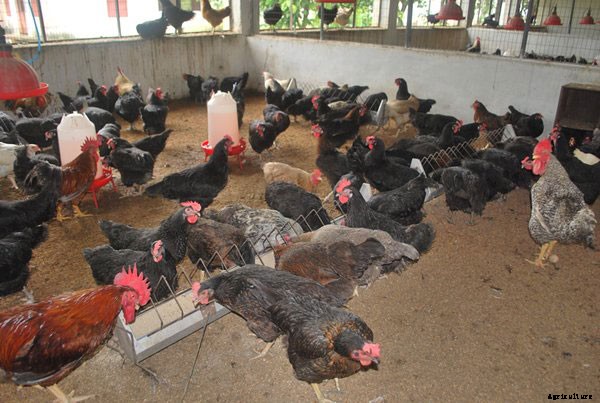
Main Requirements For Poultry Farming:
If you are planning for a commercial broiler farming, make sure to have enough land to build housing or sheds with ample clean water. Budgeting for initial set up is very important as this will be helpful to save some money in the initial stages. Make sure to have a good transport facility and it is better to build a farm near to local markets. Poultry farming equipment can be bought in second-sale to save some bucks. A proper plan is required with all mandatory things to be included. Daily labor is needed for farming work.
In case of going for a bank loan or applying for any scheme, contact the nearest bank for poultry loan and procedure. There are some financial and technical requirements to meet bank loan approval.
In many places, contract farming is available where they provide everything from feed to vaccination and wholesale purchase under one roof. The farmer has to provide only housing, water, power and a person to work there. They pay per kg of meat for every batch. This is very good for people who don’t want to take much risk and requires low investment.
Good and suitable housing play a prime role in raising all types of poultry birds. Some birds grow and live happily in the floor of poultry house and some in cages. Depending on the birds, you have to make a suitable house for your birds. Consider the following factors while building a poultry house or shed.
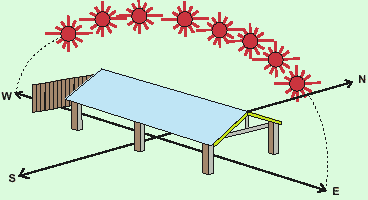
Always keep sufficient space in your poultry house, depending on the birds. So that your birds can live, grow and produce happily. Should never over-dense the poultry house and house must have a good ventilation system and should have sufficient flow of fresh air and light inside the house.
If you are planning for commercial poultry production, should consider keeping the proper distance between one house to another. It is recommended to clean the house and equipment on a regular basis and sterilize the house before bringing new birds/chicks into the farm. Make sure to have steps for preventing all types of predators and harmful animals. Temperature management is very important so that your birds do not suffer by excessive heat or cold. House or shed should have proper drainage system inside so that the cleaning of the house would be easy.
Establish your farm in a calm area and make sure the transporting bird’s without any hassle.
The main equipment needed in poultry farming for both layers and broilers is given below.
The poultry birds which are raised for egg production are called layers. A commercial hen generally starts laying eggs at the age of 12 to 21 weeks. They start laying eggs regularly at their 25 weeks of age. After 70 to 74 weeks of age, egg production of layer birds gets reduced. For commercial layer poultry farming, farmers generally keep the hens for 12 months from their first laying period. And then sell them for slaughter (meat) purpose. For commercial egg laying poultry farming systems, the environmental conditions are often automatically controlled by the producers. For a simple example, the presence of light helps the bird for laying eggs earlier. So, the producers should provide more lightening period to increase the probability of beginning of laying eggs. Usually, the egg-laying birds lay more eggs in warmer months than the cold months. So, it is recommended to keep the temperature of the room moderate will be very helpful for better egg production. Some commercial layer chicken breeds may produce more than 350 eggs a year. Layer poultry is raised in various methods of systems.
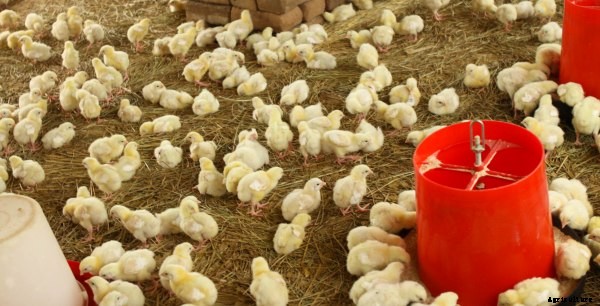
The birds which are raised for commercial meat production are called broiler poultry. By using intensive farming methods, broiler chickens become suitable for consumption within their 5 to 6 weeks of age. Deep litter is the common raising systems in commercial broiler poultry farming.
Broiler farming is preferred for the following reasons.
Usually, there are 4 systems followed in commercial poultry farming.
However, the most common system followed is Cage system and Deep litter system under an intensive system.
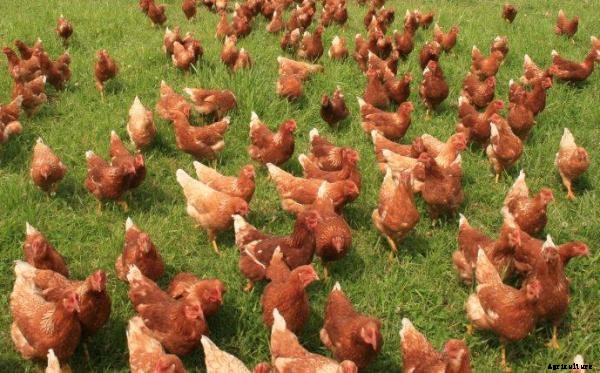
This method is the oldest one and has been used for centuries by general farmers. This is suitable where there is no shortage of land. In this free-range system, can find an appreciable amount of food in the form of herbage, seeds, and insects, provided they are protected from predatory animals and infectious diseases. Currently, nobody is using this system as a cage and deep litter system (intensive) has many advantages over this.
Generally, this system is suitable and adopted where the extent of free space available is limited, but it is necessary to allow the birds 20 to 40 sq.yards/bird of outside run. Wherever possible, this space should be divided giving a run on either side of the house of 10 to 20 sq. yards/bird, thus enabling the chickens to move onto fresh ground.
This folding system of housing is an innovation of recent years. In portable folding units, birds being confined to one small run, the position is changed every day, giving them fresh ground and air and the birds find a considerable proportion of food from the herbage are healthier. In this system, the disadvantages are that food and water must be carded out to the birds and eggs brought back, so there is some extra labor involved in the regular moving of the fold units. This increases the cost and maintenance of the farm. The most convenient folding unit suitable to handle is for 25 hens. Usually, a floor space of one sq.ft should be allowed for each bird in the house, and 3 sq.ft /bird in the run, so that total floor space to the whole unit is 4 sq.ft /bird, as with the intensive system. A suitable measurement for a folding house to take 25 birds is 5 feet wide and 20 feet long.
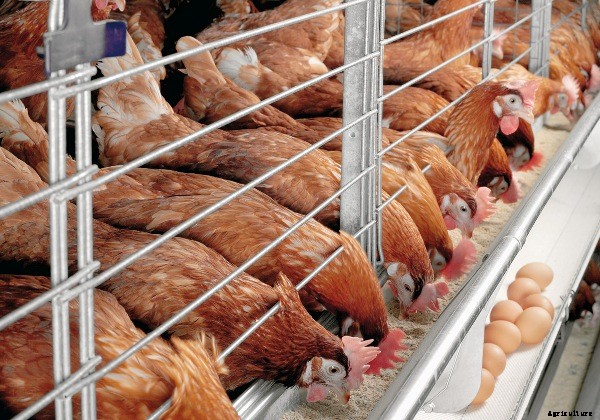
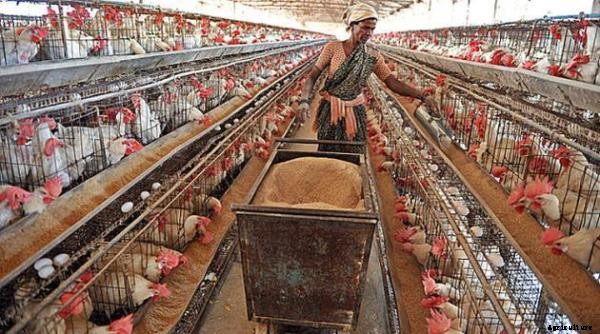
The cage system used in rearing birds has been considered as a super intensive system providing a floor area of 450-525 sq.cm. (0.6-0.75 sq.feet) /bird. In this system, the birds are kept in 1, 2 or 2 per each cage, arranged in single or double or triple rows.
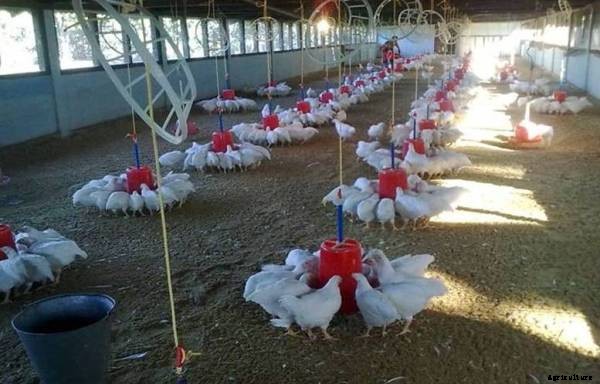
Consider the below points while adopting a deep litter system.
Spacing
in meters
Area in Hectares
Chicks age in days
Day-1, Day- 2, Day-3, and Day-4
Day -5
Day-6
Day-7
Day-8
Day-9
Day-10
Day-11
Day-12
Day-13
Day-14
Day-15
Day-16
Day-17
Day-18
Day-19
Day-20
Day-21
Day-22
Day-23
Day-24
Day-25
Day-26 onwards
Feed Weight in grams
20 gm/bird/day, 22gm/bird/day 24gm/bird/day, 26gm/bird/day
28 gm/bird/day
30 gm/bird/day
32 gm/bird/day
34 gm/bird/day
36 gm/bird/day
38 gm/bird/day
40 gm/bird/day
42 gm/bird/day
44 gm/bird/day
46 gm/bird/day
48 gm/bird/day
50 gm/bird/day
52 gm/bird/day
54gm/bird/day
54gm/bird/day
56gm/bird/day
58 gm/bird/day
60 gm/bird/day
62 gm/bird/day
64 gm/bird/day
66 gm/bird/day
68 gm/bird/day
Body Weight gain/day
45 – 55 gms, 55 – 95 gms, 95 – 135 gms, 135 – 175 gms.
175 – 215 grams.
215 – 255 grams.
255 – 295 grams.
295 – 335 grams.
335 – 385 grams.
385 – 425 grams.
425 – 465 grams.
465 – 505 grams.
505 – 545 grams.
545 – 585 grams.
585 – 625 grams.
625 – 665 grams.
665 – 705 grams.
705 – 745 grams.
745 – 785 grams.
785 – 825 grams.
825 – 865 grams.
865 – 905 grams.
905 – 945 grams
945 – 985 grams
985 – 1,025 grams
1,025 – 1,045 grams.
The minimum requirements for protein, calcium, and phosphorus in poultry feeds are shown in the below chart. Remember, chickens raised for egg production are fed pullet-type diets, not broiler diets, regardless of being from broiler or egg-type.
Minimum
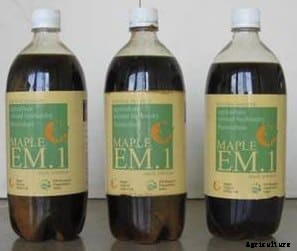
Effective Micro-Organism (E.M) is a brown color concentrated liquid produced from the cultivation of 80 strains of beneficial microorganisms collected from the natural environment.
What are the advantages of E.M. Technology in livestock production or in poultry farming?
E.M. in Broiler feed on a daily basis:
Age of birds E.M. Bokashi 01 – 07 days 30 grams/ kg feed 08 – 14 days 20 grams/ kg feed 15 days onwards… 10 grams/ kg feedE.M. solution should not be mixed with anti-biotic, disinfectants / chlorinated water. Contact any agriculture university or department of agriculture for detailed feed and nutrition requirement in poultry farming.
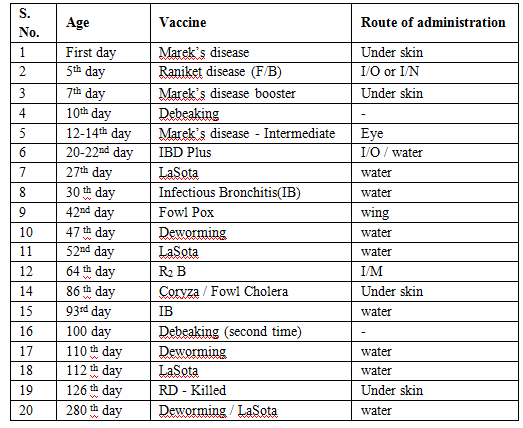
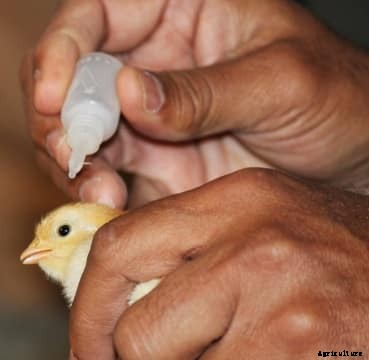
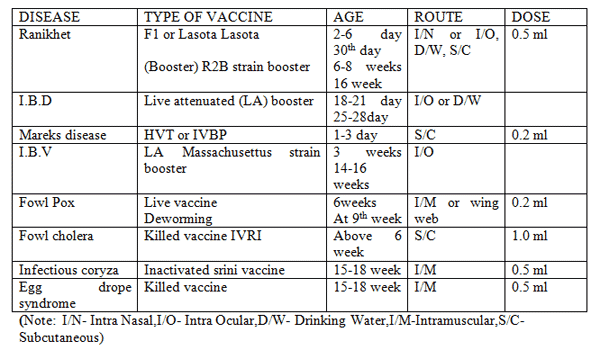
The Following chart shows the chart for vaccinations in chicken.
Diseases in Poultry Farming:
For diseases , symptoms and their control measures, click here.
Loan or Scheme For Poultry Farming:
Check with local banks about poultry loan procedure. Most of the banks or financial institutions have certain guidelines to meet the loan eligibility requirement. Farmers should meet some technical and financial parameters to get the loan or scheme approved.
Marketing of poultry products is very easy as they can be sold in the nearest markets or can hire any local agent to market the products. Large scale commercial poultry farms are approached by local/national chicken companies as well. Most of the regions in Asia have established markets for poultry products.
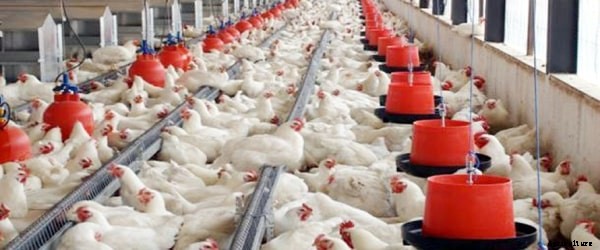
Practicing good farming methods, daily care of birds, visiting nearby poultry farms, watching poultry farming videos in YouTube, getting training in poultry farming, getting tips and ideas from agriculture departments will be helpful in succeeding in the commercial poultry farming business.
For Quail Bird Farming: Read here.
For Sheep or Goat Farming: Read here.
For Indian Agriculture Guide: Read here.


