
Welcome to Modern Agriculture!

The origin of the Cashmere goat is due to the shepherds of the Chinese interior migrated towards the Indian region of Kashmir. The most exquisite variety is known as pashmina a scarf made with the wool of cashmere goat. Indian and Iranian merchants introduced cashmere fabrics into Roman markets 2,000 years ago. In nineteenth-century Europe, this wool became fashionable among the social elite.
The Scottish firm Johnstons was one of the pioneers. In fact, Scotland today produces and produces the most prestigious cashmere fabric of the Old Continent from Asian goats that have acclimated to their mountains. Although the origin of the species is located in the Himalayas, it is in places like Mongolia, the land of blue skies, where it has been worked with more profusion.
There, the nomadic herders take care of their flocks throughout the year, taking them through wide meadows where animals graze freely.
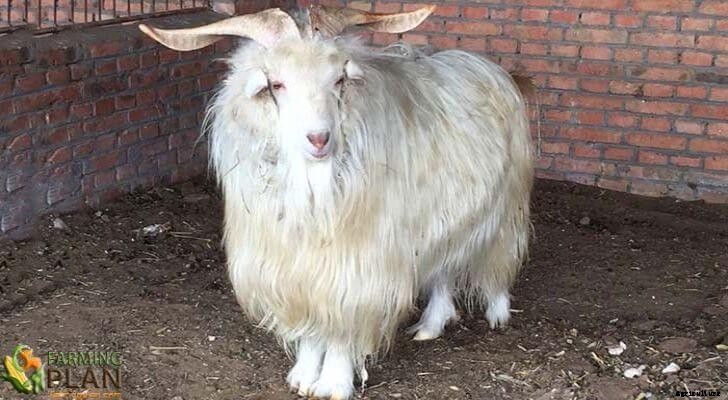
Cashmere goat is a species of herbivorous mammal of the goat family. Although it is not a species in itself, it is rather any species of goat that produces cashmere wool, a highly valued raw material. It is characterized by its extreme and pleasant softness and can be brown, cream, gray, or white.
This last color is the highest quality. Cashmere is found in the semi-desert cold areas of Asia, especially in Iran and the western provinces of Inner Mongolia. Although they are often found on different scales between gray and even black. Cashmere goat also has brown and curved horns ringed at the tip and base.
The cashmere goats develop a thin and smooth outer layer. Kashmiri goats are scattered in flocks over the Himalayan peaks, the highlands of Tibet, and the lunar landscape shared by China and Mongolia in the Gobi Desert. You May Also Like To Read Goats Breed.
The cold and the altitude, together with strong nutrition, give the hair a magnificent brilliance and a perfect shield when the thermometer goes down. Most of the animals live in levels close to 2,500 meters above the level and withstand temperatures that can reach 30 degrees below zero.
To protect themselves, they have developed two layers; external wool, thick, straight hair, a rough fiber that has a thickness between 15 and 19 microns (fractions of a millimeter) in diameter. Below it grows a delicate and short fluff, between 4 microns, product of an extra protein that their body generates depending on the rigors.
The colder and closer to the peaks, the finer the wool that produces cashmere goat. This inner coat is call pashmina, and the one that covers the neck is the most required to make sweaters, suits, and fashion accessories. This breed is shear in preferably in spring. After the harsh winter in which the animals develop their best coverage to protect themselves from the cold.
It is time to extract the animal’s fur. Most wool is obtained from areas such as the neck. And so get a fiber that is longer and softer than sheep’s wool. However, its production is more scarce. With the material from a single goat, there is enough to make a scarf and little else. You May Also Like To Read Boer Goat.
Cashmere goat lives in places with very strong climates. This caused the race to develop and grow eating exotic foods. However, they graze in open spaces. Its diet is base on herbs, plants, branches.
Cashmere goat is mainly used for the production of excellent quality wool. It has two layers of cashmere give elastic wools, strong and bright, which adapt to moisture and insulate as soft shields. The goat changes its hair in spring to face the following winter. It is at that precise moment when the wool can be collected. With absolute care. Because the authentic and indigenous cashmere or Kashmir is not wool shear but carte. This way this breed gets long hair and price.
Cashmere goat is very different from other similar fibers. It has a unique natural curl that gives it a special facility when it comes to turning it into a thread. That’s why it’s more natural to the touch has been less batter during spinning, and it shows. The combination of that particular shape with the diameter of the fibers is between 13 and 15 micrometers. You May Also Like To Read Saanen Goat.
What gives it, also, optimal conditions to develop a characteristic brightness. The most used is the two-strand yarn for its uniformity and strength. The softness, lightness and special touch are achieving with that confection that gives it sponginess and protection against cold.
With the help of this guide, you should be able to identify a cashmere goat and its wool. Whether it is for your home or business needs, you now know more about these animals than most people do! So what are you waiting for? Get on your way to finding that perfect cashmere goat today!


