
Welcome to Modern Agriculture!

Rabbit Farming is nowadays popular farming. Rabbit meat is soft, tasty and easily digested. Their skin is used in the manufacture of various objects. It produces soft and light wool. The rabbit’s own feces and urine are used as manure since they constitute a special fertilizer, very rich in phosphates and nitrates.
Even the viscera produces flour that is used to feed other animals. Newborn rabbits (neonates) are used in the manufacture of foot-and-mouth disease vaccines, as well as adult animals used as test animals and laboratory research.
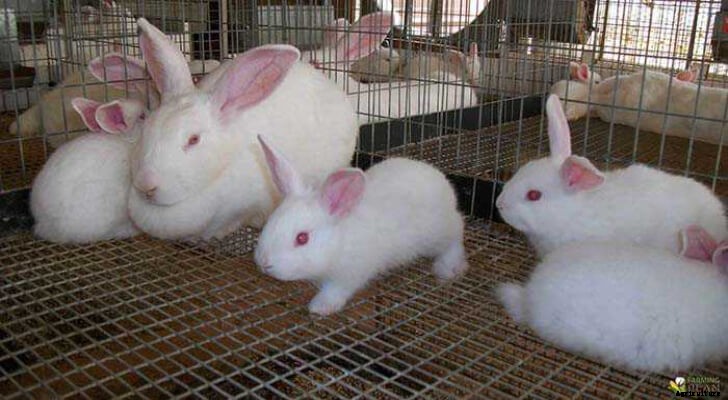
The breeding of rabbits has been recommended by international organizations, is a type of animal that has great advantages:
A single rabbit has a production similar to that obtained with Three sheep or goats, with one lamb or goat per year, each of 10 Kg channels.
There are more reasons for “enthusiasm” towards the production of rabbit meat, which the reader will unveil with the reading of this publication. You Can Also Read Rabbit Housing Here.
There are some points of management or care of the rabbit. They are very simple if we do not get or decide to do them correctly. The expected results can not be achieved. The originality of the physiology and etiology of rabbits requires that we have to take care of some minimum extremes of comfort, to avoid, as far as possible, the risk of diseases and low yields for long periods.
Failure to follow them would make their multiplication unviable. Hence it is essential, more than in other animals, to follow concrete and proven management patterns of years and years, to be able to be profitable to this prolific animal indefinitely.
The poorly recommended systems of raising rabbits in the yard, with leaves or leftover food, still seem an easy saving, can never be profitable, and because of the many casualties, interest is lost and a critical reaction to this type of Exploitation, and even against the consumption of rabbit meat.
The rural peasantry or urban suburbs can be safely started and in their own interest in rabbit farming. First, based on small operations of smallholding or homemade, so we call them “family packages”. Rather than planning, without previous practice and with difficult to repay loans, rabbits with greater volume. The size can already be reached, gradually, in the near future. (Here lies the advantage of such high ease of rotation of staff).
The smallest “family pack” is four rabbits, which requires eight “holes” (or cage spaces). Four holes for each of the four rabbits. One hole for the male, and the other three for rabbits Of fattening and recreate. Another package, more advisable to start, is one of 12 rabbits. That need 20 cages, the twelve for the rabbits, one for the male, and seven for the fattening and recreate.
This pack of 12 rabbits with 20 cages occupies less than 7m of a floor. It can be attached to a wall occupying. For example, 80 cm background by 8m long, and only one meter high. These twelve rabbits will produce as much meat a year as a herd of 30 sheep or goats.
Following the basic recommendations, benefits can be gained over the years. But something must be invested, especially in cages, as they are absolutely necessary. Raising rabbits on the ground, and we must repeat it. Consuming roots and green leaves and by-products without control is not recommended at any level. The same can be said of cages made of pieces of old wood and chicken coats.
Once you are interested in starting, or expanding, or simply improving, a small rabbit breeding operation. We must decide how many rabbits we are going to need weekly for consumption and which we will put on sale, and how we will do it. Once this amount has been decided, multiplying by 52, we will know the annual forecast.
It is a mistake to foresee the production first and seek the distribution or the consumers afterward. Rabbits produce many bunnies, but the number of viable rabbits depends on the four pillars of all livestock. Quality animals, good management, complete feeding, and strict sanitation. Therefore, production can range from 10 to 60 per year for each adult female, according to these four bases.
If you’re considering getting in on the rabbit farming game, consider our tips for reducing your sector’s impact on antimicrobial resistance. Already well-known as a valuable source of meat, rabbit farming is forecast to continue its growth in response to the growing food needs of an expanding population. With that said, it can be challenging to ensure that any new farmers are aware of how they should handle their rabbits when it comes to preventing widespread antibiotic use. To help with this challenge, we hope this guide has helped answer some questions and given you good ideas about what steps you need to take if you want to get into this business! Good luck out there!
As A Reference: Rabbit Farming


