
Welcome to Modern Agriculture!


Jeff and Marcie Dell quickly move a polywire gate, stringing a few poles as they go. Flailing outstretched arms, they move their herd of goats across the driveway into a small paddock, host to a tangle of weeds. The first animals into the new field busy themselves by chewing their way into the stand of broadleaf weeds. Some stretch necks as high as they can, while others knock down stalks of Canada thistle, common burdock, and creeping Jenny.
Jeff and Marcie are trying out a lot of innovative things on their cattle ranch near Nisland, South Dakota – polywire fence, bale grazing, rotational grazing, irrigation systems, no-till, and goats.
They have to be creative, says Marcie, because the heavy, clay-based soil is a challenge. “We call it gumbo. It’s very difficult to get water to infiltrate into that soil. It likes to seal up on the top and shed water off.”
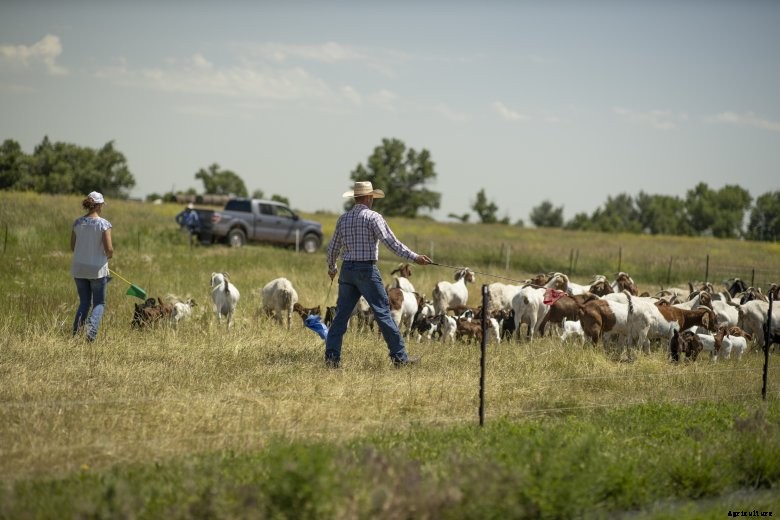
To improve the soil, they are using rotational grazing. That means noxious weeds have to be controlled. To that end, the Dells purchased a small herd of Boer meat goats. It worked. “We estimate that 60% of their preferred diet is weeds,” says Marcie. “They choose the grasses that our cows don’t want, so it’s a diversity win between the cattle and the goats.”
Goats roam and browse more than cattle, she says. “They don’t want to be in a small spot for too long.” The Dells move the goats into different paddocks every four to five days, using electric fence. “We run them in irrigation ditch areas and our canals and drains – places where the cattle don’t prefer to go,” Marcie explains.
“Part of the reason that we moved into raising goats was the need to create more diversity with our livestock,” says Marcie. “We thought adding the goats could have a financial benefit, too. It’s another crop we can sell twice a year, and now we’re growing more native grass. The goats are consuming what our cows aren’t eating, plus we don’t have to spend time and money spraying fields.”
You can run five goats to one cow when you’re grazing them, says Marcie, and “the monetary difference is about 200% percent vs. a calf. It’s significant!”
The goats are prolific, she explains. About 60% of the kids born are twins, and the other 40% are singles, triplets, or quads. “We’ve had a lot of triplets, and most of the mammas do a really good job raising triplets,” says Marcie.
The ranch is in the Belle Fourche Irrigation District Project, so water is delivered either through canals or pipeline. It takes 7 miles to get to the Dells’ house, and from there they use pivots, open ditches, or pipe to get to pastures. The irrigation pipe is gated pipe, so every foot to 18 inches there is a slot that opens and the water flood irrigates the land. “We found with the pipe we get a lot better coverage in a shorter time frame because we’re not having to soak up the open ditch and run it out the end,” says Marcie.
Marcie grew up on a dryland ranch, so irrigation was something new to her on their new place. “Being able to irrigate the fields throughout the year is super beneficial. There are definitely challenges that go with that because it takes a lot of time and work to water the different fields. We make sure our fields are irrigated, but not flooded totally, that the water’s draining, and that you’re spending time making the fields get the most benefit.”
Co-mingling the cattle and goats is a priority, says Jeff, who is looking out over the hungry goats chewing their way into the weed patch. “We would like to try to start grazing the cattle on a rotational grazing system with them, and follow with the goats. The undesirable plants that the cattle don’t want to eat, the goats will come through and consume. That will take care of the leftover weeds and other undesirable plants the cattle would never touch. We feel that cattle are putting down a heavier hoof impact on the land. They’re defecating and urinating on the land, and then the goats are coming through after eating a whole different group of plants. They have a different form of hoof impact.”
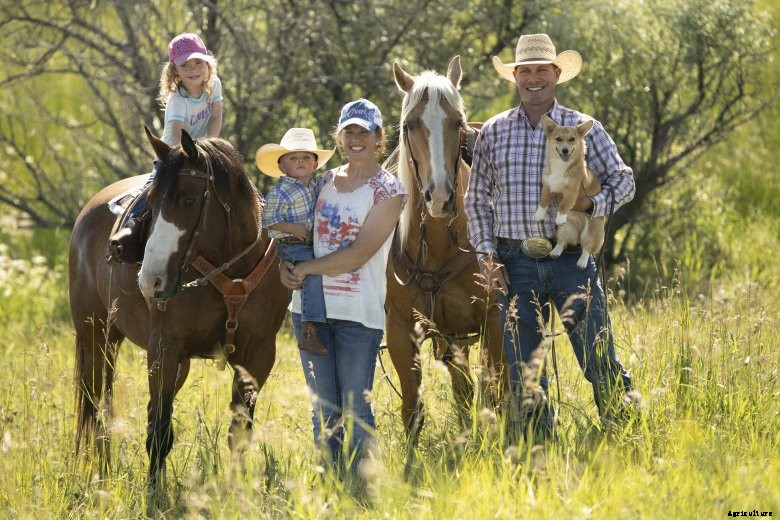
The Dells have two children, Mesa, 5, and Maxson, 2.


