
Welcome to Modern Agriculture!

Poultry is an important source of protein patronized by most people irrespective of their religious backgrounds.
Poultry species commonly raised for commercial purposes in Ghana are fowls/chicken, categorized as broilers and layers for meat and egg production respectively.
Contents hide 1 What is Broiler production 2 Management of Broilers 3 Biosecurity measures 4 Vaccination RegimeBroilers are birds kept purposely for meat. They are fast-growing and mature between 6-8 weeks.
Commercial broiler production is commonly managed under an intensive system. The preferred housing for broiler production is the deep litter.
| Broiler | Age in weeks | Ft.sq/bird | m.sq/bird | Birds/m.sq |
| Starter | 0-4 | 0.6 | 0.06 | 17.8 |
| Finisher | 5-12 | 1.25 | 0.11 | 9.1 |
Chicks require 1.3-1.5cm/chick (0.5-0.6inches) of trough space. As chicks grow, that is from 4 weeks, space must be increased to 2cm/bird (0.8inches) of trough space.
Chicks require 5cm (2inches)/chick of trough space. As chicks grow, space must be increased to 7.6cm. (3 inches) of trough space per bird.
Chicks are brooded for a period of 2-3 weeks in a hygienic environment to avoid infections.
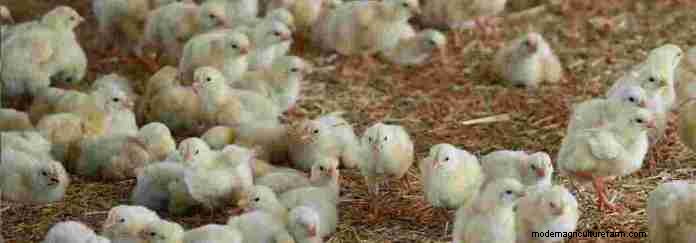
Birds are transferred from the brooder house to the growing house/pen at 2-3 weeks of age. Read more on how to prevent mortality during brooding of day-old chicks.
There are two types of feed for broilers; broilers starter from day old to 4 weeks and broilers finisher.
| Ingredient | Kg S.F | Kg S.F | Kg S.F | Kg S.F | Kg S.F | Kg F | Kg F |
| Maize | 60 | 50 | 60 | 54 | 60 | 40 | 58.5 |
| Fish meal | 19 | 20 | 18 | 19 | 16.3 | 20 | 22 |
| Brewer’s spent grain | 12 | 12 | – | – | 12.4 | 11 | – |
| Wheat bran | – | – | 15 | 10 | – | 13 | 8 |
| Rice bran | 8 | 7 | – | – | – | – | – |
| Oyster shell | 0.3 | 0.3 | 2.0 | 2.0 | – | 1 | 0.5 |
| Vitamin premix | 0.5 | 0.5 | 0.5 | 0.5 | 0.3 | 0.5 | 0.5 |
| Salt | 0.2 | 0.2 | 0.5 | 0.5 | 0.5 | 0.5 | 0.5 |
| Total | 100 | 100 | 100 | 100 | 100 | 100 | 100 |
S- Starter diet.
F- Finisher diet.
Feeding should be ad-lib (feed without limit).
Wash troughs with clean water and detergent daily. Provide a foot bath with disinfectant at the doorstep.
The poultry house and feed storage area should be kept free of rodents and wild birds. There should be good aeration and light in all poultry houses.
Avoid wet litter conditions as this promotes the growth of the infectious disease.
| Vaccination | Age |
| 1st Newcastle disease | 2nd week |
| Gumboro disease | 3rd week |
| Fowlpox | 4th week |
| 2nd Newcastle disease | 6th week |
If you encounter any challenges, please contact your district livestock/veterinary officer.
Reference: http://mofa.gov.gh


