
Welcome to Modern Agriculture!

Introduction: Hello farmers, we are back with a great informatin on integrated fish and duck Farming. Integrated fish farming is the system that blending of different compatible agricultural enterprises into a unified whole farming for the purpose of sustainability. It is a no waste, low cost and low energy production in which the by-products of one enterprise is recycled into another as input.
The integrated fish farming practices can utilize the waste from different components of the system that is duckery, poultry, piggery and various other agriculture byproducts for fish production. Raising ducks over fish ponds fits well with the fish polyculture system. The system is advantageous to farmers in several ways;
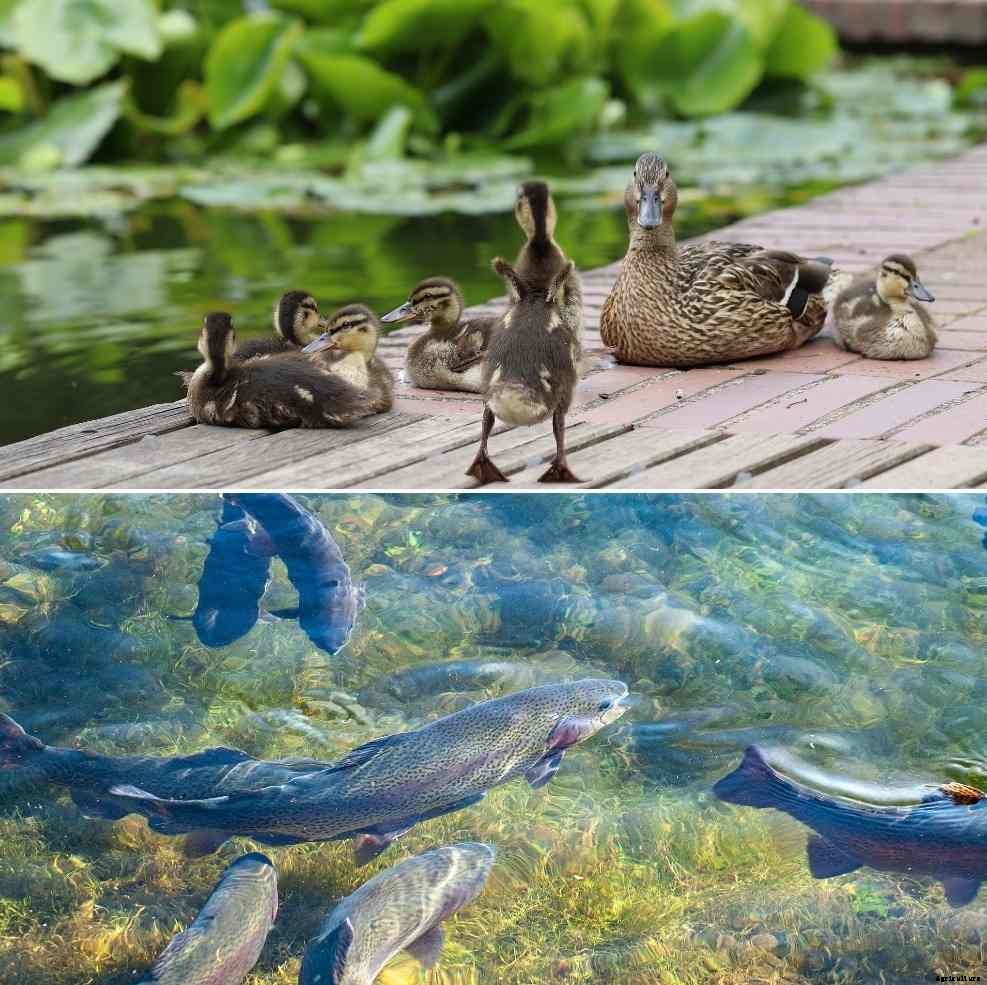
The suitable fish species for fish cum duck farming are those fishes that could filter and feed on phytoplankton, zooplankton, and bacteria from water. The integrated fish cum duck farming is to make maximum plankton in water through manuring which is rich in protein and also a natural feed for fishes.
Fish species selection for integrated system is very important, where the plankton feeder should be 60% and omnivorous should be 40%. A combination of six species that are, Catla (20%), Silver carp (20%), Rohu (20%), Mrigal (15%), Grass carp (10%) and Common carp (15%) must be stocked at density about 8000 to 8500 fingerlings/ha for the targeted production level of more than 3500 kg/ha. Such integration is suitable for rearing and stocking ponds where fishes are above 12 gm.
Depending on the feeding nature the fishes are divided into three categories they are;
An integrated system of fish both indigenous and exotic species are recommended. The indigenous species, for example, Mrigal, Kalabasu are detritivorous and common carp an exotic species which are detritivorous or omnivorous are a bottom feeder. Exotic species such as Grass carp which are herbivorous cover surface, column and marginal area of feeding zone.
You should not miss the Plant Nursery Project Report for Bank Loan in India.
Successful pond management is mainly the basis of profitable fish culture. Build the pond (about 1000 m²) near your house to enable you to take proper care of ducks and fish and to discourage poaching. Check the pond dikes and repair the damages. Deepen the pond so that it retains more than 1-meter depth during the dry season. Dry the pond and remove all the remaining fish stock from the pond by applying 15 kg bleaching powder and 15 kg urea/1 000 m². Urea and bleaching powder can be carefully applied one after the other and the dead fish netted out. Alternatively, 250 kg of Mahua oil cake can be applied which not only kills fish but also acts as pond fertilizer.
Apply 20 to 25 kg of lime about a week before manuring the pond. A mixture of bleaching powder and urea is applied to eradicate the predatory and weed fishes, then apply 5 to 10 kg of lime. Manure the pond with a basal dose of cattle dung about 500 kg/1 000 m².
The kind of duck to be raised should be selected with care since all the domesticated races are not productive. The most important breeds of Indian ducks are Sylhet Mete and Nageswari. The improved breed, Indian runner, being hardy is suitable for this purpose; they are not as good layers as exotic Khaki Campbell.
Ducks required for manuring of a one-hectare fish pond is a matter of consideration. About 200 to 300 ducks are sufficient to produce manure adequate to fertilize a hectare of water area under fish pond culture. About 2 – 4 months old ducklings are kept on the pond after providing them prophylactic medicines as a safeguard against epidemics.
Mostly fine rice bran and poultry feed (layers mash etc.) are used as duck feed at the rate of 100 to 120 gm feed/day/duck. Duck feed must be stored in a cool and dry environment to avoid growth mold producing aflatoxin. Inclusion of maize in duck feed can be avoided as it is rich in magnesium which will favor mold growth in a moist environment. Apart from that Duck weeds are fed to the ducks. Duck consumes tadpoles, juvenile of frogs, dragonfly larvae and various other organic materials. Protein content in natural food organisms of the ponds consumed by duck is very high. Then, the duck reared in fishponds saves the cost of protein substantially in duck feeds and gives more eggs in comparison to duck which is not allowed in fishponds. The leftover feed is given to the ducks and duck dropping fulfill 60 to 65% of the food requirements of farm fishes. Algal bloom could increase, and then duck dropping should be stopped periodically by using a plastic sheet at the bottom of the duck house and removed.
In the integration of fish culture with duck, supplementary feeding to the cultured fish is not required as duck excreta helps in fertilizing the pond water to generate fish food organism – phytoplankton and zooplankton. About 60 percent of the operational cost of farming goes for feed alone. So, the local availability of fed ingredients as well as their cost is important. Apart from that some fish such as- common carp take duck dropping directly as their feed. But the supply of feed to the herbivorous fish such as- grass carp, java puthi, etc is required. They need to be fed with grasses such as- Para grass, Napier or Hybrid Napier, banana leaves, chopped green cattle fodder, etc.
Duck-fish production systems can be divided into three types. They are;
This is the popular system currently practiced. Here, duck and fish are closely integrated through the bidirectional material flow. In the system, the duck shed is built on the pond dyke or above the fishpond. And some of the pond areas are enclosed with netting as a swimming area for the ducks. The swimming area is directly connected to the fenced playing ground on the pond dyke, which is connected to the duck shed.
This is another type of duck-fish production commonly practiced in the open water bodies in the three provinces. The duck shed is generally built on the river bank or lake/reservoir side. A certain area of water and land is fenced by netting and serves as playing ground for the ducks.
There are different duck-paddy-fish production systems. A closely integrated duck-paddy fish production is the combination of duck rearing with fish culture in paddy fields. The paddy field is modified for concurrent fish culture by digging peripheral and also central cross ditches. Fish stocking could be carried out before or after transplanting.
The duck shed is built on the broad ridge of the field and duck rising starts after the transplanted seedling turns green. Another duck-paddy system is practiced in a looser form. Ducks are raised in the duck shed on the pond dyke or bank of a lake, reservoir or river during most of the production period. After the paddy is harvested, the ducks are grazed on the paddy field in the daytime and then return to the duck shed in the evening time.
Harvesting of fish in integrated fish and duck farming
Keeping in view the demand of the fish in the market, partial harvesting of the table size fish is done. After harvesting partially, the pond must be restocked with the same species and the same number of fingerlings. Final harvesting will be done after 12 months of rearing.
Fish yield ranging from 3500 to 4000 Kg/ha/yr and 2000 – 3000 Kg/ha/yr are generally obtained with 6 – species and 3 – species stocking respectively. The eggs are collected every morning. After 2 years, ducks can be sold out for flesh in the market. About 18,000 to 18,500 eggs and 500 to 600 Kg of duck meat is obtained.
That’s all folks about duck dropping as manure for integrated fish and duck farming. You might be interested in Quail Farming Business Plan in India.


