Leghorn Chicken Facts, Profile, and Characteristics
Leghorn Chicken Information Guide:
Leghorn Chicken Breed Profile:
Name: Livorno, and Livornese
Varieties: Barred, Black, Blue, Buff, Buff Columbian, Dark Brown, Exchequer, Light Brown, White, and Silver.
Chicken Weight: Male Chicken weighs about: 2.4–2.7 kg; Female chicken weighs about: 2.0–2.3 kg.
Eggs: The Leghorn chicken lays around 200 or more eggs per year.
Cost of Leghorn Breed: US$ 3.63 to US$ 4.37 approximately.
Rarity: White Leghorn chickens are common other varieties are rare.
Purpose: Egg Layers.
Egg Laying: Very high.
Egg Color: White.
Egg Size: Large.
Comb Type: Single comb/Pink comb.
Feathered Legs: No.
Number of Toes: 4.
Cold Hardiness: Hardy in winter.
Heat Tolerance: Not especially heat hardy.
Personality: Calm, very friendly, suitable for confinement, easy to handle, Docile, and quiet.
Climate: Tolerant to all climates.
Introduction:
Leghorn chickens are originated from The Port of Leghorn in Italy and introduced in Britain in the late 1800s in the white color and then the brown-colored chickens. The Leghorns were one of the breeds used to develop a modern battery hybrid layer, as they are highly productive birds and are able to adapt to all conditions.
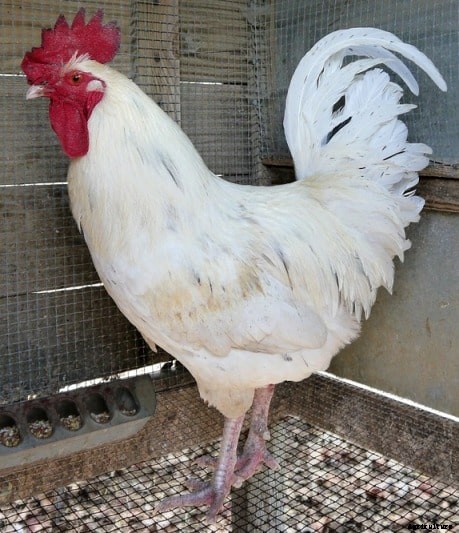
Leghorn Rooster.
Leghorns are very active, and highly ambitious chickens. These chickens are always willing to work, hunting and scratching. On the range, they are good foragers and fewer eaters. These breed chickens are prolific, highly fertile, and hardy. Leghorn chickens lay very large numbers of eggs – in fact, they lay as well or better than other chicken breeds. These chickens are a combination of hardness, rate-of-lay, and small appetite.
Read this: Plymouth Rock Chicken Facts.
Origin of Leghorn chickens:
The Leghorn chickens have originated in Northern Italy near the port for its namesake, Leghorn. The ancestors of this fowl are not clearly known. The Leghorn chickens are introduced to America in the mid-1800s by Captain Gates. Many varieties of Leghorn chickens are APA recognized.
Many believe that this breed is derived from the light breeds originating in rural Tuscany. The name for the breed comes from the Leghorn, the traditional Anglicization of Livorno.
These birds were initially known as “Italians”; they were first referred to as “Leghorns” in 1865, in Worcester, Massachusetts.
The Leghorn was listed in the American Standard of Perfection in 1874, with three colors: black, white, and brown (light and dark). Rose comb light and dark brown Leghorn chickens were added in 1883 and rose comb, the white chicken breed was listed in 1886. Single comb buff and silver were listed in 1894, and red, black-tailed red, and Columbian in 1929. Rose comb black, buff, silver, and golden duckwing were added were listed in 1981.
At the initial stages these birds were small, not exceeding 1.6 kg in weight; to increase the weight, they were crossed with Minorca and Malay stock. Pyle Leghorns were first bred in Britain in the 1880s with increase weight; gold and silver duckwings originated by crossing with Phoenix or Japanese Yokohama birds. Buff Leghorns was introduced in Denmark in 1885, and to England in 1888.
Physical Characteristics of Leghorn Chickens:
These breed chickens are small, spritely, noisy birds with great style, Leghorns like to move about. They are excellent foragers and can often glean much of their diet from ranging over the fields and barnyards.
Leghorns are capable of flight and often roost in trees. Leghorns are the most numerous breeds in western countries. The Leghorn has red wattle, white earlobes, and has either a single or rose comb. Leghorns go broody very rarely.
These chickens have yellow legs and the eye is red all colors. The female chickens have a double folded comb, a deep abdomen, and a whipped tail. The eyes are prominent, and the beak is short, hard, and stout. And they have well-defined ear lobes, and the wattles are long, thin, and fine in texture. Their legs are long and featherless with four toes on the feet and a long straight back toe and they have feathers on the body that is soft and silky. Most of the Most Leghorns have single combs, and some have a rose comb in some countries.
The Italian standard Leghorn chicken male chicken weighs about; 2.4–2.7 kg (5.3–6.0 lb), Female chicken weighs about 2.0–2.3 kg (4.4–5.1 lb).
According to the British standard, fully grown Leghorn make chickens weigh about 4 kg (7.5 lb), and the hens weigh about 2.5 kg.
Varieties of Leghorn Chickens:
In the Leghorn breed, there are ten color varieties that are recognized. And there is a separate Italian standard for the German Leghorn variety, the Italian (German: Italian).
The Fédération française des volailles (the French poultry federation) divides the Leghorn chicken breed is categorized into four types: the American white, the English white, the old type (golden-salmon), and the modern type, in which there are seventeen color variants are listed for full-size birds, and fourteen for bantam.
The American Poultry Association and the American Bantam Association recognize a number of Leghorn varieties they are white, red, black-tailed red, light brown, dark brown, black, buff, Columbian, buff Columbian, barred, and silver.
In Britain, the Leghorn breed is divided into eighteen colors: golden duckwing, silver duckwing, partridge, brown, buff, exchequer, Columbian, pyle, white, black, blue, mottled, cuckoo, blue-red, lavender, red, crele, and buff Columbian.
Read this: Broiler Farming.
Leghorn Chicken Behavior:
The Leghorn chickens are intelligent and resourceful birds, and they find their own food if allowed to range.
These are busy, intelligent, and active birds. They are very good flyers and will roost in trees if allowed. They can be a bit noisy, not for an urban backyard.
They will tolerate confinement if we provide a lot of room for them. They can get bored easily if we don’t allow them to roam as they are high-energy birds.
They make lots of noise and highly strung, but this behavior varies from strain to strain, many Leghorn lines are not flighty.
The male Leghorn chickens are more amenable to humans but don’t expect to make a lap chicken out of them.
They rarely go broody and are non-sitters. They are good layers and lay eggs throughout the year and eggs are large white eggs.
These breed chickens grow faster and mature quickly. Leghorn chicks are very easy to rear, and they feather up very quickly.
These chickens have a large comb and need to be taken proper care of in cold, frosty weather to avoid frostbite.
These chickens are prolific layers, but not good for meat production.
Egg Laying:
The Leghorn hen most selective breed in industrial poultry. These hens can lay from 280-320 eggs per year.
These chickens can, well, even in their third or fourth year too.
They lay white shelled eggs around 55g (2 ounces) each.
Leghorn chickens do hatch, they feather up fairly quickly and are fast maturing.
Advantages of Leghorn Chickens:
They are very beautiful chickens.
These chickens are the best layers.
Leghorn chickens are very calm and cool chickens.
These are very curious birds.
Rearing these chickens is very easy.
They eat very little food.
Friendly birds and great foragers.
These chickens feather up quickly and mature very fast.
Disadvantages of Leghorn Chickens:
These are not good meat providers.
Flighty and curious chickens.
These chickens make lots of noise.
They don’t go broody, and the hens are not good mothers.
In case if you are interested in this: Quail Farming Business Plan.