
Welcome to Modern Agriculture!

Impacted crop surgery on your chicken sounds scary, but it’s not impossible to perform this surgery. It’s inevitable if you have chickens that you are going to encounter crop issues at some time.
The crop, located on the hen’s right side just beneath the skin, is a balloon-like pouch where everything they eat or drink first goes to start the digestion process. Generally speaking, your chickens will have full crops every night when they go to bed and empty crops the next morning.
If a chicken still has a full crop the next morning, that’s a sign that the crop is impacted – something is blocking the food from moving through the rest of the digestive system.
I have had several chickens with crop issues over the years. I’ve been lucky enough that some resolved with just a little bit of crop massage, and I’ve learned that the sooner I notice a crop issue, the easier it is to resolve.It’s only the worst-case scenario that requires impacted crop surgery.
Please note that I’m not a vet and can’t tell you whether or not you should operate on your chicken. If you have a vet in your area that treats chickens, my advice would always be to take your chicken to a vet for treatment. However, in some cases there was no vet available and I’ve needed to perform surgery to empty an impacted crop.
I keep a chicken first aid kit handy with disposable scalpels, wound antiseptic, veterinary glue, and various bandages. You can purchase most of these items at your local farm store or drug store. You’ll also need some saline solution, disposable gloves, a sterile syringe, and some clean gauze.
Once you have the necessary items assembled, get your chicken ready for surgery on the impacted crop. I towels and my dining room table – it has a nice bright light overhead – as my surgical area. I lay a thick clean towel down on the table and use a second towel to wrap the chicken.
It’s easiest to work on the chicken if you have a second person who can hold the bird still. Wrap the chicken in the towel, including the head to help keep it calm and still during the procedure.
Clean and prepare the surgical area. If the crop is impacted, odds are good it’s bulging out and easy to find. To prep the area, you may need to pluck some feathers to get them out of the way. Spray or wipe the skin down with an antiseptic.
Use the scalpel to make a small incision in the skin above the crop. Start around half an inch because you can always make it bigger if you need to. Use clean gauze to dab away any blood – there shouldn’t be much.
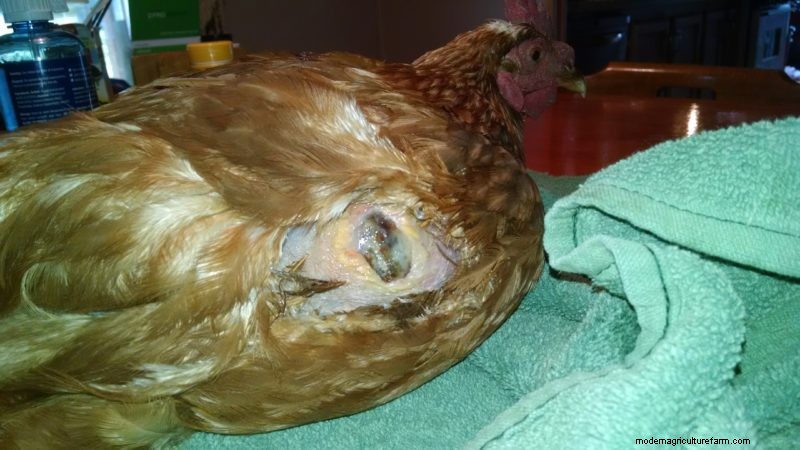
You can see the incision I made to access the crop, which is located just beneath the skin.
I like to offset the incision in the crop slightly. To do this, I pull the skin (and the incision) to one side and then going through the opening, make an incision in the crop beneath it.
Be prepared at this point because that crop is full of some nasty junk and it’s going to come oozing out of the opening. You’ll definitely be glad you put a towel down first! Let as much flow out on its own as you can and examine what’s coming out.
Are you seeing food? Is it just liquid? You need to know what comes out of the crop so you have an idea of what’s still in there blocking it.You may need to swipe your gloved finger around inside the crop to dislodge whatever is blocking it.
Once you have the crop cleaned out, the hard part is over. If you’ve offset the incisions, you can actually leave the incisions as is. They will heal rather quickly on their own. If you had to make a larger incision, or just feel more comfortable with them closed, you can use the veterinary glue to close both the crop and the skin.
Close the crop first and give the glue time to dry before you close the skin. You can also apply a clear protective film such as Tegaderm to the skin to keep the wound closed and clean
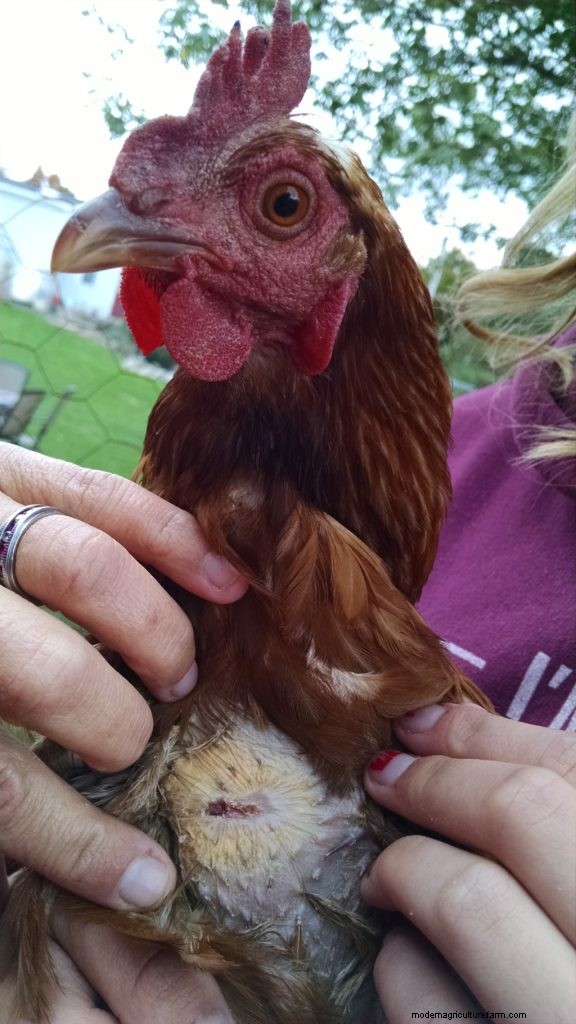
This hen is healing nicely after surgery for her impacted crop
.
Monitor the chicken closely for the rest of the day and give it just a limited amount of water. You don’t want the crop to stretch too much after you just cut it open! I offer just a small amount of soft food, such as scrambled egg. After about 24 hours, your chicken should be recovered from impacted crop surgery and fine to return to the rest of the flock.
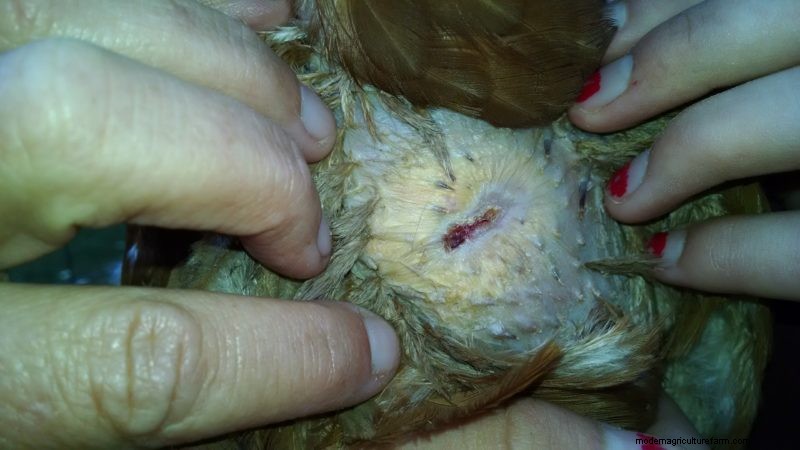
You can see here the incision is almost completely closed.
Continue to monitor the chicken daily to make sure the crop is emptying and the wound is healing. In about a week or so, your chicken should be as good as new.
Traci DeLore grew up around chickens on her family’s farm, but didn’t start keeping her own chickens until she was in her 40s. Her desire to keep chickens came from a desire to have her own fresh eggs from chickens she knew were well cared for and happy. Traci started with six chickens – and then chicken math took over. These days, she has about 60 chickens — and three “rotten” ducks. (I say this because having ducks is like living with toddlers.) Traci also raises and processes her own meat chickens on occasion. Follow her on Instagram.


