
Welcome to Modern Agriculture!

Chickens are one of the easiest livestock to take care of, but did you know there are different ways to feed your chickens other than with regular chicken feed? While you can buy chicken feed at the farm store, or even make your own, there are ways you can cut down on the cost of feed. You can even completely feed your chickens without ever using chicken feed.
Ultimately, the best way to get away from a chicken feed bill is to allow your chickens to free range at all times—or at least during the day. You can accomplish this through a pasture ranging set-up, or just through letting your chickens roam your yard.
Otherwise, here are some other ways you can feed your chickens!
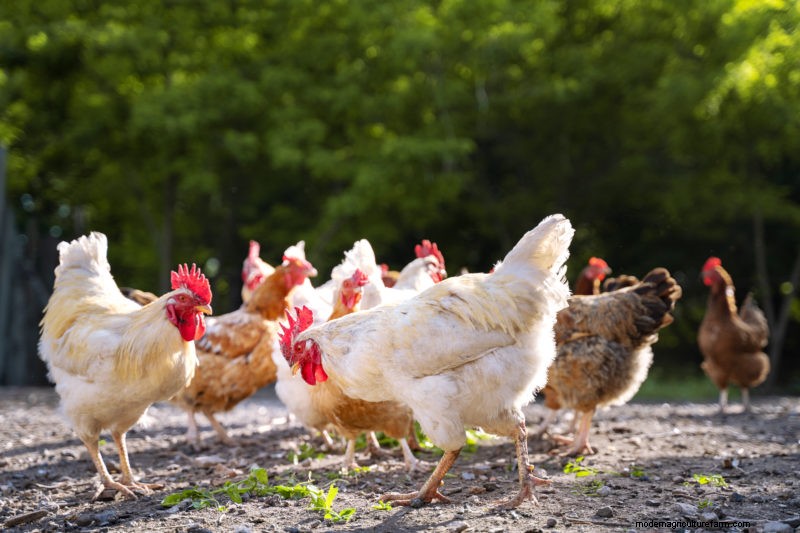
Provide nutritional food for your chickens while saving on feeding costs. Adobe Stock/Irina.
If you’re looking to stretch your chicken feed out longer—or help your chickens digest their feed better—you can ferment or soak your chicken feed. This works best with mash, whole grain, or chicken crumple feed. Pellets tend to disintegrate into the water during the soaking period. Because fermented and soaked feed is digested easier, your chickens will naturally eat less chicken feed than if you didn’t ferment or soak it.
Fermenting chicken feed is easy. Since it takes about four days total to ferment, you’ll make it daily in order to have fermented feed for each day.
Day 1. In a 5-gallon bucket, add ¼ pound of chicken feed per chicken. You’ll more than likely bring this down to ⅛ pound of chicken feed per chicken, but you’ll need to see how much your chickens eat before you make the weight change.
Add enough water to cover the chicken feed by about 3 inches. Mix well, making sure you get all of the feed at the bottom of the bucket. If the feed isn’t still covered by 3 inches or so of water after mixing, add more.
Cover loosely by setting a lid on top (but don’t make it airtight) or by securing some cheese cloth on top with a large rubber band.
Days 2 and 3. Repeat Day 1 in another bucket. By Day 4, you’ll have four buckets of fermenting feed, with one bucket complete.
Day 4. Now your first bucket from Day 1 is ready to be fed to the chickens. Pour the fermented feed into a livestock bowl or open chicken feeder. Don’t put it into a chicken feeder that naturally rotates or drops food. Instead, put it into a bowl or even on the ground.
Repeat Day 1 so that you always have 4 buckets going at one time. Always use the oldest bucket of feed first, as it takes four days for the feed to ferment fully.
If ever you see any mold, throw out the feed and start over.

Soaking chicken feed.
We have a lot of chickens, and as a farmsteading mama, I just don’t have a lot of time to keep up with fermented feed. So, I prefer to soak our chicken feed instead. Soaked chicken feed is simple and has similar digestive benefits as fermented chicken feed. Soaked feed is easier for your birds to digest so they eat less of it, as the nutrients are better absorbed.
Start by placing ¼ pound of feed per chicken in a 5-gallon bucket. (You could cut that in half if they don’t eat it all in one day.) Cover the feed with water and mix thoroughly. The feed should be completely covered with water by about 3 inches. Allow the feed to soak for 24 hours before feeding to your chickens.
You can use the same bucket over again when you go to soak your next batch; just give it a good rinse first. We simply use the same bucket every single day, since we just put feed right back into it to soak.
One of the most common ways to offset feed costs, or to completely get rid of chicken feed, is to simply give your chickens your feed scraps and feed waste. Leftovers, vegetable and herb cuttings, and even foods close to or just past expiration all contribute to feeding your chickens.
Likewise, you can also allow your chickens into your compost pile every day. Your compost pile contains bugs and good microbes that help feed your chickens. It’s also good for your compost pile, as your chickens will help you turn the pile each and every day.
Of course, this will depend on how many chickens you have. If you’re running a larger operation with more than 6 to 10 chickens, you probably won’t be able to feed your chickens just with your kitchen scraps or compost pile. However, local grocery stores or farms may have excess scraps, imperfect or expired vegetables, and more to offer if you ask them.
If you’re looking for healthy grass and grains for your chickens, fodder is the best way to go. You can grow fodder just about anywhere. Depending on how big your flock is, you can have a simple set up going at all times. Or, if you have a large flock, you may need something more complicated, such as shelving, for all the fodder you’ll need to grow.
Fodder is basically the process of growing grass with a rooted mat system (no dirt) at the bottom. Your chickens will not only eat the grass, but also the roots and lingering grains that the grass sprouted from.
Sprouted grains and fodder are extremely dense in good nutrition for your birds. Not only will it make your birds healthy, but it’ll give you beautiful dark-orange egg yolks packed full of those same nutrients. Fodder is a great option for those who have chickens that can’t free-range. It’s especially great for wintertime feeding.
You can grow a few types of grain for fodder, including wheat, oats, barley, and rye. Wheat has the highest protein content, while barley and oats have the most digestible fiber content. Higher starch is found in wheat and rye, while barley and oats have lower values of starch content. Barley, by far, has the highest calcium percentage. Keep all of these things in mind when choosing a grain for your flock, or when mixing several grains together.
All grains become 40 percent more digestible when sprouted or grown into fodder. For this reason, your chickens will need to consume less fodder than their regular feed ration, because the nutritional value is higher and the absorption rate into the chicken’s system is greater.
Chickens need to eat 2 to 3 percent of their body weight in fodder each day, if feeding only fodder daily. Offer it along with their grit, mineral, and vitamin supplements.
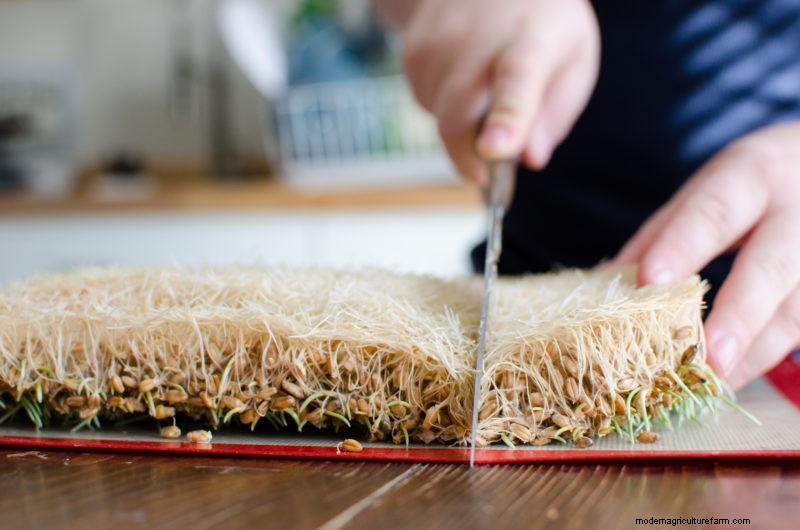
Cut up your sprouted fodder and feed it to your chickens. They’ll eat all of it!
You can grow fodder in as small or as large of batches as you’d like. Since we don’t use it as a full-time feed, I grow it in my little greenhouse in the winter months, or on the kitchen table, when necessary. But if you’re wanting to completely supplement or replace feed with fodder, you’ll need to set up an entire system. You can accomplish this by just setting up racks with multiple containers and grow lights or heating mats.
Supplies
Shallow container (with small drain holes in the bottom)
Grain of choice
Water (non-chlorinated)
Directions
Creating fodder can take a few tries to master, but once you’ve mastered it, you’ll begin putting together a constant rotating system that suits your needs.
While fodder is great, putting your chickens on pasture most of the year is your best option, if space allows. Fodder acts as a pasture replacement when pasture-raising isn’t an option or isn’t available during cold months.
If you don’t have the time to grow fodder, try sprouting wheat, broccoli, peas, or other grains and veggies in a Mason jar! Simply soak them every day in water, drain well, and watch them grow!
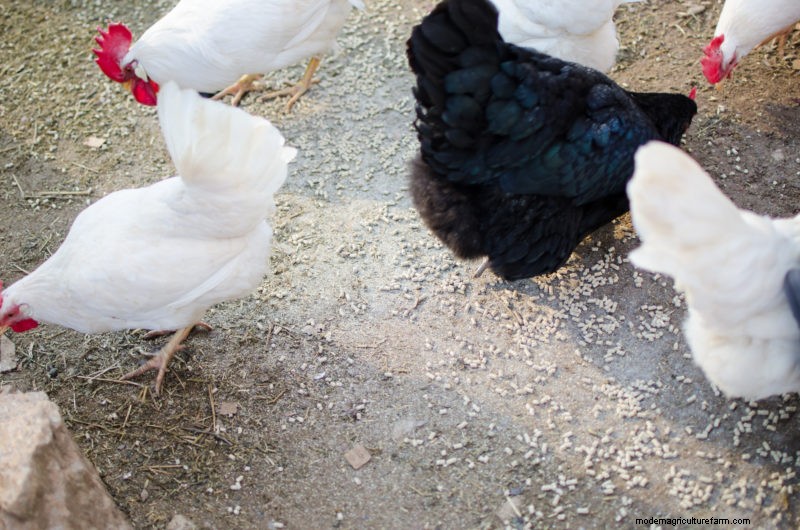
Experiment with different chicken feeds, and see which one works best for your and your chickens.
As you can see, there are a lot of alternative ways to feed or supplement chicken feed. Most of them are things we should be doing anyhow! Pick and choose what works best for you and your birds, and you’ll be sure to have the healthiest flock you’ve ever had.
For more information on innovative ways to feed your chickens, check out 9 Innovative Ways to Get Free Chicken Feed.
Amy Fewell is an author, homesteader, and the founder of the Homesteaders of America. She is the author of The Homesteader’s Herbal Companion and The Homesteader’s Natural Chicken Keeping Handbook. She lives in the foothills of the Blue Ridge Mountains in Virginia, where her and her family holistically and naturally raise their livestock, gardens, and mini-homesteaders! You can follow her doings at The Fewell Homestead.

