
Welcome to Modern Agriculture!

Another way to promote good circulation is to incorporate circulation stimulating supplements into your flock’s diet. Certain supplements make the body respond in such a way that trigger circulation and encourages proper blood flow. Some popular herbal supplements include ground ginger root, cayenne pepper, and parsley.
Of the three supplements, parsley can be used the most frequently since it is a mild herb that also provides many other good health benefits. Ginger root is a stronger herb that should be used in moderation and offered during times when circulation may be suppressed. Cayenne pepper should be used with most caution since it is a very potent herb, and since chickens can’t taste spicy things, they are prone to over-consuming cayenne pepper.
Here are a few safe ways to promote good blood flow and circulation in your flock this winter:
Sprinkle some black soldier fly grubs in some straw for your flock to forage for
Include interactive elements in their enclosure, such as swings, unique perches, tunnels, balance beams, and ramps
Provide free-choice parsley once a week or sprinkle some in their feed
On cold mornings and nights, serve them a warm snack like raw oats sprinkled with some ground ginger
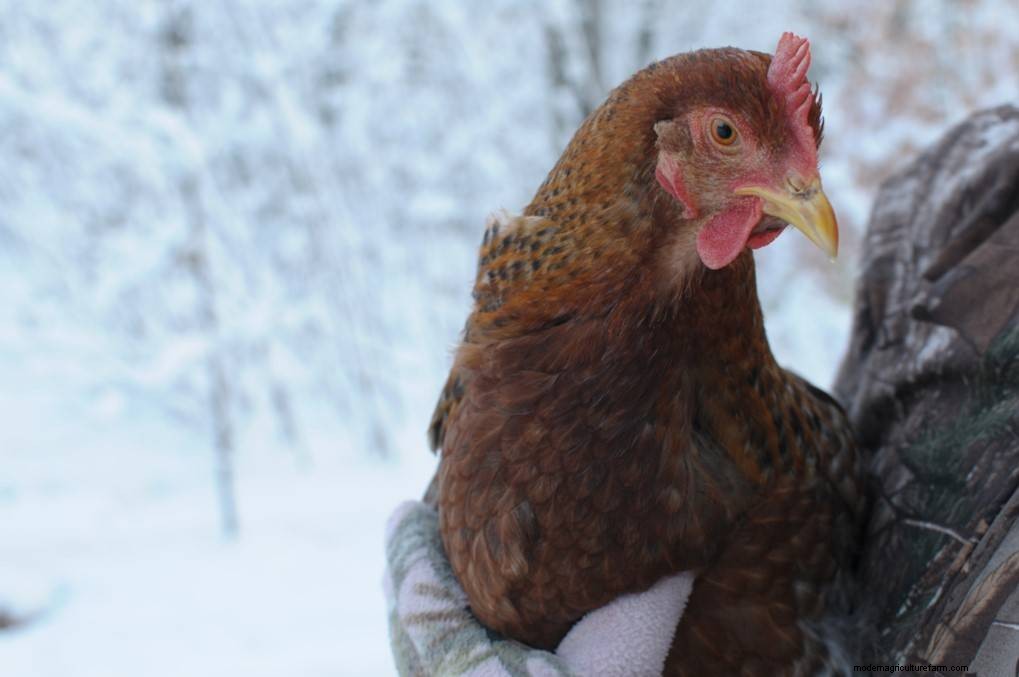
Reducing the water surface area within the coop will allow for less evaporation, which decreases the amount of moisture that is in the air. Dry coop air will prevent frostbite by limiting any moisture that could gather on the chickens’ combs and wattles. The main source of water surface area in the coop will be water founts. Bell waters, troughs, bowls, and other open-water systems will have water surface area that moisture can evaporate from. While it’s important that your flock have an easy to access source of water during the winter, it's also important to reduce moisture content in the coop to keep them healthy. So, there are several ways around this dilemma.
First, you can invest in a closed-water system, such as poultry nipples. Poultry nipples can be mounted to PVC pipes or buckets, which can then be covered to reduce water surface area. There are two common problems with closed-water systems though. One is that you have to be very careful that the system doesn’t leak. Constant dripping or an accumulation of drips will make for damp, moist bedding which just adds to the moisture problem instead of solving it. Also, closed-water systems can be hard to keep from freezing during the winter. So, if a closed-water system doesn’t sound like your cup of tea, there is another option.
Your other options is to move your flock’s water source outside to their enclosure. This will remove the water surface area from the coop but will still provide water for your flock. One challenge you may encounter is how to keep their water from freezing. However, electric pet bowls, heated bases, and other systems can all be rigged up in the enclosure to easily keep the water from freezing. The two main ways to reduce water surface area in the coop and prevent frostbite are to invest in a closed-water system or move the water source outside and make sure you clean up any water spills and prevent damp litter within the coop.
Fresh chicken manure has a moisture content of around 75%, which may vary depending on the type of dropping. However, all that moisture doesn’t stay with the poop. In fact, about 35-55% of that moisture can evaporate into the air. It’s pretty safe to say that chicken poop can account for a lot of the moisture in the chicken coop air!
During the winter, we are trying to keep the moisture levels low in the coop, which means proper chicken poop management! There are two ways you can manage the droppings to reduce moisture evaporation: remove the droppings or absorb the moisture.
For removing droppings, a droppings board or sling below the roosts can make cleaning up nightly droppings super easy in the morning. If you have a litter that does not compost droppings, you will have to clean up any droppings in the litter as well. A kitty litter scoop works well for sifting out droppings from the litter.
To absorb moisture from droppings, you have to choose a litter that is not only absorbent, but also promotes the composting of the droppings. If the litter is just absorbent, it will eventually become too saturated and add to the moisture problem instead of preventing moisture in the coop. When the litter both absorbs moisture and composts the droppings, the composting process uses up the moisture to create a healthy compost.
To keep moisture evaporation from chicken poop to a minimum, have a good droppings management system in place such as removing the droppings every morning or stimulating the composting process by using a deep litter method in the coop.
Good ventilation is also essential to having dry, non-humid air within the coop. You can remove all the water surface areas and keep droppings to a minimum but still have high moisture content in the air. Where is that moisture coming from then?
The answer is your flock. When chickens respirate (aka breath), they exhale moisture. To take care of this moisture, you must have good ventilation in the coop.
Ventilation encourages air exchange. Old, moisture-laden air should be exchanged with fresh, oxygen-laden air. This exchange often occurs near the roof of the coop. Moisture-laden air is also warm air, so it naturally rises to the top of the coop. If you have good ventilation in your coop, the warm, moisture-laden air can escape and be replaced with fresh air. Having good ventilation will help keep the coop smelling good and promote dry air within the coop. Dry air makes it easier for chickens to stay warm and prevents frostbite.
Promoting good ventilation can be as simple as having small, hardwire covered openings near the top of the coop or having windows that can be opened and closed. Make sure your coop is well ventilated for the winter months so that moisture-laden air can easily be exchanged to prevent frostbite.
Another way you can prevent frostbite during the winter is by also preventing cold stress. Cold stress is the stress a chicken experiences when colder temperatures require the body to expend more energy to stay warm. Not all cold stress is bad, and healthy chickens can handle spells of minor cold stress just fine. However, cold stress can lead to frostbite when the body starts restricting circulation to conserve energy.
During the winter, a chicken has the added need of expending energy to stay warm. When the need to stay warm reaches a certain point, the chicken’s body will start restricting blood flow to the parts of its body that keep it cool in the summer, namely the comb and wattles. This helps conserve energy. However, once blood flow is restricted to those appendages, it opens them up to frostbite. So, preventing cold stress is one way to prevent frostbite.
Here are a few things you can do to prevent cold stress in your flock this winter:
Not only does exposure to the weather elements cause cold stress, but it can also speed up the process of frostbite. A cold wind or moisture from precipitation can encourage frostbite to set in. Wind chill can make temperatures drop even lower and will cause moisture to freeze faster, which is bad when moisture is gathered on a chicken’s skin. Not being able to get away from blowing snow or icy rain will also increase the chances of frostbite.
One often overlooked source of exposure is the floor of the enclosure. If the litter in the enclosure is not insulating, the ground will get very cold which can cause frostbite on the toes. To prevent frostbite by reducing exposure, take these measures to protect your flock from the elements:
Cover the enclosure with a weatherproof covering
Put up a wind block all around the enclosure or just on the windiest sides
Use straw in the enclosure during the winter to insulate the ground
Make sure there are perches in sunny, protected spots in the enclosure
While taking preventative measures to reduce the moisture in the coop is the key to reducing moisture build-up on combs and wattles, you can also apply a salve that will protect against moisture. Some chickens will naturally tuck their heads under their wings at night to keep their comb, wattles, and face warm throughout the night. For chickens with short combs, this behavior will help protect their comb from frostbite. However, chickens with tall combs and long wattles will be more prone to frostbite no matter how many measures they take to protect those appendages.
This is when we can step in and add a little extra protection in the form of a comb and wattle salve. Salves that are beeswax based are the best for protecting against moisture. Oil-based salves actually trap moisture next to the skin, so they should be avoided. Salve should be applied on extremely cold nights as well as on days when the wind chill is extreme.
When roosters drink, they may accidentally dip their wattles into the water as well, this can accentuate frostbite. Roosters benefit from more frequent salve applications than hens. Applying a salve to the comb and wattles of a chicken may be a two-person job, but your chickens with tall combs and long wattles will appreciate the extra protection!
The last thing you can do to prevent frostbite from being a health issue in your flock is to try your best to choose cold hardy chicken breeds if you live in a northern region. Cold hardy breeds are less likely to have tall combs and will also have more feathers for protection against the cold. Feather footed breeds are more protected from frostbite affecting their toes and feet. Breeds with muffs, beards, or crests are also less prone to frostbite since they may have very small combs and wattles or none at all.
Breeds with a pea comb, cushion comb, or walnut comb are also usually cold hardy. Many dual-purpose breeds are cold tolerant and some breeds have been specifically developed to handle cold temperatures. So, when choosing new feathered family members, try to make sure you evaluate each breed’s cold hardiness.


