
Welcome to Modern Agriculture!

There are countless hungry pests that veggie gardeners need to guard against, with foes such as aphids and caterpillars appearing in nearly every patch. But if you grow any kind of peas, there's one specialist bug in particular you need to be on the lookout for.
The pea beetle, as its name suggest, has a particular fondness for pea plants and seeds, however it will also infest some other legume crops such as broad beans and soybeans. While the beetle is not as widespread as other more general pests, it has the potential to ruin an entire crop, and it's a pest that shouldn't be taken lightly.
Also known as the pea weevil, or more formally Bruchus pisorum, this legume-loving bug is a serious problem for commercial crops. It infests seed stores and potentially destroys the next year's crop before it even begins growing. However, it can also cause difficulties on a much smaller veggie patch scale, weakening plants and reducing harvests, or even preventing them altogether
If they infest agricultural grain stores, pea weevils are capable of turning the entire seed supply to dust through their invasive feeding. In the home garden, they're most likely to weaken growing plants by feasting on the leaves, or to spoil harvests through damage either to flowers or the immature seeds in the pods. In severe cases, the whole crop can be destroyed by a combination of the two.
The main signs of pea beetle feeding are ragged, scalloped cuts around the edges of the leaves, along with damage to flowers.
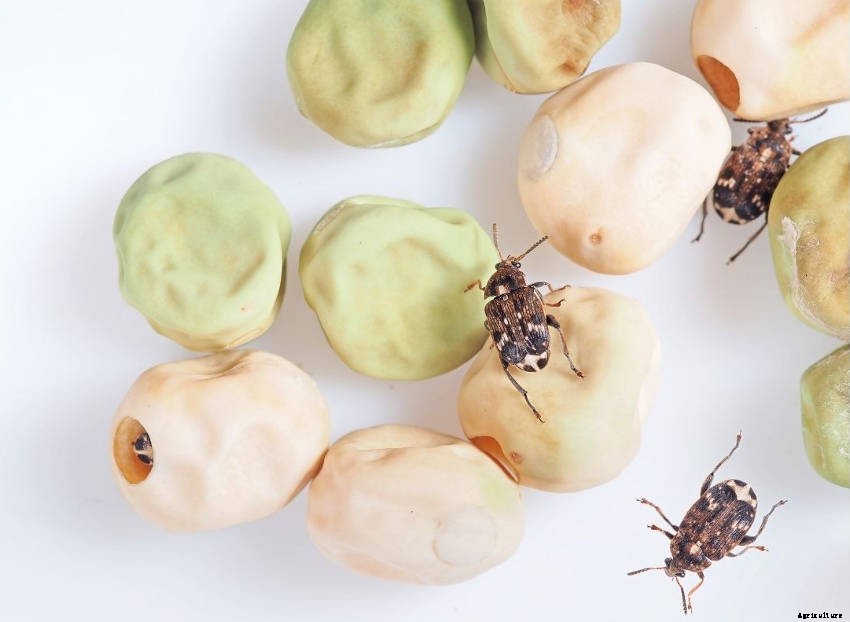
But leaf feeding aside, if you're planning to dry your pea harvest for later use it's important to check the seeds for signs of weevils first. Seed damage can be seen after podding through malformed or missing peas, or by peas with distinctive exit holes left by emerging adults after the insect's pupation stage. Any infested seeds you find should be disposed of carefully to prevent the next generation of weevil appearing in your veggie patch.
There's only one generation of the pea weevil per year, which begins with eggs being laid directly onto growing pea pods. The eggs are small and white when fresh, darkening to near black before hatching, and are readily visible with a careful inspection.
After two to four weeks, the eggs hatch into creamish-white larvae which are around 6-7mm long, legless, and curved into a 'C' shape. The larvae immediately begin to burrow into the pod, with each individual eating its way into a single seed within. The entry holes to the seed are tiny and barely visible, especially as the seed continues to grow.
Once inside, the larvae feed on the seed and then begin to pupate, emerging as adults after 40-50 days. As they chew their way out of the seed they create a perfectly round exit hole approximately 2.5mm across, which effectively destroys the seed's potential for germination.
Once they leave the seeds, the adults may go on immediately to hibernate in the soil directly beneath the plant, or if the seeds are in storage, they may remain dormant in place until the spring.
After hibernation, the beetles will awaken and emerge at roughly the time that pea plants come into bloom. They'll then start feeding, with the females heading particularly for the flowers' nectar before laying eggs to start the cycle again.
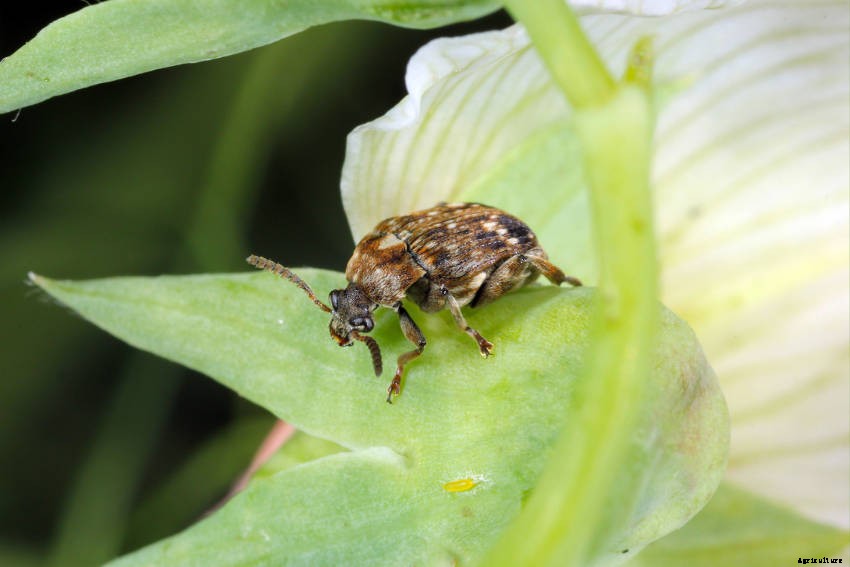
Catching the beetles before their eggs are laid is key to preventing a large-scale infestation. Check for adults on the underside of pea plant leaves in spring or early summer, or in the soil below after the harvest.
The beetles are approximately 6mm long, mainly brown in colour but speckled with white, black, or grey. Their bodies are broad and rounded, and like many other weevils they have a short, wide snout on the head. One easily identifying feature is the pair of wing casings which don't cover the whole of the body, leaving the back of the abdomen protruding pointedly behind.
In commercial growing, pesticides are often used to control pea weevil numbers. Fortunately, this is rarely necessary in a home garden. Following some basic tips usually works well enough to keep the beetle levels under control.
However, if you have a serious infestation despite these measures, then a food-safe pesticide narrowly targeted at weevils can be used as a last resort, bearing in mind the potential collateral damage to other insects in your garden's eco-system.
Unless you're a commercial grower with an enticing seed store, pea weevils may not be your number one garden enemy. But if you let these pests get a foothold, you may find your pea-growing efforts bear less fruit than you hoped.


![Why deer Don’t Eat Lavender [And How To Protect Your Other Plants]](https://modernagriculturefarm.com/article/uploadfiles/202211/2022111623022572_S.jpg)