
Welcome to Modern Agriculture!

When most of us think of ginger, we likely think of ginger ale as a digestive aid or to quell nausea. And that seems to be the main way that most use ginger, but this delicious, slightly spicy herb has a lot more benefits for us as well as for our chickens. I first discovered that my chickens loved ginger after tossing them some peels along with other kitchen scraps after making dinner. After that, I always made it a point to save the peels and discarded ends for them.
Knowing some of the health benefits of ginger to humans, I logically reasoned that adding some ginger to my chickens’ diets would also be beneficial to them: ingesting ginger, whether fresh, powdered or dried, can help with digestion and works to soothe the gastrointestinal tract, eliminate harmful bacteria and support the good bacteria. It can be beneficial if offered to a hen suffering from diarrhea to help get her through a rough bout.
A powerful anti-inflammatory, ginger also works to reduce swelling in the throat or sinuses, especially when taken in a liquid form, as when ginger root is steeped in boiling water. Ginger is also an antiviral, which makes it wonderful for treating congestion. It helps keep the mucus membranes healthy and stimulates the immune system.
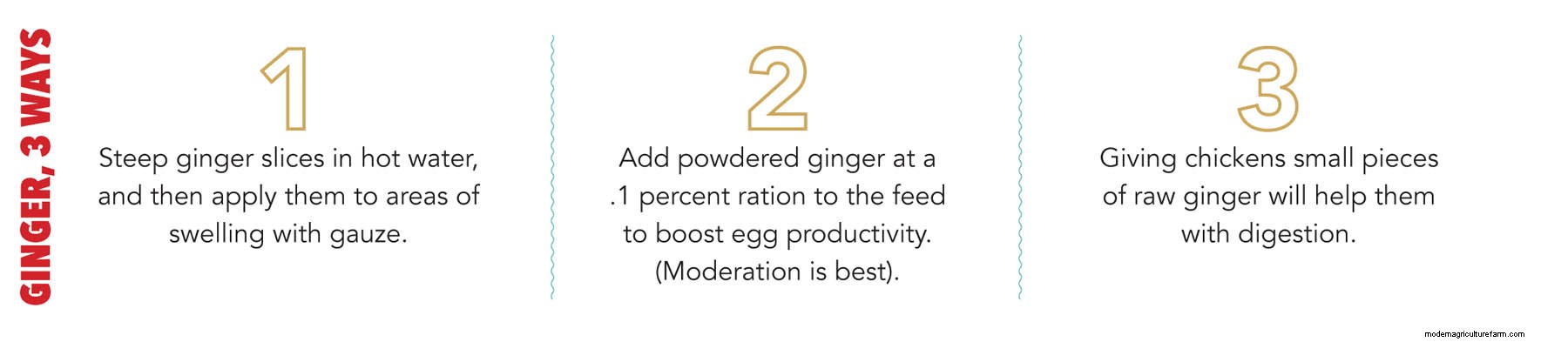
Applied externally, it can also help with arthritis, or to soothe a chicken in pain due to swelling of an injured leg or a sprained toe. Steep slices of the root in hot water and then press them onto the inflamed area for a few minutes several times a day, or wrap them in gauze and secure them to the leg or toe with Vetrap.
Ginger is a wonderful aid to circulation, which not only will help your chickens stay warm in the winter, but can also help to prevent frostbite as well as alleviate some of the pain that can accompany it — and help the affected comb or wattles heal.
But the most interesting property of ginger for us chicken keepers involves a 2011 study that was published in Poultry Science: adding powdered ginger to your laying hens’ feed (in a .1 percent ratio) can actually result in increased egg productivity, specifically laying of larger eggs containing more antioxidants. However, like anything, remember that moderation is best and your chickens should be offered a wide variety of healthy foods and treats always free choice (let them decide how much is enough).

Lisa Steele is the author of Fresh Eggs Daily: Raising Happy, Healthy Chickens…Naturally (St. Lynn’s Press, 2013). She lives on a small hobby farm in Maine with her husband and their flock of chickens and ducks, two dogs and a barn cat. She is a fifth-generation chicken keeper and writes about her experiences on her award-winning blog at www.fresheggsdaily.com. In her free time, she loves to garden, bake, knit and sip homebrewed herbal teas.


