
Welcome to Modern Agriculture!

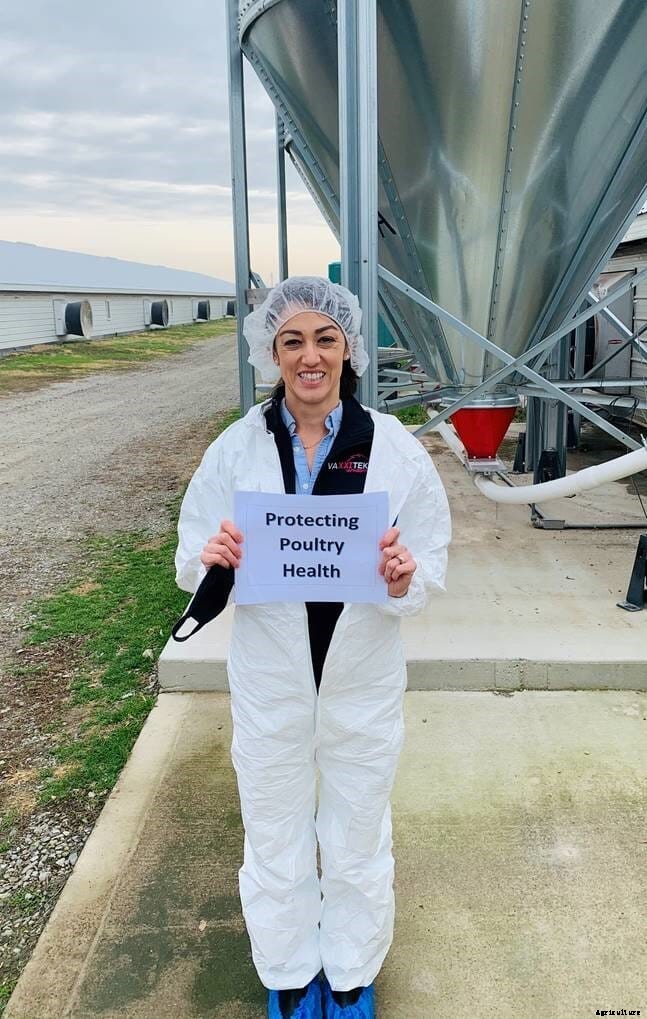
One of my favorite parts of my role is the variability in my day-to-day activities. I spend time in the field with customers doing posting sessions, vaccination monitoring and support as well as being heavily involved in advancement of diagnostics capture and analytics. I have even been working with developers over the last three years to design custom applications for improved vaccine monitoring! This role allows me to interact with many different types of poultry production and even collaborate with colleagues across Boehringer Ingelheim’s different species groups, such as swine, ruminant and pet medicine. I also participate in both internal and external industry research and education and help our customers solve their most pressing problems as well as plan health and vaccination strategies. Rarely are two days the same for me!
The time I spend on diagnostics analysis and interpretation allows me to gain and share insights with customers on their birds’ health and performance that they may not have access to otherwise. Given my veterinary background, working in this area helps me see and understand trending that would be hard for a traditional data analyst to appreciate. Connecting the dots between vaccination, flock performance, traditional monitoring and the effect of different health programs and interventions is a fascinating area that provides constant learning and insights and hopefully leads us improved poultry health strategies.
Managing the amount of information that is generated in poultry medicine and assuring that trending is true and meaningful requires careful attention to detail. A bit of skepticism can be helpful to assure that trending is the real result of an action and not a coincidence or the result of unidentified factors. This requires careful attention and sharing of information between our customers and us which can seem unrelated at first glance. I feel very fortunate that our customers trust us to share their information and enjoy the collegial nature of working with them in this way.
The hard work of many people in the industry has improved poultry performance in so many ways over the last 50 years. Genetics, improved vaccine technologies and enhanced biosecurity protocols have made great strides towards optimal production and happy, comfortable birds. I believe we can take these efforts that we can now effectively quantify and capture and unify the data to help us gain additional insights and a better understand of the interactions of the many factors that go into successful poultry production. This decision making, based on data and previously successful methods, can help us continue to advance bird health and comfort even further still.
There are so many folks who have helped and educated me along the way that it would be impossible to name them all. Drs. H. John Barnes and Michael Martin from North Carolina State University were among the first to spark my interest in Poultry medicine and I am very grateful for their dedication to poultry health and the advancement of students in the poultry industry. Dr. Isabel Gimeno is inspirational to me as her work in Marek’s disease has contributed tremendously to our control in this area in the US. I worked with her early in my poultry career (pre-vet school!) and her drive and focus is truly inspiring.
The occasions in which I am the only woman in a meeting, posting session or customer activity, are becoming rarer now than when I started in this field. I am proud to see the representation of women in poultry growing. Rather than allow these situations to be intimidating, I try to use them as an opportunity to add my unique skill set to the mix, which includes attributes in which women often excel, including organization, thoroughness and problem solving.
In my career, I hope to contribute to better use and networking of the incredible amounts of data that poultry vets must consider in managing flock health. I would love to see more cohesive programs in use for holistically managing data and the ability to better understand how different aspects of flock management truly affect each other. I believe this can be done, but it will require poultry companies and our supporting industry to communicate and collaborate on the programs they use and the learnings they attain from them.
Watching the continuing evolution of poultry health management from reactive to proactive, prevention-based models is an exciting innovation that has further room for growth. An illustration of this is the experience of seeing the reduced use of antibiotics requirements be translated from a restriction to an opportunity for more proactive disease prevention by the veterinary community. Vaccine technology advancements, such as the use of vectored vaccines and the possibility of other advancements, like mRNA technology are also exciting to consider.
Meeting veterinary students with an interest in poultry and seeing their enthusiasm for the industry is very exciting to me. The blend of increased technical capabilities and the rich experience that is shared between generations of poultry veterinarians makes for a promising future of the industry. It is exciting to see the growth of technology used in the field and I look forward to seeing some of the innovations that the next generation of tech savvy veterinarians bring into use.
Being part of a growing and diverse veterinary team at Boehringer Ingelheim, I am excited to tackle industry wide concerns and come up with innovative solutions. We are uniquely positioned such that our advancements could be shared and adopted worldwide and also shared among multiple species both in the company and among our large customer base. I hope to engage in more cross-species and cross-functional collaborations that will result in the improvement of animal health and benefit my customers and the consumers they serve.


