Grouper Fish Farming:
Introduction of Grouper Fish:- Grouper is one of marine fishes belongs to the genus of “Epinephelus”. This fish culture is gaining commercial importance across the world. This fish is locally known as “Lapu Lapu” or “Inid” in Philippines. India is also showing lots of interest in Grouper fish culture. The taste of grouper fish is better than Murrel (sneak head) fish. These fish have highly valued because of their excellent body texture and flavour. The export market for grouper is rapidly increasing specially in in Hong Kong, and Singapore, Japan. When it comes to body characteristics of grouper fish, most of the fish is found with light yellowish to brown spots on their body fins and head. There are two type’s species such as E. coioides and E malabricus are popularly cultured in either net cages or ponds out of 40 species are distributed in tropical waters. The biggest challenge in commercial production of grouper fish is the shortage of fingerlings or seed from the wild or hatchery (nurseries). Because of seed shortage, high market value of this fish have encouraged many countries in Asia including India to initiate research and development programmes on grouper breeding and seed production. In India, until now, naturally collected seed from wild waters are serving the purpose. Now the breeding of groupers has started in India as well. Grouper fishes are extensively cultured in coastal brackish water ponds and floating, fixed net cages in many south Asian countries.
Family Name of Grouper Fish:- Serranidae.
Botanical/Scientific Name of Grouper Fish:- Epinephelinae.
Health Benefits of Grouper Fish:- The following are some of the health benefits of grouper fish meat.
- Grouper fishes are naturally low in calories and high in proteins.
- Grouper fishes are great source of vitamins and minerals.
- Groupers are good for heart health and good source of Omega-3 fatty acids.
- Grouper fishes are good for ling health.
- Grouper are good for eye and skin health.
- Groupers may relieve symptoms of rheumatoid arthritis.
- Gropers are good for brain health.
Local Names of Grouper Fish in India:- Panni meen, Kalavan (Tamil), Murumeen, Kalava (Malayalam), Muri meenu, Gopra, Guri (Kannada), Muri meenu (Telugu), Lal vetki (Bengali).
Nursery Rearing of Grouper Fish:- First and Foremost, the fish fingerlings should be reared for growing in net-cage culture or pond culture. The early fingerlings of grouper fish should be stocked first in either small nursery ponds or in small floating net-cages. Nursery ponds are about 100 m x 100 m with 1 to 1.5 meter depth. Grouper fingerlings (small fish) having 5 to 7 cm are being stocked @ 100/sq. meter. These fingerlings are being fed with frozen fish. The stocked fingerlings grow 10-12 cm in 2 to 4 weeks. One can expect a survival rate of 85-90% in the nursery pond or net-cage. At this point of time, floating nursery cages with mesh size of 1.5 to 2.0 cm should be made of polyethylene netting supported by wooden frame. These should be kept afloat with metal drums, anchored with concrete blocks and should be stocked with 250 to 600 frying or fingerlings. At this point in time, these fingerlings can be fed with trash fish. Later on, these should be fed with fish meal, mineral and vitamins. Once fry or fingerlings reach 15 to 20 cm in total length, they should be transferred and stocked in net cages or brackish water ponds.
Grow-Out Systems for Grouper Fish Farming:- There are mainly two grow-out systems followed in grouper fish farming.
- Net Cage Culture in Grouper Fish Farming:
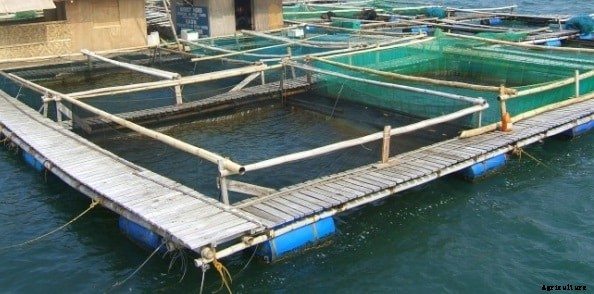
- Site Selection in Grouper Fish Farming: Site selection in fish farming is also a major factor to be considered for better yield. The site selected for net-cage culture should be free from predators and strong wind and waves. Apart from this, make sure there is enough water exchange and good water quality for net-cage culture of groupers.
- Construction of Net Cages in Grouper Fish Farming: In net-cage culture, floating cages are built with bamboo poles and polyethylene netting material at 25 to 50 mm diameter. In the process of cage culture, the net cages are formed by 2 net panels with one four side panel to form the waters of the net cage and other one bottom panel. Generally, these net cages are secured to bamboo poles (raft structure) buy ropes or wires. The rope system holds the bamboo together onto which the nets are tied. Buoyancy should be provided by empty plastic gallons attached to the bamboo frames.
- Stocking in Grouper Fish Farming: The ideal water temperature for grouper fish farming should range from 27°C to 30°C and dissolved oxygen content at 5 mg/l. It is recommended to have water salinity between 26-30% and pH 7.8-8.3. Commercial fish farmers should go for water testing to maintain optimal techno parameters. Generally fingerlings of grouper fish with length of 12-15 cm (which are being raised in nurseries) are stocked in net-cages @ 45-50/sq. meter. These fingerings should be fed with trash fish or any fish meal.
- Feeding in Grouper Fish Farming: Generally, feeding is done morning and evening @ 3to 5% of body weight. The grouper fish grow @ 90-100 grams/month and reach market size of 700 to 800 grams in about 7 to 8 months from an initial weight of 90-100 grams.
- Yield in Grouper Fish Farming: A net cage of 5 meter x 5 meter x 3 meter (Length, Width and Height of the net cage) can yield up to 600 kg in about 7 months from stocking period assuming that the fishes weighing 600 grams are being harvested (collected).
- Pond Culture in Grouper Fish Farming:
-
- Construction of Pond in Grouper Fish Farming: Well, pond preparation requires good attention for better yield. Pond area depends on the fish density (stoking capacity) and general pond depth is about 2 meters. Pond bottom should be levelled for easy harvest. It is recommended to have ponds in the inter-tidal zone to receive tidal fishing. Make sure continuous flow of clear water supply. The optimal techno parameters such as salinity, temperature should be maintained in the pond. The ideal salinity of 330 mg/l and temperature range 16-32°C should be maintained in pond culture of grouper fish. When it comes to pond size, generally it varies from 0.2 ha to 0.3 ha in area with a height of 1.5 meter to hold the water level with support of concrete dike. 0.5 meter from the ground should be left free (free board). Generally in open pond system, green algae are formed because of sun light and this needs to be removed frequently. A pipe system can also be integrated in pond system for daily removal of waste and excreta accumulating at the bottom of the pond.
- Stocking in Grouper Fish Farming: The ponds are stocked with 9-12 cm long fingerlings of groupers @ 40,000/ha.
- Feeding in Grouper Fish Farming: Feed should be provided twice a day (morning and evening is preferred) @ 7 to 8% of the body weight.
- Yield in Grouper Fish Farming: Under Ideal conditions, the fingerlings of grouper grow to 30 cm in length and 600-800 grams in weight in about 7 to 8 months. The survival rate would be 80 to 90%. In these conditions, one can expect a yield of 19 to 20 tonnes/ha.
Monitoring in Grouper Fish Farming:- Constant water monitoring is required for recommended quality, salinity and water temperature.
Harvesting in Grouper Fish Farming:- Collect the fish when they attain the market size of 600 grams. Usually they reach marketable size in 6 to 7 months.
Bottom Line:- Grouper fish farming has an excellent future as this fish possess high value in local and export markets. One can get decent profits in Grouper fish farming with proper fish farming business plan in place.
For Rohu Fish Farming: Read here.
For Asia Agriculture: Read here.


