
Welcome to Modern Agriculture!

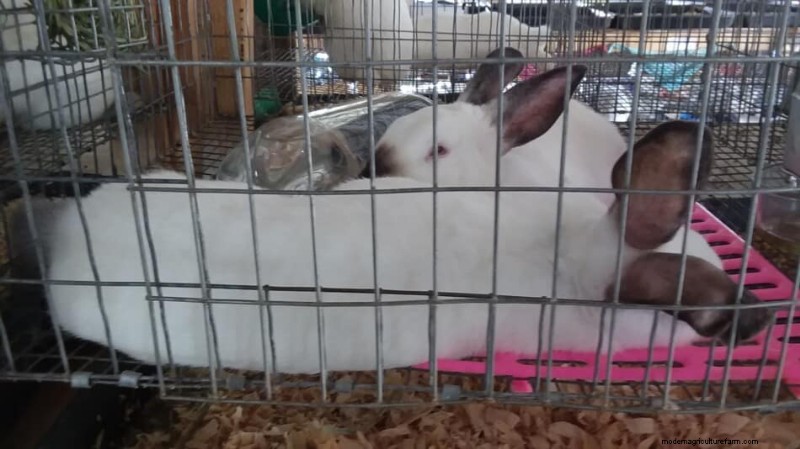
Thinking of getting a pair of meat rabbits? They would be a great way to start building your skills and providing for your family!
Here’s the big question that’s on everyone’s mind: how much meat can you expect a pair of rabbits to produce in a year?
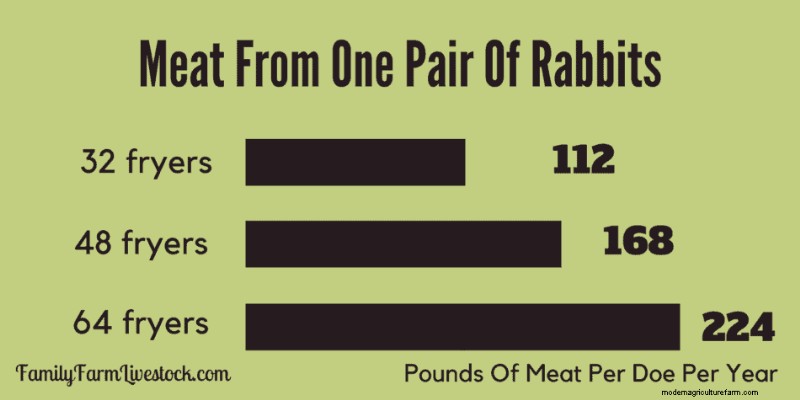
A pair of meat rabbits will produce 224 pounds of meat per year in a highly intensive breeding system or 112 pounds of meat per year in an average breeding system.
First off, you have a decision to make: do you want the highest production possible or a more moderate production plan?
Getting Started With Meat Rabbits goes over the cost of the rabbits, as well as the equipment you’ll need to raise fryers.
| Production schedule | Litters (per year) | Number of fryers (per doe) | Pounds of meat (per doe) |
| Intensive (high production) | 8 | 64 | 224 |
| Moderate (medium production) | 6 | 6 | 168 |
| Moderate (low production) | 4 | 4 | 112 |
This chart shows the basics to give you an idea of what you can produce with good meat type genetics.
Wondering about the cost of raising meat rabbits? Check out my article Cost To Raise A Rabbit For Meat.
This is also called an intensive breeding plan.
What you are doing here is breeding the doe back when she is nursing a litter that was born two weeks ago.
This is the type of breeding system that will get you the most fryers and then meat out of your rabbits.
Before you get too excited thinking about all of those fryers, realize that this high level of performance will require you to be on your game.
Your management must be top of the line and your nutrition plan must be super.
Intensive rabbit production is definitely possible, it will just require more from you and your rabbits.
This high level of reproduction will require genetics that can keep up.
No cheapo rabbits, here. Get good genetics to start with.
If you have decided that you can keep up with the needs of your doe and are willing to get breeding stock that can perform at this level, here is the math you can use to figure up your results.
Is Raising Rabbits For Meat Worth It? helps you figure out a budget for raising your own fryers.
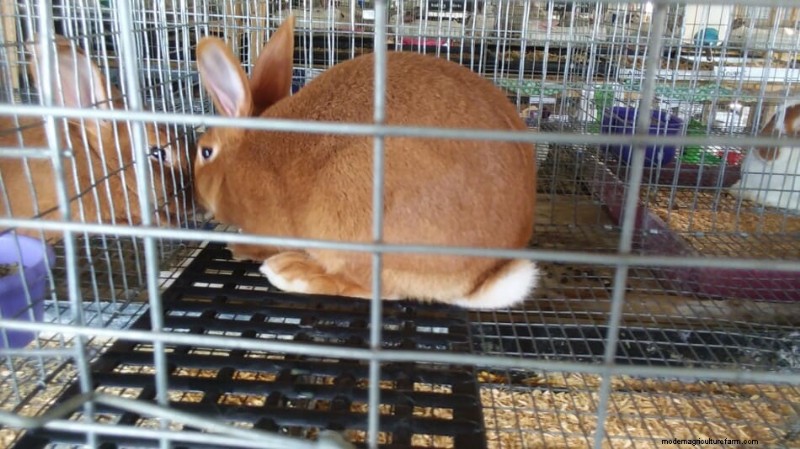
Kindling first litter: The kits are born!
Breeding: You will breed the doe back at two weeks post kindling.
Weaning the litter: She will need to be removed from the litter to wean the kits she has now.
Usually, the kits are weaned at 4 weeks, giving the doe some time off before the next kindling.
Kindling second litter: If you are still on schedule, your doe will give birth to a new litter 45 days or so after the first litter was born.
Now the schedule repeats on a 45 day cycle.
In order to get to the 224 pounds of meat per year, the 45 day cycle must be maintained.
Miss a few breeding dates or get messy with your management and things will start to go wobbly on you.
Here is a great article on profitability of raising meat rabbits, by Carla Carter.
Why should you read it?
The management tips that make a rabbitry profitable are also points to keep in mind to help you save money and be successful with raising your own meat.
This is good stuff, check it out.
If you can maintain the 45 day interval throughout the entire year, you will have your doe kindling 8 times per calendar year.
If she has an average of 8 kits per litter, you will have 64 fryers from this doe per year.
8 litters per year x 8 kits per litter=64 kits per doe per year
16 Breeds Of Rabbits For Meat gives you the common and the not so common meat rabbit breeds.
Each fryer will dress out at about 60% of live weight, when butchered at 5 pounds. This will get you 3.5 pounds of meat per fryer.
3.5 pounds of meat x 64 fryers=224 pounds of meat
Remember that this is a very intensive breeding plan and will only give you these results if you can keep up with the needed nutrition and management.
This 224 pounds of meat is something of a perfect world number.
What I mean by that is to reach the potential 224 pounds of meat per pair everything has to go right:
Another aspect of getting the 224 pound of meat that will be a challenge is that the first year with rabbits you are automatically behind schedule.
What?
The doe will need a 30 day gestation before the kits are born.
Unless you bought her bred and ready to kindle any day, you will need to wait for that first litter of babies.
The breeding plan is 45 days after kindling.
If you breed her to your buck or the buck you bought her will when you get them back to your house, you’ll need to add 30 days gestation to the front of the timetable.
This is only if you get a breeding age doe and buck.
If you purchased younger rabbits, you’ll need to wait until they are 6-9 months old depending upon the breed and your rabbit production schedule will start then.
With the 224 pounds plan that is hard to remember is that rabbits take 10 weeks to reach 5 pounds. Poor genetics, poor feeding practices/feed or alternative feeding (like grazing pens) will take longer.
This means that you don’t have any fryers to process for the freezer until 10 weeks after they are born.
Your second year and beyond the grow out time will overlap other rabbit activities. It will still take 10 weeks but be less noticeable.
The first year and especially the first litter, you’ll notice and you’ll wait.
Here is an example for the first litter:
Instead of seeming to take 10 weeks to butchering size, this first litter seems to take much longer.
It doesn’t, of course, you just think so since you haven’t gotten through the rabbit raising cycle yet.
You’ll only have this lag time at the start of the first year or anytime the production cycle doesn’t go as planned, like skipping a breeding or not breeding in the heat.
For a more moderate approach to raising your own meat and to make your does last longer, consider breeding on a more spread out schedule.
If you plan on 6 litters per year per doe with 8 kits per litter, you will be getting 168 pounds of meat per doe per year.
8 kits x 6 litters=48 kits
48 x 3.5 pounds of meat/fryer=168 pounds of meat per doe per year
Something more like 4-6 litters per year will be easier on the doe and allow for some “wiggle room” in management, meaning there is a bit of grace built in to the system.
A six litter per year plan will look more like this:
You’ll notice that this schedule and the intensive breeding schedule both have the first litter reaching butchering size on the same day, so the first litter is unaffected by the accelerated breeding schedule.
You could easily do a more relaxed schedule than this one, with litters every three months for a total of four litters per year.
This schedule will be easier on the doe but will drop your meat production back to 112 pounds of meat per year for the pair.
4 litters x 8 kits=32 fryers per year
32 fryers x 3.5 pounds of meat=112 pounds of meat per year
The easy answer here is to get more than a pair to start with. A buck can easily handle the breeding of five does.
If you need more meat, get a few more does.
I have to admit, I would start with a trio, two does and a buck, instead of a pair.
Or if you need more meat than this (you looked at the meat math above, right?), get a few more does.
It will cost the same to feed the buck if he is breeding one doe or multiple does over the course of the year.
We have to decide how often you want to eat rabbit each week or the pounds of meat per week you plan to need.
How Many Rabbits For A Family Of Four? is an article I wrote for anyone who wants to get into the numbers more specifically.
Once we know the weekly goal, we can figure out how many rabbits you need.
Let’s say you want to eat rabbit twice a week. You decide that one (3.5 pound) fryer will work for your family per meal.
2 fryers x 52 weeks =104 fryers needed per year
Or 3.5 pounds x 2 meals=7 pounds of rabbit meat per week
7 pounds x 52 weeks=364 pounds of meat needed per year
If you are wanting to manage for the more moderate production schedules, you will need:
4 does kindling 4 litters per year OR 3 does kindling 6 litters per year
If you are willing to manage your rabbits for the intensive production schedule, you will need:
2 does kindling 8 litters per year
If you want to change up the math a bit and go with eating one fryer per meal for five meals a week, the number of does you’ll need changes quite a bit. Let’s figure it up.
5 fryers per week x 52 weeks=260 fryers per year
For 260 fryers, you would need: 4 intensive does (at 8 litters per year), 6 moderate (at 6 litters per year) or 8 does at the lower production of 4 litters per year.
While that may seem like a crazy amount of fryers, it is doable, even on a small amount of land. That’s the beauty of rabbits!
If you are only wanting to have one doe and one buck the most meat you can produce from the pair is 224 pounds.
If you decided to that your family would need one fryer for one meal per week (52 fryers), one doe managed for the intensive breeding schedule would give you the meat you needed.
You will need more does if: you plan on eating rabbit for more meals per week or if you need more pounds of meat per meal.


