
Welcome to Modern Agriculture!


This year I switched from being a year-round cow-calf operation to being a seasonal heifer developer. I bought a group of 35 open, yearling Red Angus heifers in April, turned bulls in with them in August, and sold them pregnant in November. It went well enough that I plan to do the same thing next year, but I learned quite a few things the expensive and stressful way.
One of the biggest issues I had was with temperament. With a cow-calf herd, you keep the same cattle for years. They become calm as they get used to you and your management, and as they age. You can select for good disposition and cull cattle that are flighty or mean. Calves raised by calm cows become manageable, quiet adults.
Buying a new group of young cattle from another ranch every year takes these advantages away from you. Young stock in general are more nervous than adult cows. Any genetic management of disposition is out of your hands (aside from your choice of where to buy from). Frequency of human contact and quality of stockmanship at all places the cattle were before you get them will affect your experience.
There are wide temperament variations between and within breeds. For my first few years, I custom grazed a mixed herd made up of many breeds. All cattle were subjected to the same management. I find the Hereford and South Poll cattle I have worked with to be very docile. My Black Angus were the worst behaved when corralling, sorting and trucking. I raised a bunch of Belted Galloways, of all different colors. The black ones gave me more trouble (pinkeye susceptibility, fly load, refusal to go in the corral or through the chute, and attacking me at calf-tagging time) than the dun, silver and red ones. I am starting to think that the black color trait in cattle of many breeds is linked somehow to sparky behavior.
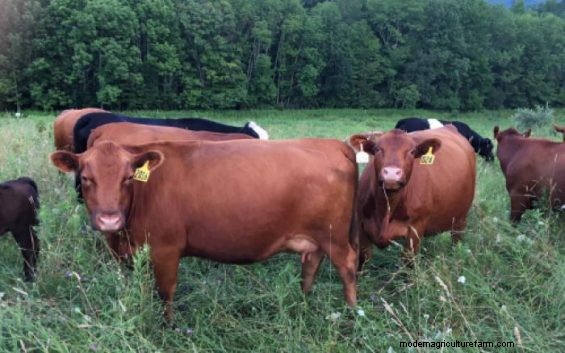
I have found the Red Angus in general to be more agreeable than Black Angus, but I still had a couple heifers and a bull this year that were complete jerks. Angus cattle of both colors are very smart (arguably smarter than I am). If they get away with something one time, they will keep on doing it. You must never let them find out that if they refuse to obey you, you will give up and let them win. There were occasions this year when I was trying to push the herd in a certain direction in the paddock, and they circled around me and ran past me the other way. Once they got by me that first time, they did it every time I tried to push them.
 How should you handle this situation? Stop trying to make cattle go places they don’t want to go. I’m not saying let the cattle dictate your management. What I’m saying is make them think it’s their idea to go somewhere, instead of letting them realize they are being managed. Any time cattle feel cornered or threatened, they stop thinking about what you want them to do. All they focus on is the threat (you) and how to escape that threat. Cattle are prey animals as opposed to predators. The survival of wild bovines for thousands of years has depended upon their ability to detect and escape from threats.
Cattle are curious animals when calm. I have been using their curiosity lately to get them to do what I want. Instead of pushing them into a new paddock, I call them while I am setting it up. I move the mineral feeder into the new paddock, then drive out of sight through the paddock on my ATV. It doesn’t take the herd long to follow me through the gate to see what’s in this new area I was just in. They are rewarded with fresh grass. Once they move through, I circle around and close the polywire behind them. This works because the cattle become curious about what’s through that gate, and they make the decision to go to the new paddock. (For an example of cow curiosity, check out this week’s Funnies.)

Pushing doesn’t work as well because they see no reason to leave their current familiar spot. Pushing also divides the herd’s attention between the new paddock and the “threat”. You want all of their attention on the new paddock. Back when I used to push cattle into new paddocks, there would sometimes be a flighty animal that would split off from the herd and double back. Chasing a lone bovine that is already scared does not accomplish anything. If this is happening, it means you are being too heavy-handed with them. Back off and that animal’s attention will shift back to the herd.
If you keep chasing a scared animal that is clearly not responding well to what you are trying to do, it will go through your fence and half of town. Quit while you are ahead! The animal will probably return to the vicinity of the herd when it calms down, and you will be able to catch it. If the same few cattle are consistently overreacting to a level of pressure that the majority respond well to, cull them!


