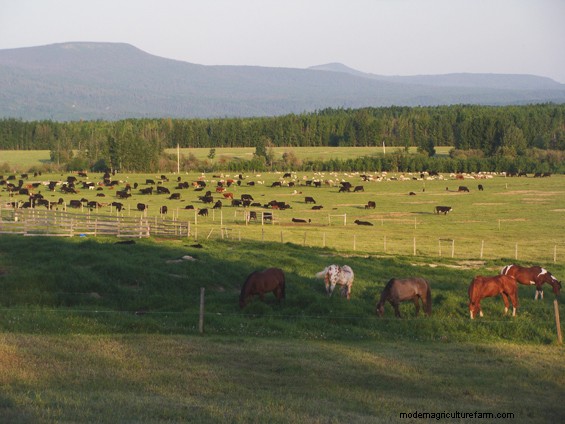
Welcome to Modern Agriculture!

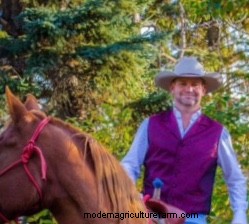
Tom Krawiec started putting multiple species into one herd as a way of reducing labor. His MOBs can include saddle horses, cattle, sheep and even pigs. In Part 1 of this series he described how he gets different species to behave as one herd and some of the helpful behaviors he’s seen as a result. In Part 2, he shared tips for birthing season and for grass management. Now he takes a look at some of the basic principles he keeps in mind as he’s moving his MOB through the grazing season.
No matter if your MOB has one species or more than one species, you must follow a couple of grazing principles. First, your rotation must be in tune with how fast the grass is growing. In my opinion, a grazing plan is critical! My first grazing plan was written in 2000. After 18 years I still rely on a grazing plan. With a plan you can see how often you need to be moving before you go out to check the grass. It has been my experience that the ‘grazier’s eye’ cannot always be trusted.
To illustrate a time when my ‘grazier’s eye’ was off, I will relate an amazing event. There was a paddock that had been under irrigation for about 15 years and only grazed with sheep. The stand was mainly short fescue from over grazing. When we came around to graze with the MOB, I could see that the grass was not ready. Consulting my grazing chart, I discovered we were already at 38 days of recovery. At that many days of recovery, the grass was not going to grow anymore. It was just going to get old! So with some trepidation, I moved the MOB (sheep, cattle, horses, and hogs) into the paddock for half a day. Eight days later, from a distance I could see a paddock lush and green. Upon closer inspection, that same short fescue paddock was covered with a variety of grasses about 12” high! I couldn’t believe my eyes, yet there it was. Once again, the importance of the grazing plan was confirmed as was the benefit of a multi-species MOB.
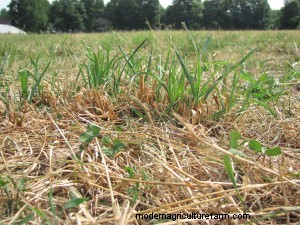
The second grazing principle that must be followed is the grazing period. When grass is growing fast, in three days there is enough regrowth that the plant can be bitten again. Further, the new growth will be sought out because it is like candy to an herbivore. By leaving your animals in a paddock longer than three days at this time, the plants are being over grazed and hence, weakened. To me it is as serious as injuring the animals grazing the plant. The only difference is that we can easily see an injured animal. We can’t readily see an injured plant.
Often during fast growth, I see a paddock with a huge amount of grass that has not been grazed or trampled. Early in my career I would leave the animals longer than what was on my grazing plan. By doing this, the rotation became too long and the paddocks ahead became mature and poor quality. You cannot catch up.
Several years ago I decided to just keep following the plan and not worry about the abundance of grass left undisturbed. What I discovered was that the animals topped most of the plants which kept them in a vegetative state. Certainly there are some plants that do go to seed. However, overall, the stand remains high quality which is very beneficial for gains and when stockpiling grass for winter.
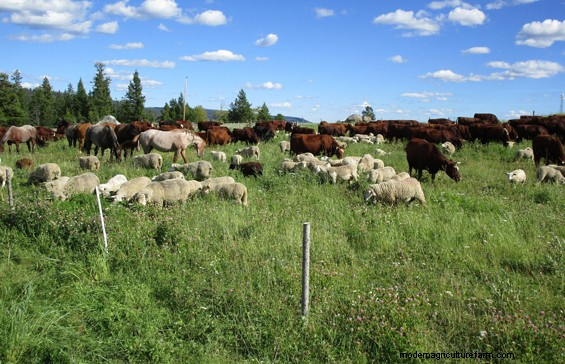
I mentioned in an earlier article the idea that each species ‘massages’ the soil differently. When your animals act as one unit, they tend to graze as a group massaging the soil as they go. They don’t graze as tight as strip grazing or ultra-high density grazing, but dense enough to have an impact on the soil. Our Holistic Management instructors, circa 1999, taught that 40 animals per acre are enough to elicit some herd effect. My observations would support that idea.
Strip grazing and/or high density grazing is a tool that can be used for brushing or for significant soil disturbance. It is my contention that it does not need to be used as a style of grazing. Again, it is my experience that when a group of animals is trained to behave as a single entity, they have enough impact to improve both the grass and the soil, which brings me to my last point on grass management.
Several years ago, my thinking went from only the grass, to the soil and the ‘animals’ below the soil. Through reading and listening to a variety of soil scientists, I realized I need to be feeding the animals below the surface the same high quality forage as the animals above the soil. This means I need to make sure the plants grazed and the material put down on the surface are in a vegetative state. This can’t be done grazing mature plants. Kristine Nichols, a soil microbiologist, has commented that for a healthy population of soil bugs, they must be fed more than once a year. Steve Kenyon, a year-round grazing specialist from Alberta, talks about providing room and board for the bugs. A multi-species MOB, following a well thought out grazing plan fulfills these requirements.
The real benefits of multi-species grazing come from the animals being grazed together. The same benefits are not realized when they are grazed separately on the same piece of land. To accomplish this goal, there are certainly logistics to overcome. Here are some examples:

1. Until hogs are about 150 pounds, I do not add them to the mix because they require grain up to that point. Sheep are very cagey and I have not been able to figure out how to keep them from getting into the self-feeder and eating all the pigs’ grain.
2. Horses tend to cause casualties to newborns because of their cavorting nature. Hence, they are not in the MOB until after the first cycle of birthing.
3. To finish lambs (110lbs) in five months and hogs (230lbs) in seven months, the stand must be high in legumes. I prefer red and alsike clover as well as cicer milk vetch over alfalfa. This is because there is much less chance of bloat and the other legumes are much more palatable than alfalfa so can be grazed just like grass.
I have not been able to run multiple species every year because of marketing issues and now, because I work for someone else. However, the benefits keep me trying to get as close as I can to my dream MOB of cattle, sheep, hogs, and horses. Sometimes all it has taken is some imagination and some courage to try!