
Welcome to Modern Agriculture!

Our March article on calving on grass talked about the monetary, health and stress reduction benefits of ranchers discovered. Here’s another way to improve birthing season that ensures more sleep, and less stress.
That’s the advice shared in this video by Glenn Selk, Oklahoma State University (OSU) Extension Cattle Specialist. The “Konefal Method” is named after a Canadian rancher, Gus Konefal, who discovered that changing his feeding time led to more calves being born during daylight hours. Researchers at the Kansas State Experiment Station followed up with a five year study to give us all a better idea of what we could expect from a change to evening feeding.
Here’s a way to make your upcoming calving, lambing and kidding season a little less stressful: feed your pregnant stock every evening, right around dusk. They’ll spend the night ruminating and wait to give birth until morning.
That’s the advice shared in this video by Glenn Selk, Oklahoma State University (OSU) Extension Cattle Specialist. The “Konefal Method” is named after a Canadian rancher, Gus Konefal, who discovered that changing his feeding time led to more calves being born during daylight hours. Researchers at the Kansas State Experiment Station followed up with a five year study to give us all a better idea of what we could expect from a change to evening feeding.
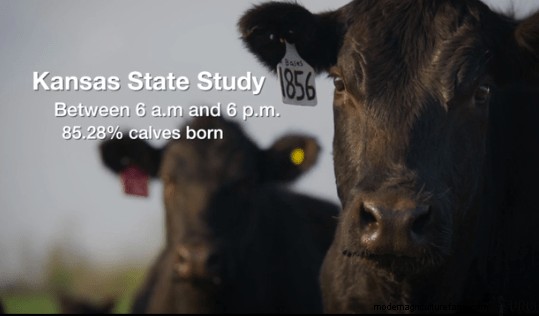
Their results are similar to other studies. Dusk feeding meant that 34% of calves came between 6:00 a.m. and 10:00 a.m. Another 21.2% came between 10:00 a.m. and 2:00 p.m., and then another 30% arrived between 2:00 p.m. and 6:00 p.m. That left only 15% of the calves being delivered between 6:00 p.m. and 6:00 a.m. Of course your results may vary. When I did this with my herd of 35 does, they all kidded during daylight hours making my life much easier.
If your livestock are grazing or you’re feeding with pre-placed round bales you can get a similar effect, though not quite as dramatic, by feeding a supplement in the evening. Research at OSU showed that 70% of calves were born during daylight hours just from this simple change.
We hope this video from OSU will make your life easier! Watch it here, or read the transcript below. The read on for info on sheep and goats too.
Glen Selk: As we get ever closer to the spring calving season, it’s time to think about how we can best save the most number of calves out of our cow herd this year. One of the ways of course is to provide assistance to those cows, and especially young heifers that might need some help. And that would be a whole lot easier if these cattle would have a high percentage calving during daylight hours.
Well there is a method that can be used that seems to encourage a higher percentage of the cattle to calve between say 6 am in the morning and 6 pm in the evening. It’s called the Konefal method, named after a rancher in Canada, that back in the ’70s discovered that if he changed the feeding time of his herd it encouraged a greater percentage of his calves to come in the daylight hours.
Research has been done extensively on this subject and seems to bear out what old Gus Konefal found out in Canada back in the 1970s.
Most recently information comes from Kansas State Experiment Station at Fort Hayes up in northwest Kansas. They kept track of that herd over a 5-year period of time. What they did was feed sorghum hay every evening right around dusk. And they kept track of the calving pattern of those cows over that 5-year period of time.
What they found was that when they did that, it looked like about 34% of the calves came in the four hour period between 6 and 10 am. Another 21.2% came between 10 am and 2 pm. And then another nearly 30% of the calves would actually arrive between 2 pm and 6 pm. That left only 15% of the calves that were delivered between 6 pm in the evening and 6 am the following morning.
That seems to reiterate some of the other research that’s been done around the country that suggests that if we can move the feeding to evening, that we get a high percentage of calves during daylight hours.
One of the questions that always come up, “Well I put out big round bales so the cows have access 24-7. What happens if we just change the supplement feeding to around dusk or 5 in the evening? Research here at Oklahoma State showed that it had a similar effect, perhaps not as dramatic. We had a record of about 70% of the cows calving between 6 am and6 pm when we changed the supplement feeding from earlier in the day until about 5 in the evening.
What some ranchers tell me is that they have had success by controlling when the cows have access to the big round bales. In other words, they put the big round bales in the feeder behind a fence and then open the gate to that particular pasture in the early evening hours. And then the following morning run the cows back out of that area into their normal pasture grazing area until the following evening. And they have reported good success in terms of having a high percentage of the calves coming in daylight hours.
It certainly looks like this method tends to work, will help us get a higher percentage of calves coming when we’re likely to be there to give assistance and have a higher survival rate from that calf crop.
Bill Fosher has this to add based on his experience:
Evening feeding worked well for my research goat herd as well. When we fed our 32 does in the evening, all of them delivered between 5:30 and 6:00 in the morning. Since we weren’t sure it would work, we still checked them throughout the day and night. But we learned from our results that this small adjustment made all the difference in the world!


