
Welcome to Modern Agriculture!

Planting an orchard is a long‑term investment that can yield fresh fruit and nuts for decades. Whether you’re starting a handful of trees in your backyard or developing a multi‑acre stand, thoughtful planning and execution are key to success.
From choosing the right varieties to designing a layout that accommodates mature growth, this guide covers every step you need to create a productive orchard that stands the test of time.
Decide which fruits and nuts will thrive in your region—apples, pears, peaches, plums, walnuts, almonds, pecans, and more. Your personal preference and the local climate will dictate the best options.
Start with the USDA Plant Hardiness Zone Map. It divides the U.S. and Puerto Rico into 13 zones based on average annual minimum temperatures. For example, a Zone 3 area (‑30 to ‑40 °F in winter) demands trees rated for Zone 3 or lower; a tree hardy to Zone 5 would struggle.
Dwarf trees are compact and easy to harvest but produce less fruit. Standard trees occupy more space, require tools for high fruit, but yield abundant crops and become impressive specimens. Semi‑dwarf trees offer a middle ground.
Planting multiple varieties of the same species ensures cross‑pollination where necessary. Self‑fertile trees—such as many apricots and peaches—don’t need a partner, but apples, pears, and plums often do. For example, pairing Black Ice and Toka plums creates a reliable pollination match.
Beware of incompatible combinations. Walnut trees release juglone, a compound that can poison neighboring apple and pear trees. Plant them with at least 30‑ft separation or use a dedicated walnut zone.
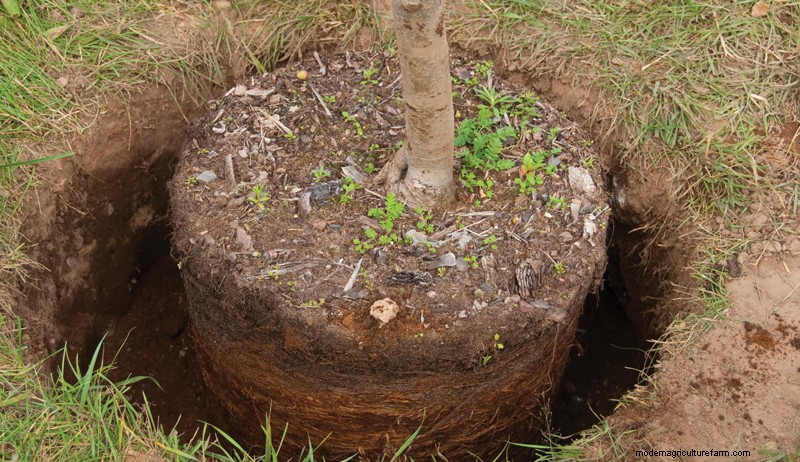
Ideal soil is deep, well‑drained loam—sandy loam preferred—with a pH of 6.0‑6.5. Aim for at least six, ideally eight, hours of full sun per day.
Windbreaks are essential in exposed areas. Rowed trees or buildings can shield orchard rows from harsh winds without creating excessive shade.
In cooler regions, south‑facing slopes retain heat longer, while north‑facing slopes buffer rapid temperature swings—use this to your advantage when selecting tree placement.
Draft a precise layout before you dig. Measure the site with a tape measure or Google Earth, then sketch a scaled plan on graph paper. A 20‑ft grid works well for standard trees; use a 5‑ or 10‑ft grid for dwarf or bushy varieties.
Mark each species with color‑coded markers to keep track of variety placement.
Read more: Planting trees on raised ground presents a number of challenges.
Consult nursery descriptions for expected height and spread. Standard fruit trees can reach 40 ft tall and 20‑25 ft wide; dwarf trees stay below 10 ft. Pruning can further control shape and size.
Nut trees such as walnuts and pecans may grow over 100 ft tall with 50‑ft crowns. Provide ample spacing to avoid crowding; otherwise, competition can stifle growth.
Read more: An orchard of nut trees can provide profitable protein in the years ahead.
Re‑confirm your plan on the ground. Use a GPS for corner accuracy and a tape measure for short distances. Mark corners with stakes and string for a clear visual guide.
Apply the Pythagorean theorem (a² + b² = c²) to ensure right angles if necessary.
Decide whether rows or scattered planting best suits your orchard’s size and intended machinery use. Commercial orchards often use geometric patterns—squares, triangles, quincunxes—to maximize yield per acre and ease equipment passage.
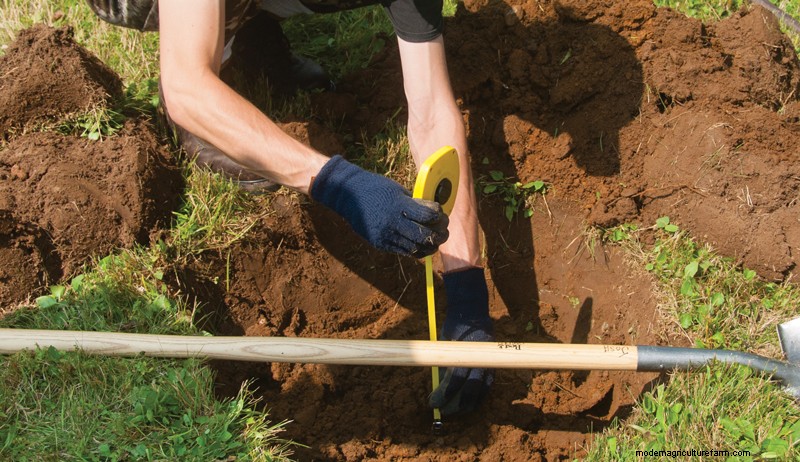
Dig holes 2–3 × root‑ball width, a few inches deeper than the root ball. Fill the bottom with loose soil to encourage downward root growth. For root‑bound potted trees, prune outer roots lightly.
Place the root ball so its top is level with or slightly below the soil surface, forming a shallow bowl that retains moisture.
Young trees need frequent watering: potted trees daily for the first weeks, then weekly for up to two years; bare‑root trees once a week during their first year. Mulch around trunks to conserve water, suppress weeds, and protect against winter cold.
Read more: Follow these 5 tips to build a better deer fence and protect your crops.
Deer, rabbits, and rodents can damage young trees. Install plastic tree guards to prevent girdling and winter sunscald. Use white fabric wraps during dormant months to reflect sunlight.
Ensure guards allow room for growth; plastic guards should be loose, while fabric wraps should be snug only during winter.
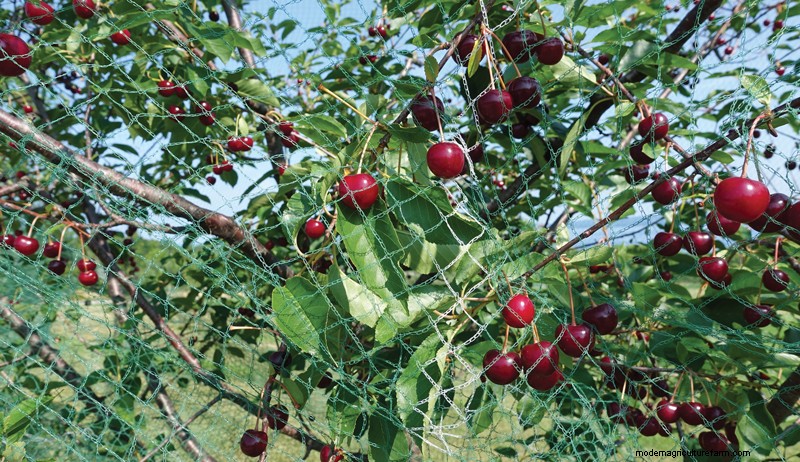
A perimeter fence at least 8 ft tall is the most reliable deterrent. Two shorter fences—one inside the other, 5–6 ft apart—can also work if slanted outward to confuse deer.
Alternatively, individual short fences (≈6 ft) around each tree can protect young trees while allowing branch growth. Welded wire on metal T‑posts is a flexible, removable option.
Choose climate‑appropriate trees, select a sunny, well‑drained site, and plan spacing based on mature size before digging.
Standard trees: 20–25 ft; dwarf varieties: 8–12 ft.
Deep, well‑drained loam with a pH of 6.0–6.5.
Not all. Self‑fertile trees include many peaches and apricots; apples, pears, and plums usually require a compatible variety nearby.
Early spring or fall, when trees are dormant and temperatures moderate.
Use tree guards, mulch, fencing, and consistent watering.
Fruit trees: 3–5 years; nut trees: 5–10 years or more.
Planting an orchard demands careful pre‑planning—tree choice, spacing, site conditions, and layout design. Even a modest number of well‑placed trees can become a reliable source of fruit and nuts. With thoughtful design, diligent care, and early pest protection, your orchard will thrive for decades.
This article was written for Hobby Farms magazine. Click here to subscribe.


