Dairy Farming In Karnataka, Loans, Subsidies, Schemes
Introduction to Dairy Farming In Karnataka
Karnataka State has always remained at the forefront of all agricultural development initiatives in the country and dairy development is not an exception. At a time when agriculture was grappling with the consequences of rapid and unidirectional intensification in its production process, dairy farming provided not just the much-required alternative but also revived and further strengthened the animal-crop production linkage. Taking full advantage of the potential of the dairy enterprise to provide continuous and regular employment as well as income, production in the state increased rapidly. Now the problem of surplus production has besieged the state to an extent that milk holidays have become a common and regular feature in almost all of its milk unions causing a great deal of inconvenience to milk producers, particularly during the flush seasons. Dairy farming in Karnataka, as elsewhere in the country, is largely characterized by the prevalence of dairy enterprises that are mostly subsidiary occupations alongside the main agricultural activity of the farmers. Specialized dairy enterprises do exist, but not only their number abysmally low as compared to regular types but also are restricted mostly to urban areas and their surroundings. Karnataka stands sixth in milk production in the country and it occupies the third position with respect to milk production under the cooperative sector in the country.
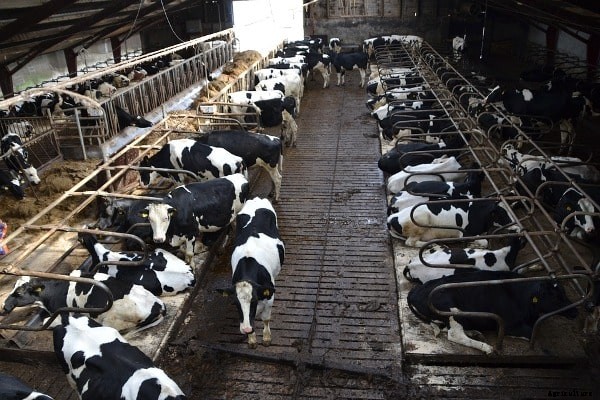
Dairy Cow Farming.
Development of Dairy Farming in Karnataka:
Dairy development in Karnataka has a history, the growth in the population of dairy animals, as well as the production, substantiates it. Karnataka Government has started an organization known a Karnataka Dairy Development Corporation in 1975. Bangalore, Mysore, Hassan, and Tumkur cover 8 Southern districts of Karnataka and later it covered all the districts.
The main objective of this project was for developing an integrated program for increasing milk production in rural areas of southern Karnataka, providing milk collection, processing, and marketing facilities, and technical services for artificial insemination and animal health. Milk cooperative societies were organized and grouped into unions, which had a dairy plant and a feed plant. The dairy development activity was continued under the organization of the Karnataka Milk Federation (KMF) that came into existence as a successor to Karnataka. KMF is the third largest cooperative in the cooperative sector in the country today in terms of procurement and sale. It stands first in South India.
Karnataka Milk Federation in Dairying:
Karnataka Milk Federation (KMF) is a cooperative Apex Body in the State of Karnataka representing dairy farmers’ organizations and also implementing dairy development activities since its inception. The dairy cooperative movement in Karnataka can be truly called the Farmers’ Movement since starting from the village level Dairy Cooperatives to the Federation at the state level. Karnataka Milk Federation is managing all milk unions and providing direction for the development of Dairy Farming in the State.
Milk Products in Karnataka:
Karnataka is a leading state in the manufacturing of milk products. At present, Karnataka Milk Federation and Unions are manufacturing and providing about 25 different dairy products, and the list has been increasing year after year, but milk and milk products are sold under the NANDINI brand name, which has become a household name in Karnataka. Toned Milk, Homogenized Toned Milk, Sterilized Milk and Full Cream Milk Under Nandini brand have been sold and some major products like Nandini Ghee, Butter, Curds, Skim Milk Powder, Cheese, Badam Powder, Paneer, Peda, Mysore Pak, Burfi, Jamoons, Khava, flavored milk, and Ice Cream are sold in Karnataka and also demand is there in other states.
Cattle and buffaloes have an integral part of the crop-livestock system in the Karnataka economy for the last thousands of years. The majority of the farmers are depending on Cattle and Buffaloes for milking and plaughing where the cattle population plays an important role in the farm community.
Farmers in rural areas supplement their income by producing milk through Cattle and buffalo and plough their land with male Buffaloes and Oxes. In recent years high yielding cross-breed cows have been playing a vital role in milk production than local, Cow, and Buffaloes.
Cross-bred cattle produce more milk as compared to indigenous ones at low cost. Karnataka is producing surplus milk at present and has been a rise in the per capita milk consumption in the country.
Cattle Breeds in Karnataka:
Karnataka state has six indigenous native cattle breeds. As the state does not have any prominent milch breed, the dairy farmers use crossbred cattle to increase milk production
Deoni cattle breed: Among the six breeds this is the only dual breed. Deoni male animals are mainly used for ploughing and transportation, And the cows yield up to 1,500 kg of milk per lactation. Deoni breed is distributed in Bidar, Gulbarga districts
The other five registered breeds are Amritmahal, Hallikar, Khilari, Krishna Valley, and MalnadGiddaand these are draught breeds.
The male animals of these breeds are good for ploughing and transportation, whereas cows are poor milk yielders with an average milk yield of less than 500 kg per lactation.
These animals are sturdy and can stand adverse climatic conditions.
Amritmahal cattle were used by Nawab Hyder Ali and Tipu Sultan for carrying ammunition into the battlefield on rough roads and across difficult terrains. Amritmahal breed is distributed in Chikmagalur, Davanagere, Shimoga, Hassan, Chitradurga, Tumkur districts.
Hallikar breed is distributed in Hassan, Mysore, Mandya, Tumkur, Ramanagara, Chamarajanagar districts.
Khilari breed is distributed in Belgaum, Bijapur, Bagalkot, Dharwad, Haveri, and Gulbarga districts
KrishnaValley breed is distributed in Belgaum and Bagalkot.
Malnad breed is distributed in Uttara Kannada, Dakshina Kannada, Udupi, Shimoga, Chikmagalur, Haveri, Hassan & Kodagu districts.
Both Amritmahal and Krishna Valley breeds are being considered for conservation.
Pandharpuri buffaloes are reared in northern Karnataka. The breed is popular for its rapid reproductive ability. This breed of buffalo yields 6-7 liters of milk per day. But under good management, the yield can go up to 15 liters.
Cooperative Milk Society in Karnataka:
The Dairy Cooperative Society functions and acts as a marketing outlet for milk produced in villages. The payment for milk procured, input facilities, veterinary first aid, sale of cattle feed, supply of fodder seeds, etc. are provided to the farmers through these societies.
District Milk Union In Karnataka:
Union is the middle tier of the complex cooperative organization’s network federating the village societies in earmarked geographical area form unions. The milk unions are organized to make economically viable and their jurisdiction extends from one to three districts.
Role of KMF in the State:
Karnataka Milk Federation is the final tier of the system by federating the milk unions in the state forming the state-level organizational unit.
The dairy union activities are being implemented by the federation. The main role of the federation is to market surplus milk and its products and to produce and supply centralized inputs.
There are 9,072 Dairy Cooperatives Registered, out of which 7,678 are functioning at village level in the state. 13 District Milk Unions are working as the middle tier of the complex cooperative society network.
Dairy cooperative society functions daily and acts as a marketing outlet for the milk produced in the village.
Input facilities are also channelized to the dairy farmers through these societies and include veterinary first aid, payment for the milk purchased by producers is also arranged through the societies.
A string of Dairy Cooperative Societies is organized to form a milk procurement route linked to the chilling center or a dairy.
The trend of establishing dairy co-operative societies by all unions has been increased in the state indicating that majority of co-operatives are established in a rural area to reduce Goulis in a rural area.
There has been a tremendous increase in the number of milk producers’ members in the state and production, marketing is also increasing rapidly year by year in the state.
There are five milk unions are Bangalore Kolar, Mandya, Tumkur, and Belgaum. Four unions cover the two districts they are Mysore Chamaraj Nagar, Bijapur, Bagalkot, Gulbarga, Bidar, and Dakshin Kannada, Udupi.
And other unions cover three districts, viz. Hassan, Chikkamangalur, Kodagu in Shimoga Union, covers Chitradurga and Davangere Districts. Raichur Union covers Koppala and Bellary Districts and One Union Territory extends to four districts. They are in Dharwad Union covering Gadag, Haveri, Uttar Kannada districts.
Feed and Fodder Utilization in Karnataka:
The feed and fodder used by the farmers for dairy farming in different milk zones in the state, clearly shows us that the usage of green fodder and dry fodder is higher in almost all zones in the state but the concentrates and labor usage is least.
In the Bangalore zone, the green fodder used for the cross-bred cows was significantly higher than that of the local cow or buffalo.
In Kolar zone dry fodder, green fodder concentrates and labor utilization is highest among crossbred cows.
In the Mysore zone, it is different, the dry fodder usage is higher than the green fodder use.
In the case of buffalo dry fodder usage highest, while that of green fodder is highest for crossbred cows, and labor usage is highest for crossbred while least for local cows.
In the Mandya zone, the green fodder usage is more than that of the dry fodder usage among all animals. Green fodder use for cross-bred is more than twice the green fodder utilization for buffalo.
The green fodder usage is highest for cross-bred cows followed by buffalo and local cows accordingly in the Tumkur zone.
In the Dharwad zone, the dry fodder use is higher than green fodder for local cows and buffalo while green fodder is used more for crossbred cows.
In the Belgaum zone, the dry fodder use is more than green fodder.
In the Bijapur zone, the striking feature is that the green fodder usage is more for all the animals, and green fodder used for buffaloes is more than that of the crossbred cow.
In the Gulbarga zone, the dry fodder utilization was more than green fodder for all types of animals.
In a Dakshin Kanada zone, the green fodder usage is more for crossbred cow and buffalo while it is less than dry fodder for the local cow.
In the Shimoga zone, the dry fodder usage is nearly twice that of the green fodder use in this one.
In Raichur Zone, the dry fodder usage is more than green fodder use for all the animals and use of concentrates is more for buffalo than crossbred cows.
In the Southern regions of Karnataka, the green fodder is used more for crossbred animals, whereas buffaloes and local cows were reared more on dry fodder.
In the Northern regions of Karnataka, dry fodder is extensively used perhaps due to the limited availability of green fodder round the year.
Read this: Fodder Crops For Dairy Cattle.
Loans for Dairy Farming in Karnataka:
Loans For Dairy Farm In Karnataka.
Central Bank of India: Offer loans for starting dairy units for milk productions.
Eligibility: Small and Marginal farmers, groups of farmers, firms, companies, societies, NGOs, etc.
Margin:
For loans up to Rs.1.00 lakh: Nil
For loans above Rs.1 lakh and up to Rs.5 lakh: 10%
For loans above Rs.5 lakh and up to Rs.10 lakh: 15%
For loans above Rs.10 lakh: 20%.
Repayment Period: Repayment period: 3-7 years.
SBI Karnataka: SBI is offering two bank loan schemes for Dairy related agricultural projects. The first one is -SBI Scheme For Dairy Societies- which provides finance for creating infrastructure like Construction of Milkhouse or Society office, Purchase of Automatic milk collection system, transport vehicles, Bulk chilling unit; and the second one is SBI Dairy Plus Agriculture loan scheme that provides finance for milk-producing societies recognized private milk dairies posting profit in the past two years.
SBI DAIRY PLUS AGRICULTURE LOAN SCHEME: gives loans from 50000 to 5 Lakhs.
SBI DAIRY SCHEME FOR Dairy Societies: LIMIT OF LOAN FOR DAIRY SOCIETIES: Milkhouse or society office Rs. 2 lakh, Automatic milk collection system Rs. 1 lakh, Milk transportation Rs. 3 lakh, Chilling Unit Rs. 4 lakhs.
IDBI Dairy Loans: Offer loans for Individuals and groups of farmers for Purchase of high-yielding milch, Construction of cattle shed, Purchase of dairy equipment, chaff cutters, etc., and expenditure for transportation of animals where the animals are not purchased locally.
Loan Limit: Min: 50000 to Max: 10 Lakhs.
Repayment Period: 3 to 6 years.
Canara Bank: Offer loans for 1. Construction of cattle shed 2. Purchase of high-yielding milch cattle (yielding not less than 5 liters per day) 3. Purchase of dairy equipment, cattle feed, and the cultivation of green fodder. 4. Expenditure incurred for transportation of animals where the animals are not purchased locally. 5. Initial feed cost for a period of 1 month at the rate of 120 kgs. per animal for the first batch of animals. 6. Setting up on-farm processing and pasteurization plants. 7. Rearing of heifers.
Eligibility:
The farmer should have cattle shed/arrangements enough to house the existing animals if any, and those proposed to be purchased.
The farmer should be cultivating green fodder or should have definite arrangements for its supply.
Drinking water should be available in the area.
Veterinary facilities should be readily and easily available, including a facility for artificial insemination.
The farmer should have experience/knowledge in maintaining dairy animals.
There should be assured marketing facilities.
Loan Margin: Loans up to Rs.1 lakh – Nil Loans above Rs.1lakh – 15-25%.
Repayment Period: 5 to 6 years.
Subsidies for Dairy Farming in Karnataka:
Subsidies For Dairy Farming In Karnataka.
Pashu Bhagya
The Scheme includes Back ended subsidy of 33% to farmers belonging to Scheduled Caste and Scheduled Tribes and 25% to other small and marginal farmers will be provided to start cattle, sheep, goat, pig, poultry units with a maximum loan of Rs.1.20 lakh from commercial banks (The subsidy to SC/ST has been revised from 33% to 50% vide Pashu Bhagya Administrative)
Short-term loans up to Rs.50, 000/- at 0% interest are given through Co-operative Banks, on the lines of crop loan, for providing cattle feed/other maintenance expenditure.
The subsidy is offered to the members of Milk Producers’ Co-operative Societies for payment of insurance premiums up to 5 cattle.
The scheme provides Rs.5,000/- ex-gratia under ‘Kurigahi Suraksha Scheme.
Read this: Contract Farming.
NABARD Subsidies for Dairy in Karnataka:
The NABARD subsidy for dairy farming scheme helps in:
In setting up modern dairy farms for the production of milk.
It offers subsidies for heifer calf rearing thereby conserve good breeding stock.
It helps in a structural change in the unorganized sector so that initial processing of milk can be taken up at the village level itself.
It helps in upgrading the quality and traditional technology to handle milk on a commercial scale.
It creates self-employment and provides infrastructure, mainly for the unorganized sector.
Eligibility in NABARB Subsidies:
Small and Marginal Farmers.
Individual Entrepreneurs.
Startup Companies
Groups of unorganized and organized sectors etc.
Groups, Dairy Societies, Milk Unions, and Milk Federations, etc.
NABARD Subsidy Schemes:
Type1: For the establishment of small dairy units with crossbred cows/ indigenous descript milch cows like Sahiwal, Red Sindhi, Gir, Rathietc / graded buffaloes up to 10 to 15 animals.
Investment: the investment will be Rs 5.00 lakh for 10 animal units – the minimum unit size is 2 animals with an upper limit of 10 animals.
Subsidy: 25% of the investment (33 .33 % for SC / ST farmers,). The Subsidy shall be restricted depending on the unit size.
Type2: Rearing of heifer calves – cross bred, indigenous descript milch breeds of cattle and of graded buffaloes – up to 20 calves.
Investment required: Rs 4.80 to 4.90 lakh for 20 calf units – the minimum unit size of 5 calves with an upper limit of 20 calves.
Subsidy: 25% of the investment (33.33 % for SC / ST farmers. The Subsidy shall be restricted depending on the unit size.
Type3: Vericompost (with the milch animal unit. To be considered with milch animals and not separately).
Investment: Rs. 20,000/-
Subsidy: 25% of the investment (33.33 % for SC / ST farmers).
Type4: Purchase of milking machines /milk testers/bulk milk cooling units (up to 2000 lit capacity).
Investment: Rs 18 lakh.
Subsidy: 25% of the investment (33.33 % for SC / ST farmers).
Type5: Purchase of dairy processing equipment for the manufacture of indigenous milk products.
Investment: Rs 12 lakh.
Subsidy: 25% of the investment (33.33 % for SC / ST farmers).
Type6: Establishment of dairy product transportation facilities and cold chain.
Investment: Rs 24 lakh.
Subsidy: 25% of the investment (33.33 % for SC / ST farmers).
Type7: Cold storage facilities for milk and milk products.
Investment: Rs 30 lakh.
Subsidy: 25% of the investment (33.33 % for SC / ST farmers).
Type8: Dairy marketing outlet / Dairy parlour.
Investment: Rs 56,000/-
Subsidy: 25% of the investment (33.33 % for SC / ST farmers).
In case if you are interested in this: Quail Farming Business Plan.