
Welcome to Modern Agriculture!

Today, let us go through the details of Fish Farming In Andhra Pradesh.
Andhra Pradesh state is the 2nd largest contributor of fisheries in India. Farmers in coastal Andhra Pradesh are responsible the Aquaculture and Pulasa fish is the special fish of the Godavari River. A fish farming method is a form of aquaculture, the act of fish farming is about raising fish commercially in tanks or enclosures for human consumption. Aquaculture is also called “aqua farming” which relates to the farming of aquatic organisms such as fish. The farming aspect of aqua farming implies aspects of intervention in the natural growing process to enhance production. According to the United Nations Food and Agriculture Organization aquaculture has grown 3 times faster compared to land-based animal agriculture.
Fish farming is mainly raising fish commercially in the tanks and ponds for the purpose of producing food. The fish farming business is the only way of earning for several people in the world including India.
Fish provides high-quality protein for human consumption. A farmer can often integrate fish farming into the presented form to create additional income and improve its water management. The farmers themselves choose the fish species they wish to rise. The fish created in a pond is the owner’s property; they are secure and can be harvested at will. Fish in wild waters are free for all and make an individual share of the regular catch uncertain. Fish in a pond are generally close at hand. Effective use of marginal land example land that is too poor, or too costly to drain for agriculture can be profitably devoted to fish farming provided that it is suitably prepared.
Data from the Directorate of Fisheries has revealed that the state has been exporting more quantities of fish abroad while depending upon its neighboring state Andhra Pradesh (AP) for meeting its domestic demands. The report comes at a time when there are many hues and cries over the probable presence of formalin, a cancer-causing chemical, in fishes brought from Andhra Pradesh. Sources in the directorate claimed that the state has been exporting fish to some foreign countries like the USA, United Kingdom, and Japan.
Most importantly, the export volume from the Andhra Pradesh state has been on a constant rise. According to the data, the Andhra Pradesh state had minted Rs 1,792 crore by exporting fish in 2015-16 fiscal while the figure was Rs 2,205 crore in 2016-17 and Rs 2,414 crore in 2017-18.
An authorized of the Directorate of Fisheries claimed that fish farmers in Andhra Pradesh are much ahead of their counterparts in Odisha in terms of volume of production. “Fish farmers in Andhra Pradesh can produce up to 20 tone fish from a pond, whereas our fish farmers are growing only 10 to 20 quintal,” said the official. It is learned that several fish traders from AP have either purchased land in some coastal districts of Odisha or have taken them on rent for fish farming.
Krishna district has an available top position in shrimp and fisheries production across the state. Kaikaluru, Gudivada, and Kolleru region of the district, which plays a main role in aqua exports, are now using advanced techniques with the minimal practice of antibiotics and chemical drugs. However, the ban forced by northeastern states alleging traces of formalin in fish is not showing any impact as most of the exports from the district is live fish.
There are many advantages of starting a commercial fish farming business and below are some of the main benefits.
Read this: Poultry Farming Loan, Application Process.
Koramenu (Chana Marulias/Murrel/Snakehead), Bocha (Catla/Katla), Tilapia, Rohu, Tella Chanduva (Pomphret), Pandu Goppa, Vanjaram (Mackeral/Kingfish), Jella. Most of the ponds are cultivated with prawn culture as well.
Some typical methods of fish farming in Andhra Pradesh.
1- The 1st method is the “Cage System” which uses cages that are placed in lakes, ponds, and oceans that contain the fish. This method is also extensively referred to as offshore cultivation. Fish are reserved in the cage-like structures and are “artificially fed” and harvested. The fish farming cage process has made many technological advances over the years, especially with reducing diseases and environmental concerns. However, the number one concern of the caging process is fish escaping and being loose among the wild fish population.
2- The second method is the “Irrigation Ditch” for raising fish. This basic condition for this method is to have a ditch or a pond that holds water. This is a unique system because at a small level, fish are unnaturally fed and the waste produced from the fish is then used to fertilize farmers’ fields. On a better scale, mostly in ponds, the pond is self-sustaining as it grows plants and algae for fish food.
3- The 3rd method of fish farming is called “Composite Fish Culture” which is a type of fish farming that allows both local fish species and imported fish species to coexist in the same pond. The number of species depends, but it is sometimes upwards of 6 fish species in a single pond. The fish species are always suspiciously chosen to ensure that species can coexist and reduce competition for food.
4- The 4th method of fish farming is called “Integrated Recycling Systems” which is considered the largest scale method of “pure” fish farming. This approach uses large plastic tanks that are placed within a greenhouse. There are hydroponic beds that are placed close to the plastic tanks. The water in the plastic tanks is circulated to the hydroponic beds, where the fish feed waste goes to supply nutrients to the plant crops that are grown in the hydroponic beds. The popular types of plants that are grown in the hydroponic beds are herbs such as parsley and basil.
5- The last type of fish farming method is known as classic fry farming this method is also known as “flow-through system”. This is when sport fish species are raised from eggs and are set in streams and released.
Fish breeding is a challenge that attracts lots of aquarists. While several species reproduce freely in community tanks, most require special conditions, known as spawning triggers before they will breed. The bulk of fish lay eggs, known as spawning, and the juvenile fish that emerge are very small and need tiny live food or substitutes to survive. A fair number of popular aquarium fish are Livebearers which create a small number of relatively large offspring. These regularly take ground flake food straight away.
The best and high-quality fish feed can make the most of the overall production. The majority of the farmers in our country depend on the natural feeds of the pond. But for commercial production, you must have to supply the fish high quality and nutritious food. You can also apply different types of integrated fish farming systems. Very profitable and most popular integrated fish farming systems are fish-poultry, fish-dairy, fish-duck, fish-pig, fish-paddy, fish-goat, and fish-vegetables.
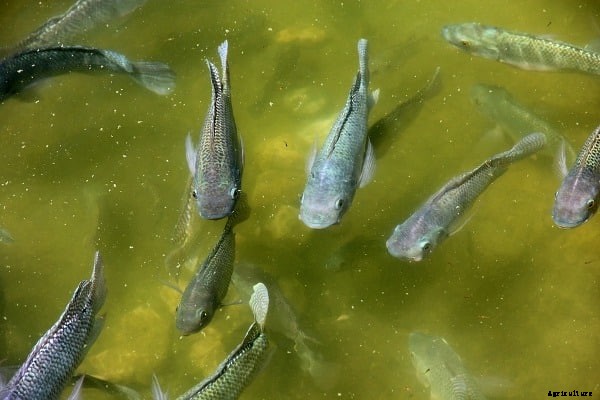
Fish feed is the main expenditure for fish farmers. Good quality fish feed management can reduce overall culture cost, improve the fish farm environment and ensure healthy growth of the fish stock. Fish feed management includes choosing the right feed, using the right feeding method, calculating the feeding cost, and ensuring the cost-effectiveness of a fish farm.
Fish farming or pisciculture involves raising fish commercially in tanks such as fish ponds, usually for food. It is the main form of aquaculture, while other methods may fall under mariculture. The construction of a pond can be the most difficult and most expensive part of fish farming. A well-built pond is an excellent investment that can be used for many years.
Read this: Fish Pond Design and Construction Plan.
The steps in building a fish pond are:
The average pond supported 320 pounds of fish per one acre. This “standing crop” consisted of 224 pounds of bluegill, 36 pounds of largemouth bass, and 60 pounds of miscellaneous fish per one acre. Once you have a pond, it is important to know the correct acreage, maximum depth, average depth, and water volume.
Here are some of the most popular places for fish farming in Andhra Pradesh.
The Coastal Aquaculture Authority (CAA) was recognized under the Coastal Aquaculture Authority Act, 2005 and notified vide Gazette Notification dated 22nd December 2005. The main purpose of the Authority is to regulate coastal aquaculture activities in coastal areas in order to ensure sustainable development without causing damage to the coastal environment. The Authority is empowered to make regulations for the building and operation of aquaculture farms in coastal areas, an inspection of farms to ascertain their environmental impact, registration of aquaculture farms, fitting standards for inputs and effluents, demolition of coastal aquaculture farms, which cause pollution, etc.
Read this: Biofloc Technology Aquaculture.
Fish farming is the act of raising or rearing fishes for commercial purposes.
Loan Amount for Fish farming in Andhra Pradesh:
In case if you are interested in this: Quail Farming Business Plan.


