
Welcome to Modern Agriculture!

The following details are about Growing Chayote Squash / Chow Chow vegetable.
Among all the vegetables the Chayote is one of the oldest vegetable that has originated and is being cultivated. It is an edible vegetable. It belongs to the Cucurbitaceae family. The scientific name of Chayote is Sechiumedule. The Chayote is also known pear squash, christophine, pipinola, vegetable pear or cho-cho. By the 18th century, they were spread throughout the Caribbean and South America and then into Europe, Africa, Australia and Asia. The Chayote plant originated in Central America. It is a perennial vine. It is an annual plant whose natural habitat is in the temperate climates. It thrives very well in cool areas also. Each and every part of Chayote can be consumed. The chayot can be used for medical purposes also.
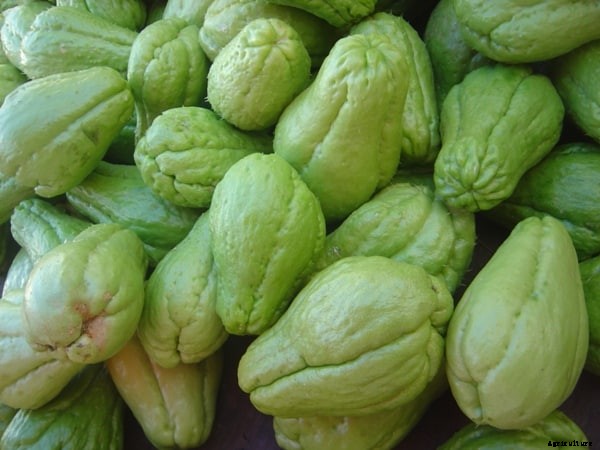
Chayote de Caballo:
Chayotillo:
Cabeza de Chango:
The soil for growing the Chayote should be well-draining. The soil which has more oolitic limestone can be used to produce better yield. The pH value of the soil should be 6.0-6.8 for Growing Chayote Squash plants. The Chayote is always referred to as a tropical plant, the plant of Chayote can thrive in the lowlands, but successful growth can be seen only in tropical areas. The temperature, which is required for the Chayote plant is 27˚C – 29˚C. The crop needs bright sunlight for growth.
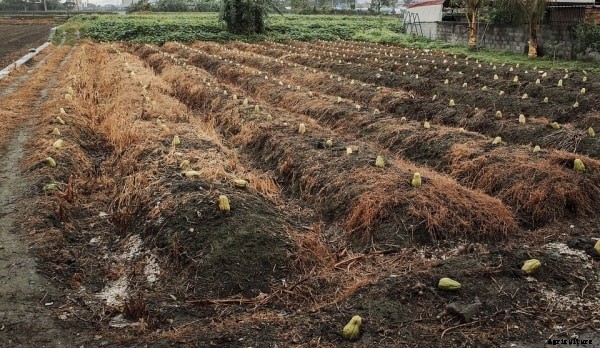
Before preparing the land the weeds and stones should be removed from the land. Land should be well prepared by mixing manure with soil. Shallow holes should be prepared of 1 sq. foot wide and the distance between the holes should be 3 m between hills and rows. Now the land should be supplied with the organic fertilizer to make the soil fertile. 3 fruit seeds should be sown in one hill, leaving 1/3 of the seed exposed. In rainy season the planting should be done so that much irrigation is not required.
The Chayote plant propagation is done by the seeds. The seeds generally germinate inside the fruit which is fully mature. Actually, it is customary to keep the fruit to sprout, but some people remove it to consume it as a fruit.
The organic fertilizer should be in the form of chicken manure or composted manure. While side dressing of the plant, basal fertilizer @ 3-5 tonnes per hectare should be applied. The triple 14 or triple 16 should be applied @ 2 sacks per hectare or as an alternative the organic fertilizers should be applied for good growth and development of the crop. The soil should also be raised to cover and to support the base of the plants and also to apply the fertilizer for them.
The Chayote plant requires more water. The planting should be done in such a place where the water is abundant and there is constant irrigation without any water problem. The plant should be facilitated in such a way that it should receive minimum 1000-2000 litres in a year. Incase of water-logging, there should be a facility for draining the water as soon as possible. The crop should be grown in rainy season so that there would be no problem for irrigation. While in the summer season, the amount of water should be irrigated is usally high.
The flowering and fruiting happens in a natural way. The fruits fall down when they are ripe and get completely rotten in some days. The seed of the fruit doesn’t develop roots and start germinating like other fruit crops. The fruit should be cut from the tree and the fruit should be kept in damp and dark place so as to develop new buds and new leaves from it.
The Chayote fruit has great ability of good germination and it start on its own without any particular place for germination. For example: If you leave the fruit in warm temperature, after few days it starts tendering the shoot and begins to grow. When the plant is ready the stem reaches 20-25 cm of its tendrils.
Weed control: Weed control in the field also helps in deterring other pests in the field. The below measures can be used for the weed control.
De-leafing: We should remove all the old and dried leaves in every 3 months. This makes the tree produce young and active leaves which are helpful in plant growth, for light reception and good food production. The plants which are infected with diseases or any other virus should be removed.
Mulching: The plants which are unwanted are called weeds. Mulching the base of the plants can control weeds and retain soil moisture.
Trellising: The plant vine should be tied with thread so that the vine grows and the root development will also be good.
The pests infesting the Chayote plant are Plant Bug, Spider Mites and White flies.
Control measures for the pests:
The diseases infecting the Chayote plant are mostly Viral in nature.
Control measures for the diseases:
The harvesting should be done once in a week. We should harvest the fruits which are smooth in texture and not fibrous. The harvesting should be done always early in the morning. So, that the morning temperatures will be low and the fruits will also be fresh.
Storing: After harvesting them. They should be cleaned and kept in a cold storage where the temperature is 9˚C – 12˚C and the humidity is maintained at 90% for 6 weeks before they show the symptoms of shrivelling. Further low temperatures may cause pitting and browning to the fruit.
Selection: The fruits should be harvested early in morning due to low temperatures, if not the fruits should be pre-cooled with water at 0˚C. Before storing them they will be graded according to their size, colour, appearance and health. The colour will be olive green and they appear smooth without the spines.
Packing: The fruits are individually packed in polyethylene bags, so that there is no accumulation of water vapour and fruit transpiration. While transporting them to the commercial markets they should be packed in boxes.
The number of fruits harvested per vine is 75-600 and it depends on the variety of the Chayote. The average yield of the Chayote in a hectare of land is 120,000 tonnes in a year.
Honey: The honey is one of the by-products which is extracted from the Chayote flowers. The female and male flowers are heavily visited by honey bees and they have 10 glands into which abundant amount of nectar can be stored and some people who know about this believe that it is one of the best honey extracted from the plants.
Fiber: The use of fiber is in cordage and in weaving. The fiber can be extracted from the old stems.
Vine: The vine of this crop is used for livestock grazing.


