
Welcome to Modern Agriculture!

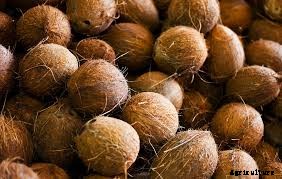
The home of coconut might have been somewhere in south East Asia, most probably in Malaysia or Indonesia. It moved eastwards to the Pacific region, and further to America. In Pakistan it is cultivated Coconut is mostly grown in coastal areas of Sindh and Baluchistan.
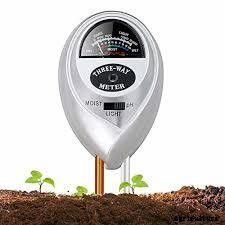
Coconut palm thrives in almost all types of well drained soils such as coastal sand, red loam, laterals alluvial and reclaimed soils of marshy low lands. Though it is mainly grown in the coastal plains it is possible to grown even at elevation of 600 to 900 m above M.S.L. in areas near the equator where the temperature remains favorable. Among the climatic factors affecting the palm, rainfall is the most important. A rainfall of 1000 to 2250 mm per annum evenly distributed throughout the year appears to be most congenial. Regions with long and pronounced dry spells are not suited to its growth. Coconut palm requires equable climate neither very hot not very cold. The maximum mean annual temp, for good growth is about 27°C with a diurnal venation of about 6° to 7°. Persistent high humidity is harmful and incidence of bud rot is more under such a conditions. The palm requires bright, sunshine of about 2000 hours a year.
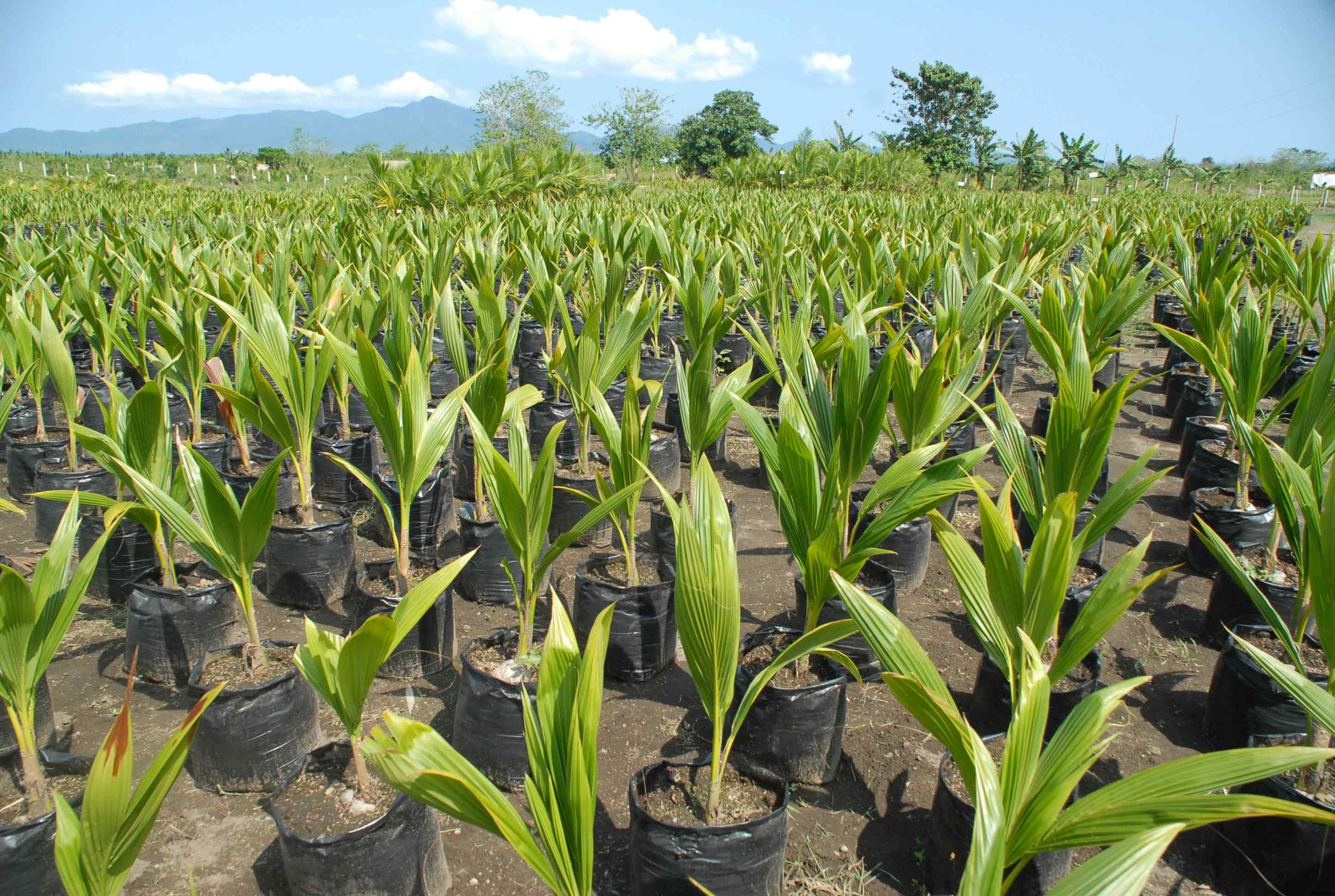
Since, it is a cross-pollinated crop which is propagated only by seeds, the selection of planting material is of vital, importance selection has to be made at the mother palm level and at the seedling stage. The mother palm should be between age group of 25 to 60 years, should be healthy, high yielding and regular in bearing. Immature arid under-developed seed nuts should not be used. The selection of seedlings at nursery stage is also important. Generally nuts harvested from January to April are used for raising seedlings. The seedlings should be:
The depth of pit depends on soil type in sand loam soil pits of 1 x 1 x 1m is generally recommended. In laterite soils, the pits of 1.2% 1.2 x 1.2 M are necessary. The pits are taken at the distance of 7.5 to 9 M apart thus accommodating 177 to 124 palm/ha. The-planting is done by square system, deep planting method is adopted. It is good practice to spread two layers of coconut husk at the bottom of the pits in areas where drought conditions prevail The seedling is placed at the center of the pit in such a way that the top of the husk is just visible from outside. The earth is well pressed down in order to keep the seedling firmly in position. In well-drained soil where water stagnation is not a problem transplanting is done at the beginning of the monsoon. In low lying areas planting is done after monsoon. The transplanted, seedlings should be shaded and irrigated properly during summer. Irrigation with 45 litres of water once in four days has been found to be the optimum especially in sandy soils.
Application of fertilizers in general reduces the prehearing age of palms. They generally start bearing at the age of five or Seven years after planting and the stabilized yield is obtained from 10th year onward till the age of 60 years. Regular intercropping and manuring is essential – for stepping up and maintaining the productivity of palm. Tillage including digging, ploughing the interspaces, making shallow basins with a radius of 2m and applying fertilizer. The proper recommended an annual application of following nutrients/palm/year.
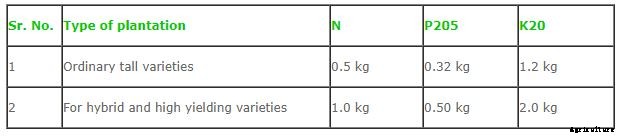
Application of the annual dose of fertilizers in two or more splits had been found highly beneficial in increasing the yield and quality of nut. To obtain higher efficiency in the uptake of nutrients of fertilizers are to be applied in circular basis 20 to 25 cm deep and 1.5 to 1.8 m radius round the base of the palm.
The phenomenon of the occurrence of barren nuts (without or with imperfectly developed Kernel) is very old. Only certain trees in the coconut plantation produce large number of barren nuts. The nuts are generally oblong in shape and quantity of husk produce is very much less as compared to normal, nut. The embryo in the barren nut is mostly absent or when present. It is in varying stage of decay. Fungal infection is also sometime noticed in the embryo resulting in the decay of the kernel and loss of water inside. In the barren nut cracking of shell is relatively more common. Several causes for the phenomenon have been reported:
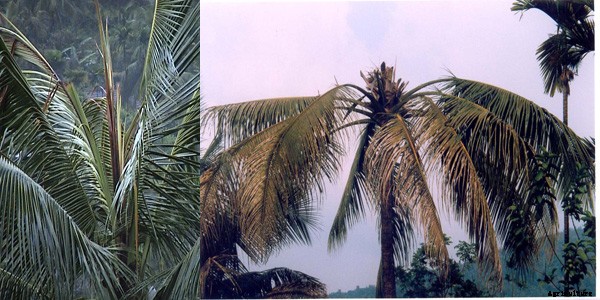
Palms of all age are liable to be attacked but normally young palms are more susceptible, particularly during monsoon when the temperature is low and humidity is very high. In seedlings, the spear leaf turns pale and comes off with a gentle pull. The earlier symptom is the yellowing of one or two younger leaves. Black spots appear on spindle leaves. Basal tissues of the leaf rot quickly and can be easily separated from the crown. Infection spreads to the older leaves, causing sunken leaf spots covering the entire leaf blade. Spot margins are irregular and water soaked, and when the leaves are unfolded the characteristic irregular spots are conspicuous on the blade. In the later stages the spindle withers and drops down. The tender leaf base and soft tissues of the crown rot into a slimy mass of decayed material emitting foul smell. Ultimately the entire crown falls down and the palm dies.
In early stages of the disease, when the spindle leaf starts withering, cut and remove all affected tissues of the crown along with some healthy tissues and apply Bordeaux paste and protect it from rain by providing a mud pot or a polythene covering till normal shoots emerges.
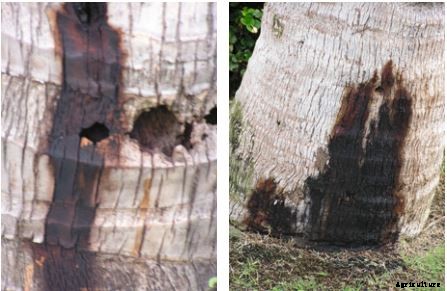
Stem bleeding is characterized by the exudation of a dark reddish brown liquid from the longitudinal cracks in the bark and wounds on the stem trickling down for a distance of several inches to several feet. The lesions spread upwards as the disease progresses. The liquid oozing out dries up and turns black. The tissues below the lesions become rotten and turn yellow first and later black. In advanced cases, the interior of affected trunks are hollow due to decay of interior tissues. As a result of extensive damage in the stem tissue, the outer whorl of the leaves turn yellow, dry and shed prematurely. The production of bunches is affected adversely. Nut fall is also noticed. The trunk gradually tapers at the apex and crown size becomes reduced in chronic cases.
For early infections, chisel or scrape out the rotten portion. Treat wounded or infected areas with fungicide and tar (for example, Bordeaux paste, mancozeb, or copper oxychloride), followed by sealing with coal tar two days later. Burn or destroy the chiseled pieces. Apply neem cake to the base of affected plants. Advanced symptoms may be virtually untreatable, requiring palm removal and destruction. Weakened coconut palms with rotting stems may be a toppling hazard in high winds.
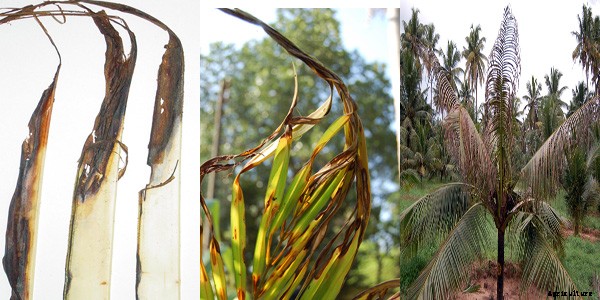
The first symptom is the appearance of water-soaked brown lesions in the spear leaves of root-wilt affected palms. Gradually these spots enlarge and coalesce resulting in extensive rotting.As the leaf unfurls the rotten portions of the lamina dry and get blown off in wind, giving a ‘fan’ shape to the leaves. Sometimes, the symptom becomes very acute and the spear fails to unfurl.
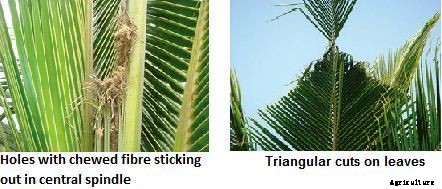
The adult beetle bores into the unopened fronds and spathes. Damage by the pest leads to 10 to 15% loss in yield. The attacked frond when fully opened shows characteristic triangular cuts.. Central spindle appears cut or toppled. Fully opened fronds showing characteristic diamond shaped cuttings. Holes with chewed fibre sticking out at the base of central spindle.
Predator: Reduviid bug
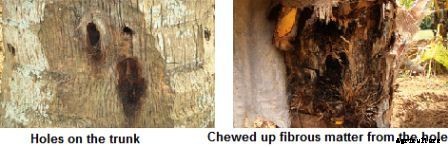
Red palm weevil is one of the most destructive pests of coconut, oil palms and ornamental palms. The hole can be seen on the stem with chewed up fibres protruding out. Many times reddish brown liquid can be seen oozing out from the hole. The grubs cause damage inside the stem or crown by feeding on soft tissues and often cause severe damage especially when a large number of them bore into the soft, growing parts. In case of severe infestation the inside portion of trunk is completely eaten and become full of rotting fibres. In case of young palms the top withers while in older palms the top portion of trunk bends and ultimately breaks at the bend (wilting). Sometimes the gnawing sound produced by the feeding grubs inside will also be audible. In the advanced stage of infestation yellowing of the inner whorl of leaves occur. The crowns falls down or dry up later when palm is dead.
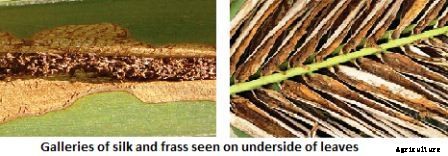
The coconut trees of all ages are attacked. Dried up patches on leaflets of the lower leaves, only three or four youngest leaves at the center of the grown remain green. Galleries of silk and frass on underside of leaflets. In case of severe infestation the whole plantations present a scorched appearance.
Parasitiods: Bracon spp., Ichneumon spp., Goniozus nephantidis, Brachymeria spp. etc. Predators: Reduviid bug, spider, red ant, earwig, ground beetle etc.
The earliest symptom on 2-3 month old buttons is pale yellow triangular patches seen below the perianth.Later, these patches become brown. Severely affected buttons may fall. As the buttons grow, brown patches lead to black necrotic lesions with longitudinal fissures on the husk.Oozing of the gummy exudation from the affected surface of the nuts.Uneven growth results in distortion and stunting of nuts leading to reduction in copra yield. In severe cases, the nuts are malformed with cracks and hardened husk.
Predators: Phytoseiid mites, ladybug beetles, syrphid flies, minute pirate bug, Oligota spp., lacewing
Termites are likely to cause damage to transplanted seedlings particularly in the earlier stage (wilting of seedlings). Base of trunks plastered with runways made of soil and fibers.
EPNs seeks out and kills all stages of harmful soil-dwelling insects. They can be used to control a broad range of soil-inhabiting insects and above-ground insects in their soil-inhabiting stage of life. The IJs emerge from cadaver, search for termites, infect, kill and again multiply and remain in the moist soil. Termites which are major pests in sugarcane can be managed by using EPNs effectively. EPN can be produced even at farmer level using either Galleria or Corcyra as a host.
There are different ways of Harvesting
The average yield per ha varies from 10,000 to 14,000 nuts per annum. From a well maintained garden an annual yield of 25,000 nuts / ha per5 year can be obtained.


