Periwinkle Plant Cultivation:
The following content briefs about Periwinkle plant cultivation.
Introduction to Periwinkle Plant Cultivation
When it comes to Periwinkle plant description, it is a perennial evergreen herbaceous plant or is a species of flowering plant which can grow up to 100 to 120 cm height. The Periwinkle plant is native to Madagascar and its cultivation extended to remaining parts of the world as an ornamental and medicinal plant. The USA is a top user of this plant’s raw material. The leaves of this plant are oval to oblong in shape with 2.5 cm to 9 cm long. These plant flowers are white to dark pink in color with a darker red center. These plants have significance in Ayurveda as the extracts of their roots and shoots are being used against several diseases.
Family Name of Periwinkle
Apocynaceae.
Botanical / Scientific Name of Periwinkle
Catharanthus roseus.
Genus of Periwinkle
Catharanthus.
Economic Parts of Periwinkle Plant
Indian States of Commercial Periwinkle Production
- Tamil Nadu.
- Karnataka.
- Andhra Pradesh and Telangana.
- Madhya Pradesh.
- Assam.
- Gujarat.
Health Benefits and Uses of Periwinkle Plant
- Natural remedy for Leukaemia stage 1.
- Lowers the high blood pressure naturally.
- Good for diabetics.
- Natural remedy for kidney stones.
- A natural fever reducer.
- Good for Asthma.
- A natural treatment for anemia.
- Helps in the treatment of ulcers and boils.
- Can be used as a natural burn cure.
- Helpful in treating sore throat.
- Good for brain health.
- A Natural remedy for tonsillitis.
- A natural treatment for diarrhea.
Common Names of Periwinkle
- Madagascar periwinkle.
- Rose periwinkle.
- Rosy periwinkle.
- Vinca.
- Old maid.
- Cape periwinkle.
Varieties of Periwinkle
- White periwinkle (Nirmal and dhawal).
- Purple Periwinkle (Higher alkaloid content).
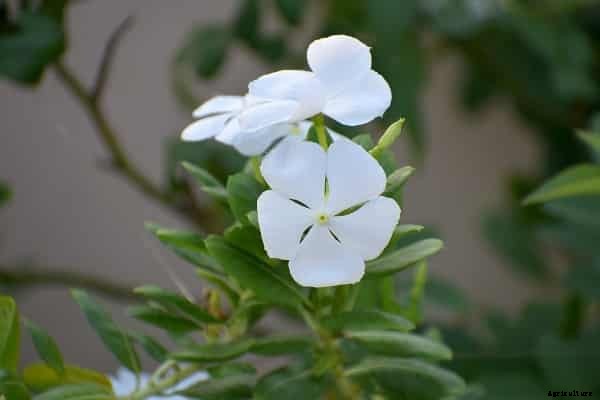 Periwinkle White.
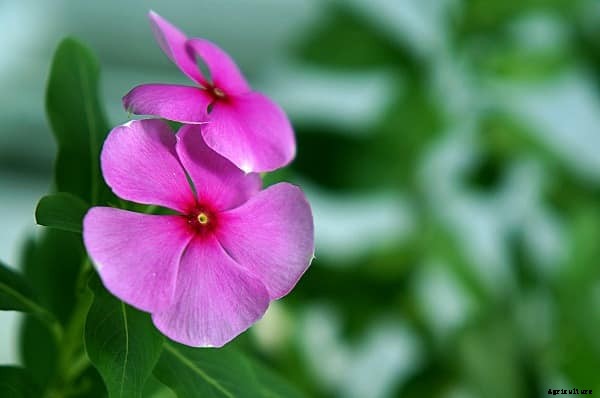 Rosy Periwinkle.
Climate Requirement for Periwinkle Plant Cultivation
The Periwinkle plant grows very well in both tropical and sub-tropical climatic conditions. There is no specific climatic requirement is essential for its growth. These plants can be grown up to an elevation of 1200 to 1300 meters above sea level. Well-distributed rainfall of 120 cm or more is good for its cultivation. Humid conditions in the climate will encourage growth. You can get excellent yields under irrigated conditions as well. The growth of this plant is better than the subtropical areas as lower temperatures in the winter season.
Soil Requirement of Periwinkle Plant Cultivation
In any herbal crop, soil plays a major role in its growth and yield. Periwinkle plants can be grown on a wide range of soils. However, deep loamy or sandy loam soil with medium richness (fertility) is better for the commercial cultivation of the Periwinkle crop. In these soils, the root development is better and it makes it easy to collect at harvest time. Coastal land, Laterite soil is also good for Periwinkle plant cultivation.
Land Preparation in Periwinkle Plant Cultivation
Land should be prepared thoroughly by giving 3 to 4 deep ploughings. Ensure levelled and weed-free field with fine tilth stage.
Propagation in Periwinkle Plant Cultivation
Propagation of Periwinkle is done either by seed sowing or transplantation.
Planting, and Spacing in Periwinkle Plant Cultivation
In commercial Periwinkle plant cultivation, a direct sowing/transplanting method or vegetative method is used.
- For the direct sowing method: You can collect seeds few months in advance are preferred. Freshly harvested seeds should be used with a seed rate of 2.5 kg/ha with lines spaced at 30 to 40 cm apart. These broadcasted seeds can be covered lightly with topsoil. In this method, seeds are broadcasted at the onset of monsoon (rainy season) during June to July month of Indian climatic conditions. You can soak the seeds and mix them with sand (1:10 ratio meaning for 1 kg of seed, 10 kg of sand) or neem cake at the time of sowing for easy handling and uniform distribution as seeds are small. Don’t use stored seeds as they lose viability very quickly. Seed germination starts after a week of sowing. Once all seeds are germinated, you can start thinning to maintain a spacing of 30 to 40 cm within a row. You can expect the flowering stage after 45 days of sowing.
- For transplanting method: Usually, a seedling is raised on nursery beds. The benefit of transplanting over direct seed sowing is seedlings with good vigour can be selected from nursery beds by discarding low-quality ones. to plant in the main field. In the transplanting method of raising, it is done on nursery beds from March to April in rows with a spacing of 10 cm and is planted 1.5 cm deep. seedlings reach a height of 1 foot in 2 months after sowing on the nursery beds. It is advised to transplant in the main field at evening times with a recommended spacing of 45 cm x 30 cm. In this method, half kg (500 grams) of seeds are required to cover the 1-hectare field. In this method, the total plant density would be around 75,000 per 1-hectare field.
- For Vegetative method: Softwood cuttings obtained from the lateral shoots resulted in better crop results than hardwood or semi-hardwood cuttings. In this method of propagation, the selection of 12 cm to 15 cm length cuttings with 6 to 7 nodes is best for a good percentage of rooting.
Irrigation in Periwinkle Plant Cultivation
Usually, 5 to 6 irrigation at an interval of 10 to 12 days is good enough after the rainy season. In the case of rainfed crops, 5 to 6 irrigations are sufficient for obtaining optimum yield.
Manures and Fertilizers in Periwinkle Plant Cultivation
Periwinkle plants respond very well to manures and fertilizers. Well decomposed farmyard manure (FYM) of 20 to 25 tonnes/ha and N:P: K of 20:50:75 kg/ha should be applied as basal dose and 50 kg of nitrogen should be applied as a top dresser after 2 months of transplanting.
Read this: Cassava Cultivation.
Intercultural Operations in Periwinkle Plant Cultivation
- Weed control: The Periwinkle crop requires 2 weedings. You can carry out the first weeding after 2 months of sowing and the second weeding after 4 months of sowing. Mulching the field with material like rice straw or any other cut grass can help in controlling weeds, retaining water, and preventing soil erosion.
- Gap Filling: Gap filling should be done 1 month after planting. Dead or weak plants should be replaced by healthy ones.
Pests and Diseases in Periwinkle Cultivation
- Dieback/top rot/Twig blight: Usually this attacks the crop during the rainy season. This can be checked by selecting dieback-resistant varieties. You can also spray mancozeb at an interval of 12 to 15 days.
- Yellow mosaic: This is caused by cultivating crops in the same field continuously for 4 to 5 years. Crop rotation is advised to check this.
- Little Leaf: This can result in stunted growth, the control measures include uprooting and destroying the disease-affected plants.
Note: It is always recommended to contact the department of horticulture for symptoms of diseases and pests and their preventive measures in Periwinkle plant cultivation.
Harvesting in Periwinkle Cultivation
Harvesting can be carried out for leaves, roots, and seeds.
- For leaf harvesting, it can be done 6 months and 9 months after sowing.
- For root harvest, the crop should be cut 1 year after sowing. Usually, the plants are cut 8 cm above the ground level. The harvested crop can be dried for leaves, stem,s and seeds.
- In the case of seed collection, it can be done from matured pods 60 to 75 days before harvesting starts.
Yield in Periwinkle Plant Cultivation
The yield of the crop depends on many factors such as soil type, other climatic conditions, irrigation method, and variety.
Generally, first harvesting should be done for leaves in six months, you go for second harvesting in 9 months. Finally, roots can be harvested after 12 months.
For Irrigated Conditions:
- 5 to 4 tonnes/ha dry leaves.
- 5 tonnes/ha of stems (air-dried).
- 5 tonnes/ha of roots (air-dried).
For rainfed conditions:
- 2 tonnes/ha of leaves.
- 75 tonnes/ha of stems (air-dried).
- 75 tonnes/ha of roots (air-dried).
Bottom Line of Periwinkle Plant Cultivation
As the demand for herbal products is increasing, you can obtain good profits with Periwinkle. However, If you are planning to cultivate on large scale, you must establish a marketing channel for bulk sales.
In case if you are interested in this: How To Grow Organic Lettuce.


