
Welcome to Modern Agriculture!

Introduction to Sarpagandha Cultivation:- What is Sarpagandha? Well, it is an important herbal or medicinal plant mostly grown in the hilly areas of Himalayan regions. This crop can be grown at an elevation of 1200 to 1300 meters. Sarpagandha can also be grown in lower ranges of the Eastern and Western Ghats and in the Andaman region. When it comes to planting description, Sarpagandha is an erect evergreen perennial shrub that can grow to the height of 75 cm to 100 cm. Sarpagandha plant roots can get 50 to 60 cm deep into the soil with tuberous branches having a diameter of 0.5 cm to 3 cm. Apart from medicinal uses, Sarpagandha can also be used in serpent wood, which is popular among woodcarving. This plant is being used in Indian Ayurveda for centuries. The parts used in the Sarpagandha plant are “Roots”. Grow this plant only when you have any marketing contract with herbal companies.
Distribution of Sarpagandha:- Sarpagandha plant grows in shady forests in India and it is an endangered species in many parts of India. So the export of the Sarpagandha plant is restricted from India. It is mostly distributed in the Himalaya regions, Uttaranchal, Uttar Pradesh, Jammu & Kashmir.
Scientific Name or Botanical Name of Sarpagandha Plant:- Rauvolfia serpentina.
Family Name of Sarpagandha Plant:- Apocynaceae.
Genus of Sarpagandha Plant:- Rauvolfia.
Health Benefits and Uses of Sarpagandha:-The following are some of the health benefits of Sarpagandha. Sarpagandha has many health benefits along with severe side effects. This root is used in herbal medicines for mild high blood pressure, nervousness, insomnia, and any mental disorders. This plant root is also used to treat snake and reptile bites, fever, constipation, feverish intestinal diseases, liver ailments, painful joints (rheumatism). However, you should not be using this without any medical professional advice or with any medical conditions.
Common names of Sarpagandha:
Varieties (Cultivars) of Sarpagandha:
Climate Requirement for Sarpagandha Cultivation:- This crop thrives best in tropical to subtropical regions under frost-free conditions and required irrigation. Humid, warm climate, shade-loving conditions are best suited for the Sarpagandha plantation. It requires an annual rainfall of 300 to 500 mm. This crop thrives best in the regions where the temperature ranges from 10°C to 30°C.
Soil Requirement for Sarpagandha Cultivation:- Choosing the best soil is first priority for growing any medicinal plants. The suitable soil for the Sarpagandha crop is slightly acidic to neutral with medium to deep well-drained black soils rich in organic matter. To some extent, they can grow in sandy loam to laterites soils. When you are growing on a large scale (commercial cultivation), Clay loamy to silt loamy soils rich in humus is best suited. The ideal soil pH for growing Sarpagandha is about 4.7 to 6.5. Commercial growers of Sarpagandha should consider soil tests for finding the fertility of the soil. Any nutrient and micronutrient deficiencies should be filled during land or soil preparation.
Propagation, Seed Rate, and Sarpagandha Cultivation:- The Sarpagandha can be propagated through seeds, stem cuttings, root stumps, and root cuttings. Commercial growers should consider seed propagation for better yields. When seedlings are raised on nursery beds, it requires 6 to 7 kg of seed to cover 1 hectare. If stem cuttings are used, 100 kg of cuttings can cover 1-hectare land.
Seeds should be collected during Jan and Feb months and dried immediately under shade. Rub the seeds to remove plumpy matter.
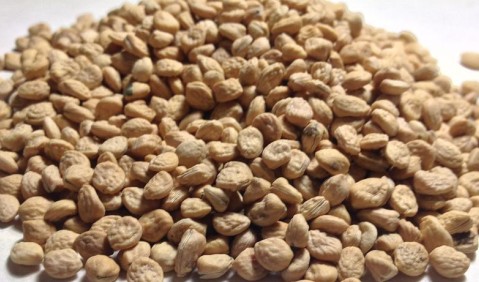
Nursery Raising and Planting in Sarpagandha Cultivation:-
Land Preparation in Sarpagandha Cultivation:- Land should be prepared by giving deep ploughings for better root penetration and development. Remove any clods, weeds, rocks from the field.
Irrigation in Sarpagandha Cultivation:- Generally Sarpagandha is grown in regions where one can expect evenly distributed rainfall of above 150 cm. However, This crop can be grown as a rain-fed crop under sub-tropical conditions or irrigated crop. The irrigation frequency depends on the climate, soil type. It requires 16 to 17 irrigation throughout its growth period. The summer or dry season irrigation interval is once in 15 days whereas winter irrigation is once in 25 days.
Manures and Fertilizers in Sarpagandha Cultivation:- Usually, any herbal or medicinal are grown without any pesticides and chemical fertilizers. You must use natural organic manures such as well-decomposed farmyard manure (FMY) like cow dung, vermicompost, garden manures, or green manures. In case of any insect pests attack or diseases, bio-pesticides should be prepared from neem kernels, neem seeds and neem leaves, cow urine, dhatura, and Chitrakmool.
You can apply well rotten farmyard manure (FYM) at 25 to 30 tonnes/ha during land/soil preparation.
Intercultural Operations in Sarpagandha Cultivation:- In any orchard, giving proper and timely intercultural operations are essential.
Pests and Diseases in Sarpagandha Cultivation:- Controlling pests and diseases is essential in any crop cultivation.
Harvesting and Post-Harvesting in Sarpagandha Cultivation:- The Sarpagandha crop can come to maturity of roots in 2 to 3 years after planting in the field. Harvesting should be done by digging up the roots. Make sure to collect thin roots as well. Harvested roots should be cleaned and washed before cutting into 12 to 14 cm pieces for drying and storing. Generally, dry Sarpagandha roots will have 9 to 10% of moisture. Store these dried roots in gunny bags on a cool and dry shelf.
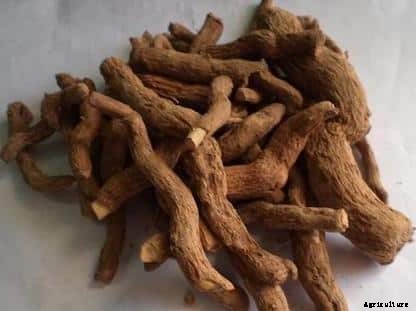
Yield in Sarpagandha Cultivation:- On average, Sarpagandha root yields vary from 1,500 to 2,000 kg/ha of dry weight under irrigated conditions. Yield may depend on soil type, climate, irrigation, and crop management practices.
In case if you are interested in this: How To Grow Organic Lettuce.


