
Welcome to Modern Agriculture!

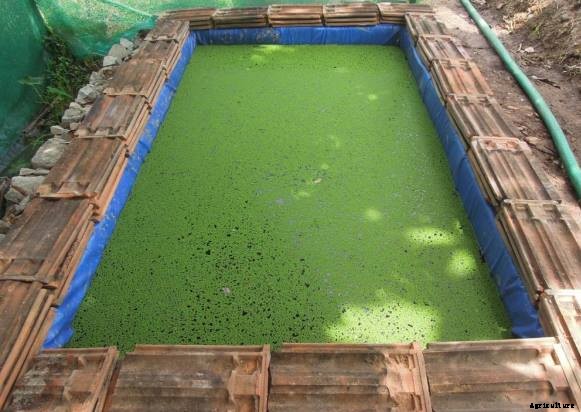
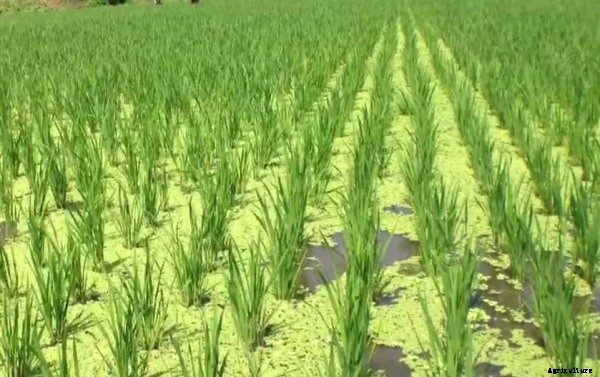
Introduction of Azolla Cultivation:- What is Azolla? Well, it is nothing but a free floating water fern consisting of a short, branched, floating stem, bearing roots which hang down in the water. It’s kind of green fodder grown on water surface. Why the Azolla cultivation is increasing and becoming popular? Because, Azolla has many nutrient benefits when compared to other fodders. Apart from this, it has nature of fixing Nitrogen in rice crop field. This is the reason the Azolla is being used as common bio-fertilizer and green manure in rice fields. The blue-green algae grow in symbiotic association with this fern and are responsible for nitrogen fixation in the rice crop. Where can it be grown? Well, it can be cultivated in ponds, ditches and rice fields of warm-temperate and tropical regions throughout the world. Azolla fodder is an excellent alternate feed supplement for livestock, poultry and fish. This is a boon for dairy farmers because; it drastically reduces the feed cost and results in increased milk yield. Though there are many species of Azolla, “A. pinnata” is popular among those. When it comes to nutrient value, Azolla possess high protein content, amino acids, vitamins, minerals (like magnesium, calcium, phosphorous, and potassium). Azolla is a highly productive plant and it doubles its biomass in 4–10 days period, depending on conditions, and yield can reach up to 8–12 tonnes/ha in Asian rice fields. Let us talk about more about growing Azolla in this write-up.
Family Name of Azolla:- Salviniaceae.
Botanical/Scientific Name of Azolla:- A. filiculoides.
Common names of Azolla:- Azolla, mosquito fern, duckweed fern, fairy moss, water fern (English); helecho mosquito, helecho de pato, helecho de agua (Spanish); Algenfarne (German); bèo hoa dâu (Vietnamese); 满江红 (Chinese); अजोला (Hindi); அசோலா (Tamil); അസോള (Malayalam); آزیریان (Persian); Азолла (Russian); แหนแดง (Thai), アカウキクサ属 (Japanese);
Uses and Advantages of Azolla:- The following are uses and advantages of Azolla.
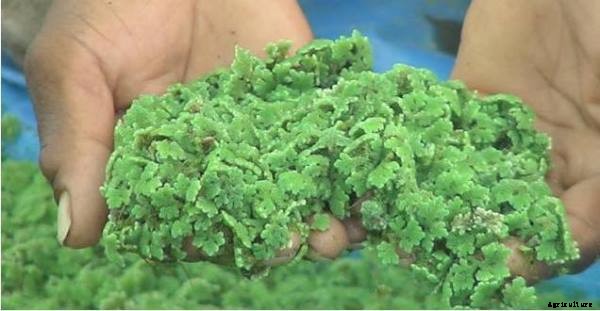
Biomass and protein content Azolla Cultivation, when compared with other grasses/fodders:
Fodder Annual production of bio- mass (MT/ha)Dry matter (MT/ha)
Protein content (%)
Sorghum 40 3.3 0.6 Hybrid Napier 250 50 4 Cowpea 35 7 1.5 Lucerne 80 16 3.4 Subabool 80 16 3.3 Kolakattao grass
40 8 0.8 Azolla 1000 80 24
Growing Conditions for Azolla Cultivation:- Azolla can be grown or found in ditches, ponds and wetlands of warm temperate and tropical regions. Azolla prefers shade and requires light (30 to 50 % light required for its growth) for photosynthesis. As we all know this (Azolla) is water based crop, one should ensure sufficient water for its cultivation. It is always recommended to have at least 5 inches of water in pond for proper growth of Azolla. Azolla grows well where the optimum/ideal temperature range is 20°C to 35°C. Higher temperatures above 36°C will seriously affect the multiplication of Azolla. For better yield and quality of Azolla, it requires the water pH value of 5.0 to 7.0 and relative humidity of 80 to 90%. Too much of acidic conditions or alkalinity has a negative impact on the growth of Azolla (fern). When it comes to requirement of nutrients, Azolla absorbs the nutrients from water and phosphorus is most important element. Usually, 20 to 25 ppm of phosphorus in the water is optimum. It is also essential to apply micro-nutrients which can improve the multiplication and growth of Azolla.
Azolla Cultivation:- For Azolla production, it requires a shallow pond. Let us discuss more about Azolla growing in fresh water ponds.
Economics of Azolla Cultivation:- The cost of preparing a 6 feet X 4 feet pond depends on labour and other elements like bricks ( if bricks are used to build the sides of pond) . Generally, it costs Rs.2000 for this pond including plastic sheet. A farmer can obtain a net profit of over Rs. 10,000 per year from the additional milk yield and reduced usage of concentrates’ feeding for livestock.
Limitations in Azolla Cultivation:- High summer temperatures, extreme lower temperatures, water scarcity, and low humidity, poor quality of water makes it difficult to adopt Azolla cultivation.
Bottom Line:- Azolla cultivation is an excellent option for farmers who want to fix the Nitrogen in paddy fields and to save supplemental feed cost in livestock.


