
Welcome to Modern Agriculture!

Introduction of Aloe Vera Cultivation:- As the use of herbals and other medicinal plants is increasing, the demand for this kind of crop growing in local and international markets. One of the miracle plants in the medicinal group is Aloe Vera. Aloe Vera is a succulent plant that is mostly grown in hot and dry climates with little annual rainfall. Literally, Aloe Vera can be grown in desert and drought regions and most parts of the world due to its wide adaptability. Due to the many uses and health benefits of Aloe Vera, this crop is grown commercially across the world. The Aloe Vera plant is indigenous to African and Mediterranean regions. Aloe Vera is also known as Aloe, Indian Aloe and in some parts of Asia, it’s called Knvar pathu and Ghrit Kumari.
This wonder medicinal plant has many commercial cosmetic uses. Many cosmetic products are being made from Aloe Vera such as face creams, shampoo, moisturizing creams, and shaving creams apart from using it in the health industry. This is being used largely in the herbal world for curing some diseases. Aloe Vera plants can also be used for decorative purposes. These plants can be grown indoors, in containers and pots.
When it comes to Aloe Vera plant description, it is stemless having thick and fleshy green leaves which can grow up to 50 to 90 cm tall. Usually, Aloe Vera flowers are produced in the summer season on a spike up to 80 cm tall. One can obtain decent profits in Aloe Vera cultivation with proper crop management practices.
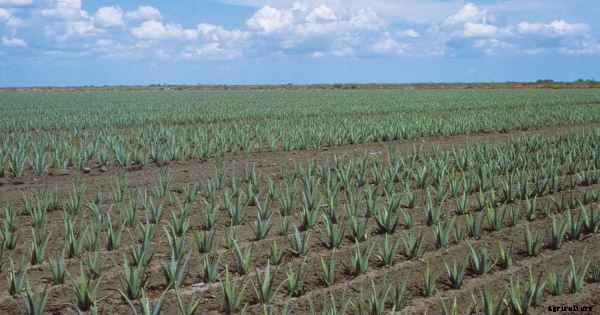
Health Benefits of Aloe Vera:- The following are the health benefits of Aloe Vera.
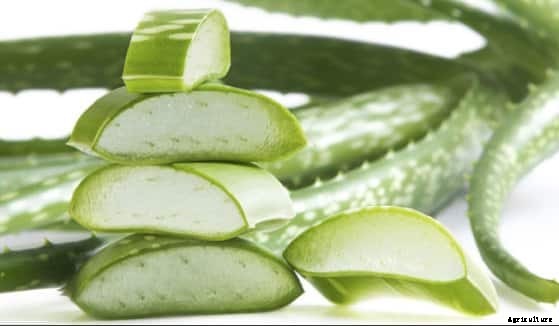
Scientific Name of Aloe Vera:- Aloe Barbadensis Miller.
Family Name of Aloe Vera:- Asphodelaceae.
Common Names of Aloe Vera:- Indian Aloe, Chinese Aloe, True Aloe, Barbados Aloe, Burn Aloe, and First Aid Plant.
Local Names of Aloe Vera in India:- Gheekumari (Hindi), Khorpad (Marathi), Kathalai (Tamil), Chotthu kathalai (Malayalam), Kalabanda (Telugu), Ghrita Kumari (Bengali).
Varieties of Aloe Vera:- Kokoerbom aloe, Gold Tooth, Orange Aloe, Red Aloe, Dorian Black, and Yellow Teeth are some of the commonly grown varieties (cultivars) of Aloe Vera in the world.
Climate Requirement for Aloe Vera Cultivation:- Dry and hot climatic conditions are best suited for its cultivation. This crop can even grow in areas where the annual rainfall is below the average of the region.
Soil Requirement for Aloe Vera Cultivation: – Aloe Vera can be grown in most of the medium fertile soils ranging from marginal to sub-marginal.However, black cotton soils (heavy soils) are best for the high yield of Aloe Vera. Commercial farming of Aloe Vera is suitable in well-drained loamy or sandy loam soils with pH values up to 8.0. However, the Aloe Vera crops can tolerate high pH soils as well. One should go for a soil test if the crop is grown on a large scale and any nutrient deficiencies gaps should be filled based on soil test results.
Land Preparation for Aloe Vera Cultivation: – As Aloe Vera is a shallow-rooted crop; it is not required deep plough during land preparation. One or two ploughing should be given followed by harrowing based on soil type and climate. Make sure to level the land after ploughing. Make beds or suitable plot sizes considering good slop for water drainage and irrigation. Any organic matter like well rotten farmyard manure (FMY) of 10 to 15 tonnes per hectare can be supplemented for better crop growth and yield. This FMY also results in better moisture-holding capacity and improves soil texture.
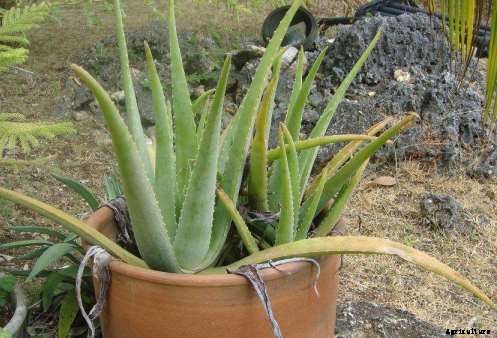
Propagation and Planting Material in Aloe Vera Cultivation:- Propagation of Aloe Vera crop is done through suckers. Consider selecting the planting material of four months old suckers having about four leaves and having 20 cm length for commercial cultivation of Aloe Vera.
Planting and Spacing Aloe Vera Cultivation: – Planting can be done throughout the year if there is an irrigation facility. However, planting right during the rainy season (from July to August in India) would be the best bet. Plant density of 10,000 to 10,500 suckers is required to cover 1-acre land or 25,000 suckers per 1-hectare land. Dig the pits of 14 to 15 cm deep and plant the suckers at 60 cm x 60 cm apart. The soil around the root zone should be pressed firmly so that there won’t be any water stagnation.
Irrigation in Aloe Vera Cultivation:- Aloe Vera grows well with little rainfall. It does not need any irrigation in the rainy season. Irrigate immediately after suckers are planted. However, during highly drought and summer conditions, one can supply irrigation once in 2 weeks.
Manures and Fertilizers in Aloe Vera Cultivation:- Aloe Vera crop responds very well to organic fertilizer as well as chemical fertilizers. 10 to 15 tonnes of well-decomposed manure should be added as part of land preparation. The N: P: K of 50 kg: 25 kg: 25 kg per 1-hectare field should be applied for proper growth and yield of the crop. Especially these fertilizers help cultivation in lighter soils.
Intercultural Operations in Aloe Vera Cultivation:- It is one of the best crop management practices to keep the field weed-free. This also helps in saving manures, fertilizers, and irrigation. 2 to 3 hand weedings should be carried followed by light hoeing in a year. Carry out the first weeding and hoeing should be carried within 4 weeks after planting the suckers. Subsequent years require 1 or 2 weedings with light hoeing to keep the weed growth in control. Destroy any diseased plants. Dried stakes should be removed regularly.
Pests and Diseases in Aloe Vera Cultivation:- The good thing about the Aloe Vera crop is there are no major pests and diseases reported. However, Black-brown leaf spots, Mealybug, and anthecnose are possible in some regions. In case of a termite problem, light irrigation can be applied. Black-brown spots can be controlled by any sulfur-containing insecticides.
Note: Your local horticulture department or any research-oriented agriculture university is a good source for finding suitable solutions for controlling pests and diseases in Aloe Vera Cultivation.
Harvest in Aloe Vera Cultivation:- Usually, the commercial harvesting of Aloe Vera can be taken from the second year of planting. Harvesting can be done with a sharp sickle. Make sure to viscous gel from the cut end dries up before packing and marketing also make sure only fully developed mature leaves are harvested for juice extraction.
Yield in Aloe Vera Cultivation:- Well, the yield of any crop depends on cultivar, soil type and fertility, plant age, and other crop management practices. One can obtain an average of 15 to 20 tonnes of fresh Aloe leaves from the second year of planting.
Bottom Line in Aloe Vera Cultivation:- Though Aloe Vera products have high demand in the market, one should pre-arrange the marketing facility before starting the commercial cultivation.
For Indian Agriculture: Read here.
In case if you miss this: Organic Vegetable Farming In Greenhouse.


