
Welcome to Modern Agriculture!

Introduction to Broccoli Cultivation:- What is Broccoli? Well, Broccoli is one of the edible green vegetable plants in the cabbage family whose large flowering head is cooked or eaten as a vegetable. When it comes to Broccoli plant description, it has large flower heads which are green colour and arranged in a tree-like structure branching out from a thick, edible stalk. These flower heads are surrounded by leaves. As we all can say is broccoli vegetable resembles cauliflower, which is a different cultivar group from the same species. Broccoli can be consumed in raw or boiled or steamed or stir- fried state. Broccoli is one of the most nutritious vegetables in the world and is an excellent source of magnesium, iron and calcium apart from vitamin ‘A’ and ‘C’. The word “Broccoli” comes from the Italian plural of ‘Broccolo’ meaning “the flowering top of a cabbage”. Broccoli can be grown in containers, indoors, pots, greenhouses, polyhouse and shade nets. Growing Broccoli hydroponically is also a good idea of getting excellent yields. Commercial cultivation of Broccoli is picking up in recent years especially in Asian countries. The following article is all about growing this wonderful ‘Broccoli’ vegetable.
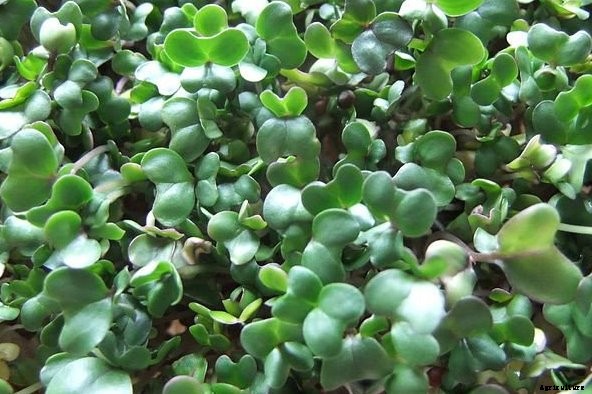
Scientific Name or Botanical Name of Broccoli:- Brassica oleracea.
Family Name of Broccoli:- Brassicaceae.
Genus of Broccoli Plant:- Brassica.
Common Names of Broccoli:- Wild cabbage, Headless cabbage, Chinese broccoli, White flowering broccoli, Jie lan cai, Gai lan (Chinese), Chinesischer Brokkoli (German), Kailan (Malay), Bróculi chino (Spanish), Broccoli de Chine (French), Kairan (Japanese),Phak khana (Thai), broccolo (Italian), brukuuli (Arabic), hari phool gobhi (Urdu), ανθοκράμβη / brókolo (Greek), Broccoli (Swedish), Brókkoli (Russian), brokolice (Czech), and Brokoli (Turkish).
Broccoli in Indian Languages:- Hari Phool Gobi (Hindi), Green Cauliflower / Chinese Cauliflower / Broccoli (Telugu), பச்சைப் பூக்கோசு / Pachai Pookosu / Green Cauliflower (Tamil), ব্রোকলি (Bengali), Broccoli (Malayalam), Brocolli / Chinese Cauliflower (Kannada), Hari Phool Gobi / Brocolli (Bengali), Sabuja kobi (Oriya), Hari Phool Gobi / Brocolli (Gujarati) and Broccopli / Hari Phool Gobi (Marathi).
World Top 10 Production Countries of Broccoli:- The following are the top ten production countries of Broccoli.
Health Benefits and Uses of Broccoli:- The following are some of the health benefits of Broccoli.
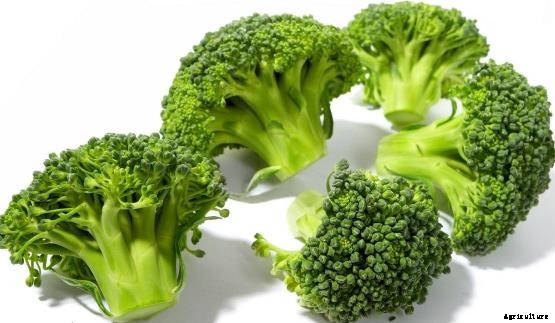
Varieties / Types (Cultivars) of Broccoli:- Actually there mainly two types of broccoli are widely grown.
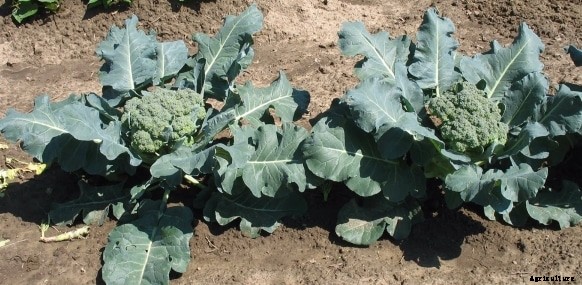
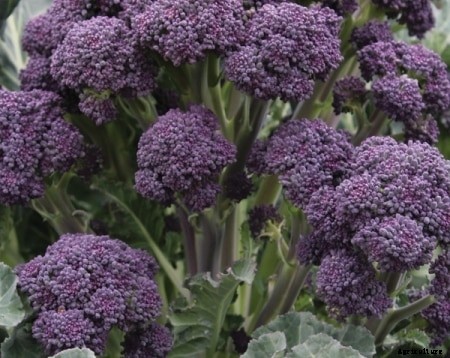
Even though these are 2 main types of broccoli, the following are also grown in some regions of the world.
Some popular varieties of Broccoli are Green King, Belstar, Calabres, Shigemori, Marathon, Blue Wind, Amadeus, Green Pia, Sonata, Waltham 29, De Cicco, Diplomat, Pinnacle Tender Green, Arcadia, Gypsy, Fiesta, Express, KTS-I, Solan Green, Lucky, Pushpa, Aishwarya, and PalamVichitra.
Note: There are many hybrid commercial high yielding broccoli varieties grown throughout the world. However, we cannot list them all here and it is always advised to find out good variety suitable to your local conditions.
Climate Requirement for Broccoli Cultivation:- Broccoli is a cool season annual crop and can be cultivated both in spring and fall. In case of greenhouse farming, this crop can be grown throughout the year. The best growing temperature for broccoli is around 18 to 20°C. For better germination, the ideal soil temperature is about 20 to 22°C. Broccoli crop is very sensitive to low and high temperatures of the regions. However, there are some improved varieties which can tolerate high temperatures to some extent.
Soil Requirement for Broccoli Cultivation:- Selection of site/soil is very important task for commercial cultivation of broccoli. Broccoli can be grown in wide range of soils from light sandy loams through to heavy clay loams. However, this crop requires well-drained and organic matter rich soils.
For best yield and healthy produce, this crop requires deep sandy loam or clay loam soil rich in organic matter along with good drainage nature. The ideal soil pH for Broccoli growing is between 6.0 and 7.0. Soils having pH less than 6.0 can be supplemented with lime. Make sure not to over lime the soil. It recommended rotating broccoli crop with other crops that are not crucifers. Commercial Broccoli farmers should go for soil analysis and testing for finding the fertility and suitability. Based on test results, it is required to incorporate any nutrients and micro-nutrients.
Land Preparation in Broccoli Cultivation:- Land should be prepared thoroughly and deeply to get the soil to fine tilth stage before planting. Remove any weeds and other dead material from the field. Ploughing and harrowing should be carried to achieve this. For single row planting and raised beds, make furrows 0.5 meter apart where as in double row planting, make 0.75 to 1.0 meter wide, 0.5 meter apart.
Propagation in Broccoli Cultivation:- Propagation of Broccoli is done by seeds. This can be direct seeding or through transplanting (Growing seedling in nurseries and transplanting in the field).However, commercially, most Broccoli seedlings are now produced by nurseries using cell trays.
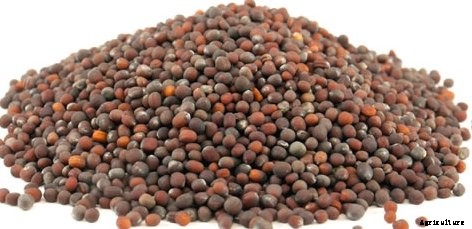
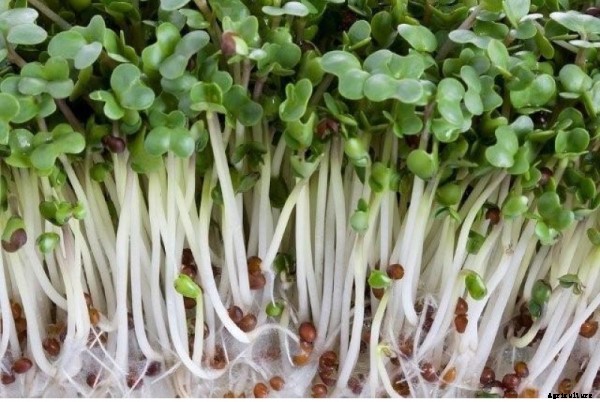
When it comes to planting distance and row spacing, within a row, space your plants 12 to 24 inches apart with 36 inches between each row. The broccoli seedlings should be watered sufficiently couple of hours before removing from seedling bed to prevent any wilting during transportation/transplanting. Do not forget to water the seedlings immediately after translating is done.
Irrigation in Broccoli Cultivation:- The frequency of irrigation depends on soil type and climate.It is important to make sure proper soil moisture throughout its growth period. The first irrigation should be given right after transplanting and subsequent irrigations should be given frequently at 8 to 10 days interval depending on soil moisture status and climate. Do not get developing heads wet when watering the plants. Provide consistent soil moisture with regular watering in drought or dry conditions and never let the soil dry. Mulching can help to prevent moisture loss and weed growth.
Manures and Fertilizers in Broccoli Cultivation:- Broccoli crop responds very well to manures and fertilizers. Well-decomposed farm yard manure (FMY) should be applied at the rate of 12 to 15 tonnes/ha. This should be done 30 days before transplanting the seedlings. The N: P: K ratio of 120:80:60 kg/ha should be applied at the time of transplanting. The nitrogen ‘N’ should be applied in split doses. After applying at the time of transplantation, remaining 1/2 dose should be applied at 30 and 45 days after transplanting.
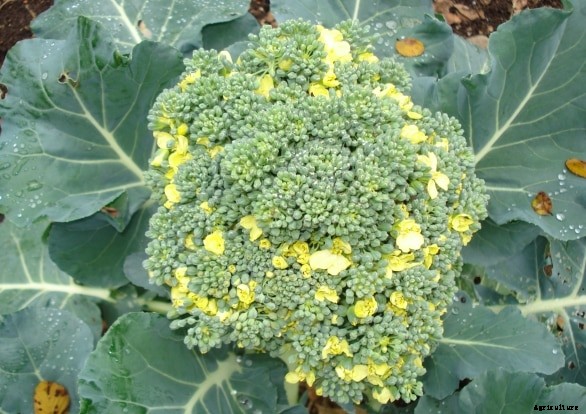
Intercultural Operations in Broccoli Cultivation:- The Broccoli crop should be kept weed free. Shallow hoeing should be carried out at 18 to 20 days after transplanting in the field to remove weeds and loosen the soil for aeration. Mulching should be done to control weed growth. Appropriate herbicides and weedicides can be used to control the weeds effectively. It is required to remove the side shoots as soon as possible to improve the yield and quality of main head.
Pests and Diseases in Broccoli Cultivation:- Controlling pests and diseases in broccoli farming is essential to ensure quality produce and high yields.
Note: Your local horticulture department is a good source of finding information about pests and diseases in Broccoli cultivation. Don’t experiment on your own without knowing the symptoms and causes.
Harvesting in Broccoli Cultivation:- Usually the Broccoli crop will be ready for picking after 75 to 90 days of transplanting in the field. However, the maturity varies from variety to variety. Use sharp knife and cut the head stem a few centimeters below the head. Don’t wait until clustered buds begin to open. Harvesting should be done in the early morning. Most cultivars (varieties) have side-shoots that will continue to develop after the main head is harvested. This allow to harvest from one plant for many weeks in the season.
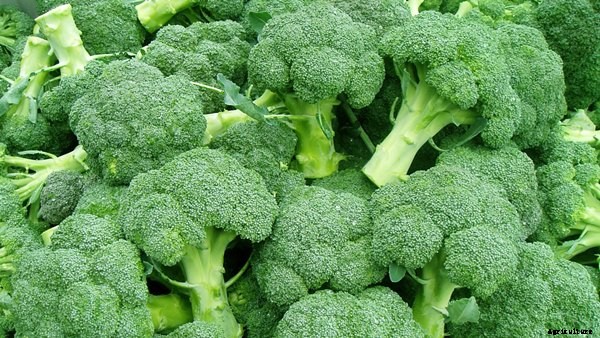
Post-Harvesting in Broccoli Cultivation:- After harvesting the Broccoli heads, pack them and transport to local vegetable markets or even you can sell at farm gate.
Yield in Broccoli Cultivation:- Yield of any vegetable depends on variety, soil, climate and other garden management practices. In case of Broccoli cultivation, on an average one can obtain 175 – 250 quintals/ha depending upon the variety.


