
Welcome to Modern Agriculture!

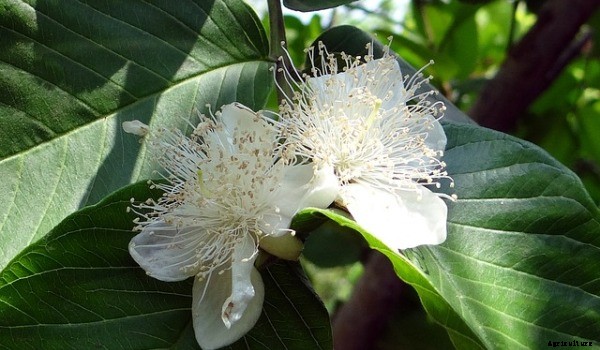
Introduction of Guava Cultivation:- Guava fruit is one of the famous tropical fruits grown across Asian countries as well as other parts of world and known as the apple of the tropics. Guava fruits are quite popular in India and south East Asia. It is said to be this fruit is native to Mexico, Central America and South America. Commercial cultivation of Guava is very much successful due to low maintenance and high yields. Guava Plants are hardy and produce good yield even with little care. The Guava plants can be grown under rainfed as well irrigated conditions in both tropical and subtropical regions. Guava fruits are grown for their excellent health benefits. Guava fruits can be consumed as raw (fresh fruits) and used in beverages, candies, ice creams, dried snacks, fruit bars and desserts. There are many improved/hybrid/commercial varieties available to specific region. Guava belongs to the family of “Myrtaceae” and genus of “Psidium”. When it comes to guava size, they range from as small as an apricot to as large as a grapefruit. Guava fruit varieties (cultivars) feature white, red, pink flesh. Commercial growers generally select cuttings/grafting for propagation as seed propagation is very slow and time consuming for getting the crop. Usually, Guava fruit measures about 5 to 10 cm in length and available in round and oval shapes depending on the species (cultivar). Now a day’s commercial growers are following high-density plantation and ultra high density plantation for higher yields in Guava fruit cultivation. Guava fruits can be grown in pots / containers, back yards, greenhouse and poly houses.
Major Guava Production Countries:- The top 10 Guava production countries in the world are given below.
Health Benefits of Guava:- The following are some of the health benefits of Guava fruit and leaves.
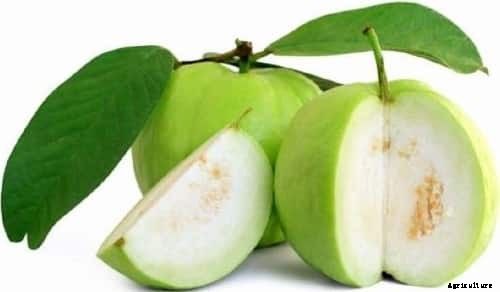
Guava Cultivars (Varieties):- There are many improved varieties including dwarf varieties suitable to each region. Find out with your local horticulture department for proper high yielding variety.
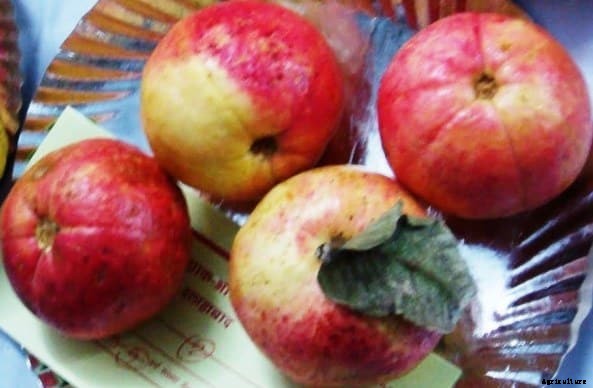
Here are some of the commercial cultivars grown in India; Allahabad Safeda, Lucknow 46, 49, Chittidar, Harijha, Arka Amulya, Saharanpur Seedless, Nagpur seedless, Arka Mridula, Hafshi, Banaras, Apple guava, Baptla, Arka Kiran, Lalit and TRY (G)-1.
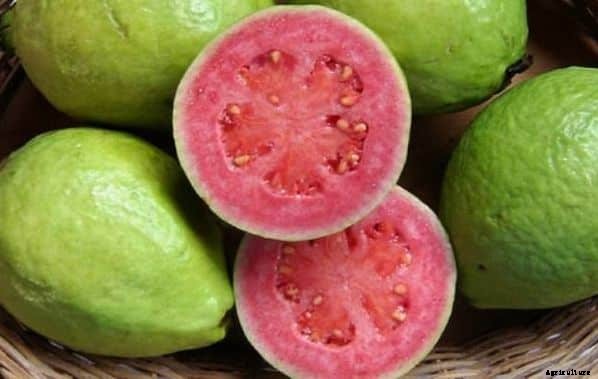
Guava Common Names:- Guava, Guayabo, Goiabeira , Red Guava , Guyava and Kuawa.
Guava Names in other Parts of World Languages:- Goyave (French), Guave (Dutch), Zaytoon (Somali),Guave (German), Gujava (Albanian), Guajaav (Estonian), Nkouáva (Greek), 반석류 (Korian), Ambaa (Nepali), Goiaba (Portuguese),Guayaba (Spanish), Guyyava (Uzbek), جوافة (Arabic), Гуава (Bulgarian), 番石榴 (Chinese), Bayabas (Filipino), Guaiava (Italian), Guava (Norwegian), quả ổi (Vietnamese), Farang (Thai), Guaba (Japanese), Gvajave (Latvian), ˈgwɑ və (Romanian), Peira (Sinhalese), Trapaek sruk (Cambodian), Guavasläktet (Swedish), Guava (Turkish),Gujávafa (Hungarian), Jambu kampuchia (Malay), گواوا (Persian), 番石榴属 (Taiwanese), Amroud (Urdu).
Guava in Indian Languages:- Amrud / Paere (Hindi), Perakka (Malayalam), Jama pandu (Telugu), Seebe / Pyarilhannu / Sibe Hannu / Perale (Kannada), Koyyapazham (Tamil), Pijuli (Oriya), Amrud (Punjabi), Payara (Bengali), Peroo (Marathi), Jamrukh / Jam Phal (Gujarati), Paer / Peron (Konkani).
Climate Required For Guava Cultivation:- Guava can be grown in both tropical and sub-tropical climates. These trees can be grown up to an altitude of 1500 meters above mean sea level (m.s.l). Low night temperatures in winter season ensure the best quality guava fruits. Generally, older Guava plants can tolerate high temperatures and drought conditions. However, high temperature during flowering and fruit development stage can cause fruit drop and lower the yield. It is susceptible to severe frost as it can kill the young plants. Guava crop can be cultivated under both rain-fed and irrigated conditions. When it comes to rainfall requirement for rain-fed crop, on an average 100 to 125 cm of annual rainfall is more than enough for growing Guava plants.
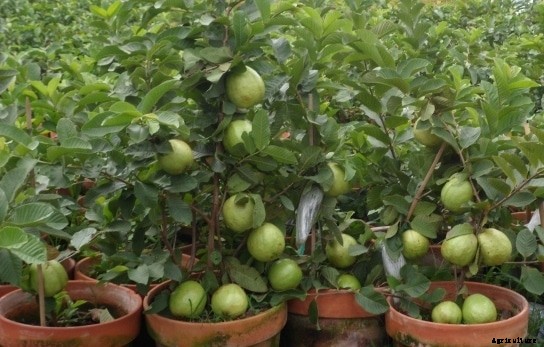
Soil Requirement for Guava Cultivation:- Being a hardy in nature, Guava plants can be grown in wide range of soils from heavy clay to very light sandy in nature. However, they require well-drained, deep loamy, friable soils for good crop yield. Avoid water logging conditions as it can cause the root rot. Soil pH of 4.5 to 7.0 is ideal for Guava Plantation. River basins are very well suited for growing Guava fruits. It is advised to go for soil test, if you are planning for commercial cultivation. Any nutrient gaps should be filled based on soil test results.
Land Preparation for Guava Cultivation:- Land should be deeply ploughed, harrowed and levelled before planting. Make sure to bring the soil to fine tilth stage. Remove any weeds from previous crops and land should be prepared in such a way that any excess water should be drained out. If the soil is not fertile, supplementing the land with well decomposed farm yard manure (FMY) is recommended for required nutrients. This organic manure should be added in last plough during land preparation. Dig the pits size of 1 meter x 1 meter x 1 meter and fill the pits with surface soil mixed with farm yard manure (FMY) or 25 kg of garden compost.
Soil Sterilization in Guava Cultivation:- Soil sterilization is also an important task which raises the soil temperature and kills many soil-borne organisms including plant pathogens and pests. This process can be achieved by both physical and chemical means. Usually, physical means include treatments with steam and solar energy where as chemical means include treatments with herbicides and fumigants. However, this can also be achieved by plastic mulch film.
Planting Season for Guava Cultivation:- Planting can be done throughout the year where proper irrigation facilities are available.
Propagation, Planting and Spacing in Guava Cultivation:- Propagation is done by seeds, cuttings, grafting and air layering. Seed propagation takes longer time; hence the most adopted propagation method in Guava cultivation is grafting and air layering.
Field should be prepared before monsoon season starts. Usually the planting should be done before the onset of rains by adopting square planting system. The spacing of plants varies from variety. Commercial growers should adopt a distance of 5 meter – 8 meter. Usually, a spacing of 5 meter x 5 meter or 6 meter x 6 meter is followed. Guava can also be planted in hedge-row system at spacing of 6 meter x 2 meter or 6 meter x 3 meter. For high density and ultra high density planting, the spacing between rows and plants should be less. Generally, in ultra high density plantation, a row-to-row distance of 2 meter and plant-to-plant distance of 1 meter is followed.
High Density Planting (HDP) in Guava Cultivation:- Commercial growers can follow the high density planting method to achieve higher yields in Guava cultivation. Some of the commercial/hybrid varieties do very well under HDP.
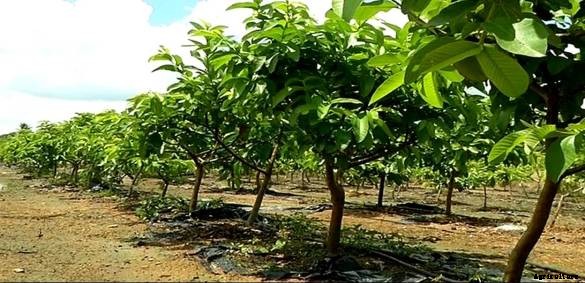
Ultra High Density Planting (UHDP) in Guava Cultivation:- Well, commercial Guava growers may consider this method for certain hybrid Guava varieties.
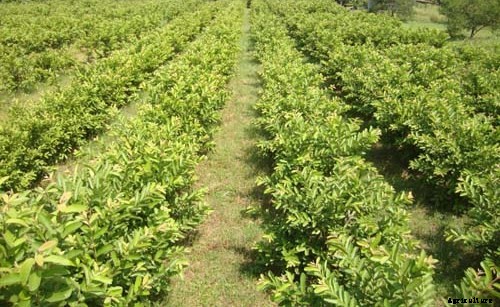
Irrigation in Guava Cultivation:- Proper irrigation of any crop ensures the good plant growth and yield in Guava farming.
Guava plants require constant moisture in the soil especially in dry season from December to May. However, Guava crop does not require any water in rainy season. Generally, water requirement and frequency depends on plants age and stage. The first irrigation should be given immediately after planting in the field for root establishment in the soil. Generally, on an average, a guava plant requires 15 to 30 liters per day. The best irrigation method used in Guava cultivation is drip irrigation. Drip irrigation provides efficient way of using water in regions where water is a major problem. Commercial growers can get subsidies on drip systems from local horticulture schemes. If drip system is installed, irrigation can be given on alternate day.
Drip Irrigation Advantages in Guava Cultivation:- There are many advantages of using drip system in Guava field.
Inter-crops in Guava Cultivation:- Guava growers can earn extra income by going for intercropping during pre-bearing stage. Legumes like green gram, yellow gram and short duration vegetable crops like tomato, chilli, okra, french beans may be cultivated as inter-crops. Intercropping also enriches the soil fertility by increasing ‘N’ content in it.
Manures and Fertilizers in Guava Cultivation:- Balanced manures and fertilizer application is essential for high yielding of Guava produce. Farm yard manure of 50 Kg and N: P: K of 1 Kg per tree in 2 split doses during March and October should be applied. To increase the fruit yield, spray Urea 1 % + Zinc sulphate 0.5% twice a year during March and October. In case of boron deficiency soils, spray 0.3% borax during flowering and fruit set stage.
Weed Management in Guava Cultivation:- Weed Control is very important task that needs to be carried out frequently to ensure healthy plant growth by utilizing nutrients properly. Proper weed control is necessary for growing healthy plants and getting higher yields. Weed control also checks the losses of fertilizer and moisture from the plant basin. Mulching can be practiced by using plastic mulch, dry leaves or paddy husk. Chemical weedicides can also be used for controlling the weeds. Shallow cultivation between rows can be given to remove weeds. Remove weeds from basins around the Guava trees by hand weeding before manure and fertilizer application followed by mulching with organic materials.
Training and Pruning in Guava Cultivation:- Training of plants in young stage should be carried out to build strong framework and to avoid weak crotches. Fruit bearing trees should be trained as low headed trees to facilitate multiple hand pickings. The open centre of delayed may be adopted for training. The scaffold branches in young Guava plants should be tipped back to encourage secondary branching. The root sucker, water sprouts and cross branches should be removed.
To check the overcrowding and to control the plant height, the terminal shoots on the periphery should be headed back at about 42 cm level in alternate years. Pruning also takes place during harvesting period as the fruit is plucked along with the shoot on which it is borne. Pruning is usually should be carried out after harvesting or in spring. Summer pruning is not recommended as it may damage the plant by sun burning.
Pests and Diseases in Guava Cultivation:- The following are the major pests and diseases found in Guava cultivation.
Fruit Fly:
Mealy Bug:
Wilt:
Note: Contact your local Horticulture department for pests and disease symptoms and their control. They are the best source for pest control solutions in Guava production.
Harvest in Guava Cultivation:- Harvesting time depends on variety grown. Hybrid varieties take less time to reach harvesting stage. Usually plants propagated through air layering come to bearing in 2 – 3 years. However, they attain full bearing capacity at the age of 8-10 years. Sickle or fruit plucking machine can be used to pick the fruits from Guava trees.
Yield in Guava Cultivation:- Yield of Guava crop depends on many factors such as, variety, age of the plant, soil type, irrigation, cultivation practices and climate. On an average, One can obtain the crop yields about 25 tonnes/ha.
Marketing of Guavas:- Because of their perishable nature, guava fruits should be sent out immediately after harvesting in the local market. Shelf life of guava can be extended up to 3 weeks by keeping them at low temperature of 5°C and 80 % relative humidity. Usually, Guava fruits are graded based on size and quality. The graded fruits can be packed and transported to local markets.
Bottom Line: Commercial Guava Cultivation is very profitable with low maintenance.


