
Welcome to Modern Agriculture!

Introduction of Sandalwood Cultivation:- Sandalwood is one of the materials being used from centuries and this tree is evergreen and reaches up to 13 to 16-meter height with a girth of 100 cm to 200 cm and is variable in habit, usually upright to sprawling. It has cultural importance and commercial/medicinal uses as well. In India, it is also being called “Chandan” and “Srigandha”. Due to restrictions of growing sandalwood in many states in India, the demand for sandalwood is very high. However, some states in India have lifted the ban on growing sandalwood. Contact your forest/agriculture/horticulture departments for the legality of growing the sandalwood in your region. Sandalwood has a special place in Indian tradition where it is being used from cradle to cremation. The commercial value of sandalwood and its essential oil has very high due to its use in cosmetics, pharmaceutical, aromatherapy, soap industry, and perfumery.
Though there are many varieties of sandalwood is available in the world, Indian sandalwood and Australian sandalwood are very famous and has excellent commercial value in the market. Though returns on sandalwood cultivation are very high in which naturally grown sandalwood tree takes 30 years to be ready for harvesting whereas intensive cultivation in organic methods gives quick results in 10 to 15 years. The sandalwood grown in India has two colours which are available white and red. The best part of these plants is this can be grown as intercrop in Malabar neem plantation/crop. Heartwood, bark and essential oil are the main parts being used in sandalwood cultivation. The leaves of sandalwood can also be used for animal fodder. In India, sandalwood is mostly grown in Andhra Pradesh, Telangana, Bihar, Gujarat, Karnataka, Madhya Pradesh, Maharashtra, and Tamil Nadu. Sandalwood is available in red, white and yellow colors.
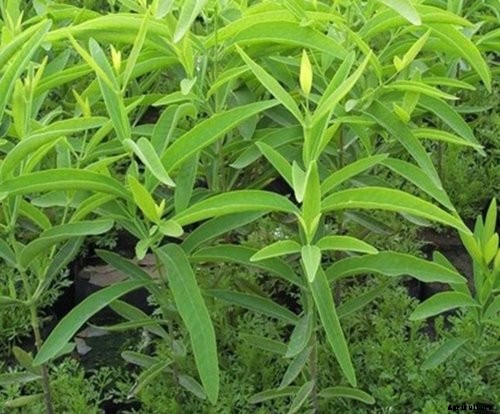
Family Name of Sandalwood:- Santalaceae.
Botanical/Scientific Name of Sandalwood:- Santalum album L.
Uses and Health Benefits of Sandalwood:- The following are health benefits and uses of Sandalwood and its essential oil.
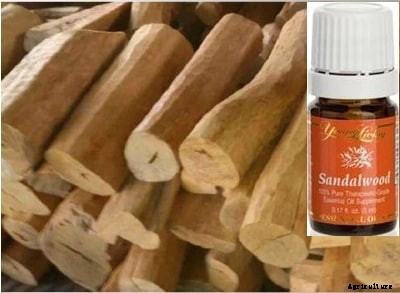
Common Names of Sandalwood in India:- Safed Chandan, Chandan, Sandal and Sandalwood, Santalum album, ShiriGandha, Aninditha, Arishta Phalam, Bhadhrashraya, Sarpavasa, Chandrakanta, Gandhasara,Thailaparna and Malayaja.
Local Names of Sandalwood in India:- Chandan (Hindi), Gandhapu Chekka (Telugu), Cantana (Tamil), Raktacandanaṁ (Malayalam), Śrigandhada (Kannada), Candana (Marathi), Candana (Gujarati), Canana (Punjabi), Candana (Bengali)
Varieties of Sandalwood:- Indian sandalwood, Australian sandalwood are mostly grown though there more than 15 varieties (cultivars) are available throughout the world.
Climate Requirement for Sandalwood Cultivation:- Sandalwood crop requires and grows well in hot and humid climatic conditions. The ideal temperature for sandalwood tree growth is between 12° and 35°C.
Soil Requirement of Sandalwood Cultivation:- Sandalwood trees can be grown in any well-drained soils having good organic matter. However, red sandy loam soils are best for their growth and yield. If you are planning for commercial cultivation of sandalwood, it is advised to go for a soil test and fulfill the nutrient requirements in the soil based on soil test results. Sandalwood grows better in slightly alkaline soils with a pH range of 6.5 to 7.5.
Land Preparation for Sandalwood Cultivation:- Give a couple of ploughings to bring the soil to fine tilth stage and weed free. Prepare the soil or beds in such a way that excess water will drain out quickly in case of heavy rains or floods.
Propagation in Sandalwood Cultivation:- Sandalwood can be propagated by means of seeds and vegetatively through tissue culture.
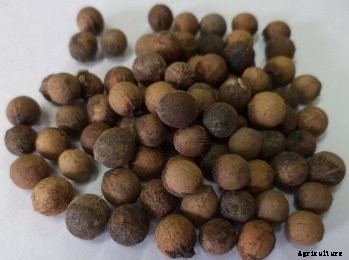
Planting and Spacing in Sandalwood Cultivation:- Usually seeds collected from plants age of 15 to 20 years in August to March is best for its growth and yield. These collected plants should be dried up and well-treated before sowing on nursery beds. Generally, 7 to 8 months old well-branched seedlings of 30 to 35 cm height raised on nursery beds are used for transplanting in the main field. Two types of seedbeds such as “sunken” and “raised beds” are used to raise the sandalwood seedlings.
The pits size of 45 x 45 x 45 cm should be dug during soil/land preparation. The plant-to-plant distance should be 10 feet. Make sure there will not be any stagnated water in pits before planting. Expose pits for sun for a couple of days to dry up the pits any pests will be destroyed. Sandalwood will start flowering after 4 years planting and need to make sure to remove the weeds and dried/diseased branches on regular basis to make the field weed free. Prefer to use Bio-fertilizers in sandalwood cultivation.
Irrigation in Sandalwood Cultivation:- Sandalwood crop can be grown throughout the year provided there is enough irrigation facility available. When it comes to water requirement, irrigation should be provided at an interval of 2 to 3 weeks when the plants are young especially in hot and summer climatic conditions. Go for drip irrigation in regions where the water source is limited. Sandalwood plant does not require any irrigation in the rainy season and make sure to drain out any excess water from the tree basin.
Manures and Fertilizers in Sandalwood Cultivation:- Any agriculture crop responds well to organic and chemical fertilizers. However, any medicinal crop should be grown without any chemical fertilizers and use of pesticides. Well rotten farmyard manure (FYM) like cow dung, garden compost, vermin-compost or any manure made from green leaves can be used. For controlling any pests and diseases in sandalwood cultivation, bio-pesticides should be prepared from Neem (kernel, seeds & leaves), Chitrakmool, Dhatura, Cow’s urine etc.
Weed control Sandalwood Cultivation:- Weeding and thinning should be carried at regular intervals for establishing a standard framework of sandalwood plantation.
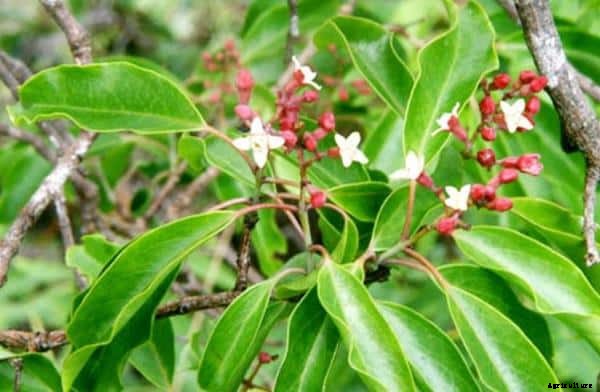
Pests and Diseases in Sandalwood Cultivation:- To prevent diseases and pests, bio-pesticides could be prepared with single or mixture from Neem kernel, Neem seeds and Neem leaves, chitrakmool, dhatura, and cow urine.
Note: It is always advised to contact your local horticulture/agriculture/forest department or NMPB (National medicinal plants board) for symptoms of diseases and pests and their control measures in sandalwood cultivation.
Harvest and Post-Harvest in Sandalwood Cultivation:- Usually sandalwood trees will be ready for harvesting after 30 years of planting. During harvesting of sandalwood, the soft wood is removed and then hard wood is chipped which would be converted into powder in a mill. After soaking the powder in water for 2 days (48 hours) and distilled. The essential oil from sandalwood is rectified by re-distillation and filtration.
Yield in Sandalwood Cultivation:- As sandalwood takes longer than any other tree to grow, one should havethe patience to wait for its yield and profit. On an averag,e it grows 5 cm girth per year under good soil and climatic conditions.
The following table gives approximate growth of sandalwood each year.
Age of Sandalwood Tree (in years). Girth (in cm). Heart wood yield (in kg). 10 10 1 20 22 4 30 33 10 40 44 20 50 55 30Primary factors that influence the sandalwood growth are; selection of land, selecting the sandal wood spices, host plant management, Irrigation management, pest and disease control management.
Economics of Sandalwood Cultivation:- Well, the rate or price of sandalwood or any medicinal plants varies every year and depends on market conditions. The retail government rate of heart wood in India is about 500 to 600 Rupees/ kg (This may vary, please contact the local forest department for the current price of heartwood.)
Subsidy and Loan for Sandalwood Cultivation in India:- In India, there is a subsidy and loan facility available for the farmers who wants to grow sandalwood. There are many banks including NABARD are financing for commercial cultivation of sandalwood projects. NMPB (National medicinal plants board) is also providing subsidies on sandalwood projects. Please contact them directly for more and current subsidy/loan information.
Cost and Profit in Sandalwood Cultivation:- Well, profits in any agriculture/crop depends on many factors. However, Sandalwood farming is a long-term and highly profitable crop. Here is a sample project cost and profit scenario in India. One should understand that these things will change region to region and year to year based on market conditions.
For one acre of land, usually, the plant density is about 400 to 440 (where 10 feet distance is maintained between plants).
Usually, cost per acre depends on many factors like plant cost, labour cost for planting, drip cost, soil working and weed control (at the current market), pests/disease cost and others.
On average 1 acre of sandalwood plantation cost 6,00,000 INR (six lakh Indian rupees).
Sandalwood heart wood is costing about 6,000 Rs/kg.
Total yield of 5,000 kg can be expected.
So, total expected price after 15 to 20 years is: 5,000 x 6,000 = 3, 00, 00,000 (3 crore).
Total cost/expenditure + other costs = 6,00,000 INR plus land cost per acre 20,00,000 INR = 26,00,000
Net profit can be expected: 3,00,00,000 – 26,00,000 = 2,74,00,000/acre.
Marketing of Sandalwood:- Any medicinal plants require premarketing strategy. Before going for sandalwood cultivation on large scale, contact agents/companies/ or any herbal suppliers for marketing.


