
Welcome to Modern Agriculture!

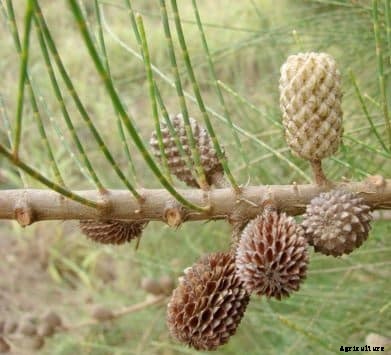
Introduction of Casuarina Cultivation:- Casuarina is a fast growing agroforestry perennial and evergreen tree with wide-ranging adaptability of different environments. These trees are excellent source of providing multiple end uses and services. Casuarina trees are an evergreen trees and can grow up to 100 feet tall with diameter of 60 cm (180 cm girth). These trees can survive up to 50 years in favorable conditions. The foilage of casuarina tree is of slender, much-branched green to grey-green twigs bearing minute scale-leaves. Casuarina trees are grown in tropical and subtropical regions of world. These trees are very delicate, and have slender terminal branches. These trees have ability to improve soil fertility by fixing atmospheric nitrogen. It does also work as good shade and wind break medium. When planted on slopes, they can protect from soil erosion as well. Casuarina trees are native to the Indian Subcontinent, Australia, islands of the western Pacific Ocean and Southeast Asia. Casuarina tree belongs to the family of “Casuarinaceae” and genus of 17 species. Some of the species of this tree include, Casuarina cristata Miq, Casuarina cunninghamiana Miq, Casuarina equisetifolia L, Casuarina glauca, Casuarina grandis, Casuarina oligodon and Casuarina junghuhniana. There are newly developed varieties which are basically considered as ‘low input- low value’ can be able to adopt to various soil & climatic conditions. Casuarina trees can give you a yield at least 45 to 50 kg of wood each. These are trees are said to be having high biomass volume as well. Commercial cultivation of casuarina trees is profitable, if proper tree management practices are followed.
Family Name of Casuarina:- “Casuarinaceae”.
Botanical/Scientific Name of Casuarina:- “Casuarina equisetifolia”.
Genus of Casuarina:- “Casuarina”.
Uses of Casuarina:- Some of the uses of casuarina are given below.
Common Names of Casuarina:- Horsetail Casuarina, Australian Pine, Whistling Pine, Bull-oak , Common Ironwood, Beach Sheoak, and Australian Beefwood.
Casuarina in Indian Languages:- Junglisaru (Hindi), Sura (Marathi), Belati-Jhau (Bengali), Kyasurina (Kannada), Sampirani (Malayalam), Saruguda (Telugu), Jahbuko (urdu),Phiramgi saro (Konkani) and Savukku (Tamil).
Varieties of Casuarina:- Some of the high yielding varieties are IFGTB CE 1, CE2, CE3, CE4, CJ9 and CJ10.
Climate Requirement for Casuarina Cultivation:- These trees can grow in hot weather conditions can tolerate up to 47°C especially coastal areas where as in inland areas the growth would be poor in extreme temperatures. Casuarina trees thrive well in both Southwest and North East monsoons. In peninsular India, the ideal rainfall should be between 900 to 3700 mm. Expect poor growth of the tress in low rainfall regions.
Soil Requirement of Casuarina Cultivation:- Casuarina trees grow very well in well-drained sandy loam soils within the range 5.5 – 6.5. However it can tolerate soil pH of 4.5 to 7.5. These trees are sensitive to frost conditions and excessive moisture in the soil. These trees can fix and improve soil nitrogen (fertility) by virtue of its vigorous root nodulation with nitrifying bacteria “Frankia”.
Land Preparation in Casuarina Cultivation:- Land should prepared thoroughly by disc ploughing and clearing any bushes. Land should be brought to fine tilth stage and levelled.
Propagation, Transplanting, and Spacing in Casuarina Cultivation:- The Planting season for casuarina is from June to September and December to January. Casuarina trees can be propagated by seeds or rooting of young shoots (Vegetative method).
Irrigation in Casuarina Cultivation:- Timely irrigation is very important in casuarina cultivation. However, over watering should be avoided. Generally, these trees require irrigation once in every 10-12 days. The first irrigation should be given immediately after transplanting in the field. As part of best water and fertilizer management practices, you can install drip system in the field. There is a subsidy available on drip system from state governments in India.
Manures and Fertilizers in Casuarina Cultivation:- These trees respond very well to manures and fertilizers.
Inter-cropping in Casuarina Cultivation:- During the first year of plantation, farmers can go for Sesame, Watermelon, Ground nut or Pulse crop cultivation as intercrops to earn some extra income.
Intercultural Operations in Casuarina Cultivation:- Make sure the field is always weed free. One rotavator ploughing to suppress weed growth. Weeding should be done once every week for the first three months and once every month thereafter.
Pruning in Casuarina Cultivation:- For establishing good framework of trees, Pruning of side branches should be done between first and second years and second and third years after transplanting. Tree branches should be pruned flush to the stem of up to 1/3rd of the stem height.
Pests and Diseases in Casuarina Cultivation:- There are few insects and diseases found in casuarina cultivation.
Note: It is always advised to contact your local agroforestry department for symptoms of diseases & pests and their preventive measures in casuarina cultivation.
Harvesting in Casuarina Cultivation:- The generally followed rotation period is 4 years with irrigation and 6 years under rain-fed conditions.
Yield in Casuarina Cultivation:- Yield of the wood may depend on variety, soil type, climate and tree management practices. However, plantations under proper irrigation and fertilizer application can yield up to 125 to 150 tonnes of air dried wood (up to 20 cm girth)/ha which is equal to 40 to 60 tonnes per acre in 4 years can be obtained. Under Rainfed conditions, one can expect an average yield of 80 to 100 tonnes/ha in 6 years period (30 to 40 tonnes per acre).
Bottom Line of Casuarina Cultivation:- Casuarina Cultivation is a low maintenance agroforestry crop which can give you good profits when followed proper plant management practices.


