Introduction: Hello farmers today we are here with a great information of Ring-pit method of sugarcane farming. Sugarcane is a perennial grass of the family Gramineae (Poaceae). It is a widely grown crop in India. The scientific name of sugarcane is Saccharum officinarum. It employs over a million people directly or indirectly besides contributing extensively to the national exchequer.
A step by step guide to Ring-pit method of sugarcane cultivation
The sugar industry in India and sugarcane production plays an important role in socio-economic development in rural areas by mobilizing rural resources and generating higher income. Among the several agriculture crops, sugarcane is one of the most remunerative crops.
Sugarcane is a main important cash crop of India and it involves less risk and farmers are assured up to some extent about return even in adverse conditions. Sugarcane presents raw material for the second largest agro-based industry after the textile. The sugar industry is instrumental in producing sizable employment in the rural sector directly and through its ancillary units.
A new method of sugarcane cultivation is called the pit method or ring pit method, which is cost-effective and at the same time helps farmers to get a higher yield, is slowly catching on. Several farm trials have proved that by adopting this ring-pit method, the crop yield can be increased to two or three times compared to the row-to-row planting technique.
Through the ring pit method of sugarcane planting, localized application of fertilizers is done in pits. It is considered that applied nutrient is used more efficiently as these are placed in the vicinity of roots which accommodate a greater amount of millable canes per unit area for yield maximization.
You should not miss the Agricultural Startups in India.
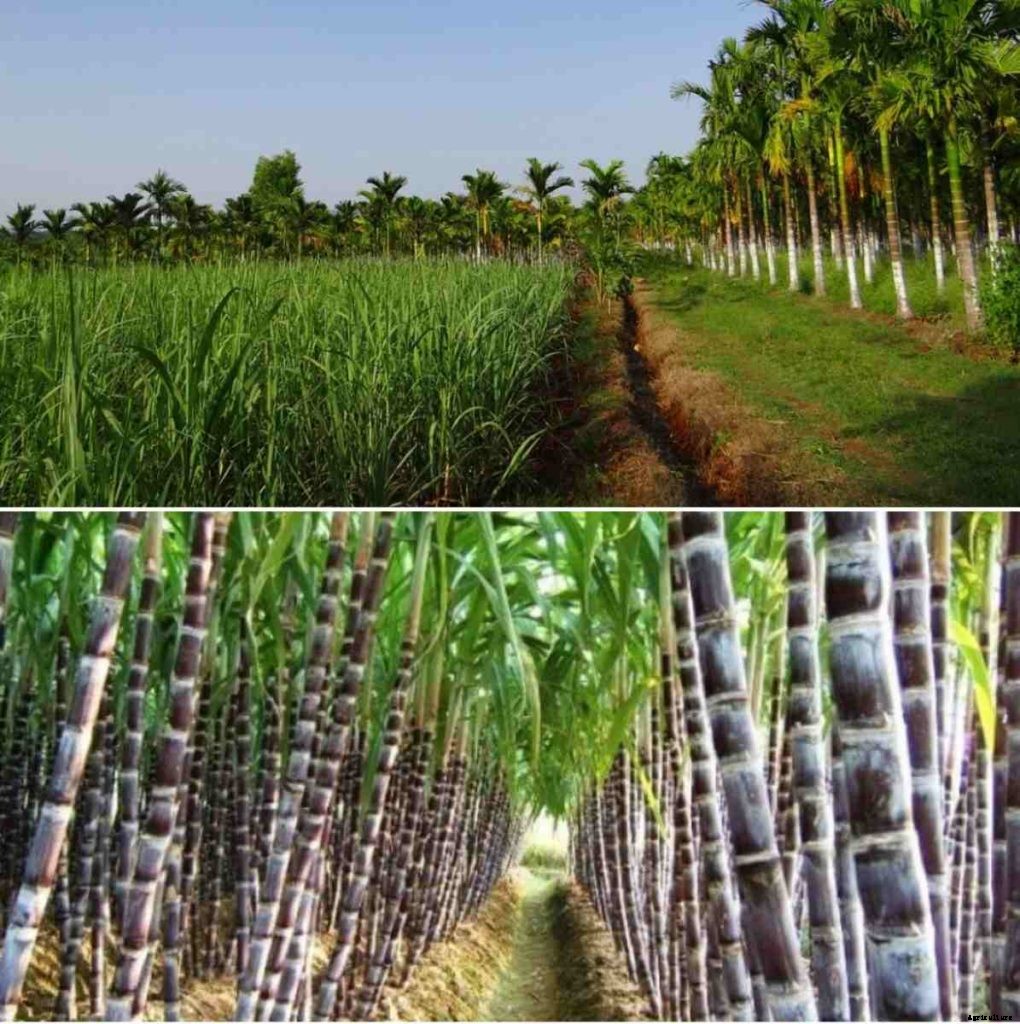 Sugarcane Farming Steps.
Sugarcane produce comprises of mother shoots and tillers. Tillers start emerging about 45 to 60 days after the emergence of the mother shoots. So, these are comparatively weak and finally effect in millable canes of lesser length, girth, and weight. Thus, to accommodate several mother shoots in the same space, tillers of sugarcane need to be suppressed. To get this, more numbers of setts are planted in a circular pit at a relatively greater depth. Thus, the mother shoots at large are allowed to produce with very less or no-tillers. That is why this technology is also known as ‘No Tiller Technology’.
Sugarcane farming by ring pit method is a long duration, high water and high nutrient crop in India. The second-largest sugar producer in the world is India after Brazil. Sugarcane production has been more or less static (around 350 million tonnes) in India during the past ten years. During the year 2014-15, the total production was a record of 362.33 million tonnes whereas, in the year 2015-16, the estimated production is 352.16 million tonnes only. Sugarcane can be planted by an improved method of planting such as Pit Planting is a revolutionary process that can double the sugarcane yield.
Important regions or zones for sugarcane cultivation in India
Broadly there are two different agro-climatic regions of sugarcane cultivation in India, they are tropical and subtropical.
However, five agro-climatic zones have been identified mostly for varietal development. They are;
- North Western Zone
- North Central Zone
- North Eastern Zone
- Peninsular Zone
- Coastal Zone
Tropical region Shared about 45% and 55% of the total sugarcane area and sugarcane production in the country, with average productivity of 77 t/ha (2011-12). The sub-tropical area accounted for about 55% and 45% of total area and production of sugarcane with average productivity of 63 t/ha (2011-12).
Major sugarcane growing states
Sugarcane is grown in several states in subtropical and tropical regions of the country. Major sugarcane growing states are;
- a) Sub Tropical region states are Uttar Pradesh, Uttarakhand, Haryana, Punjab, and Bihar with an annual rainfall of 180 to 2000 mm and the climate ranges from humid, moist sub-humid and dry sub-humid to cold arid, semiarid and arid.
- b) Tropical region states are Karnataka, Tamil Nadu, Maharashtra, Andhra Pradesh, Gujarat, and Madhya Pradesh with an annual rainfall of 602 to 3640 mm having moist to dry sub-humid and semi-arid to dry semi-arid climates.
The climatic requirement for sugarcane cultivation
Temperature for different critical stages of sugarcane is germination, tillering, early growth, active growth, and elongation. The optimum temperature for sprouting or germination of stem cuttings is 32° to 38°C. Temperature ranges above 38°C reduce the rate of photosynthesis and increase respiration. For ripening, however, relatively low temperatures in the range of 12 to 14°C are desirable.
You may be interested in Aquaculture in India, Types of Aquaculture.
Sugarcane farming steps
- Firstly, one should remember the factors and requirements the sugarcane needs to grow in India. After the favorable needs are met, the harvesting timing must be hit right. The stages of maturity must be set and the sugarcane crop should be harvested at that time itself. This will ensure the quality and quantity of the overall crop.
- The irrigation can be done about 10 to 15 days before harvesting. Speaking of harvesting, it can be done by cutting the cane at the ground level with an appropriate knife. The cut should be made in a slanting manner.
- The leaves and roots must be then removed completely. The so-called top part must be cut off as well. Bundles of canes are then sent to the crusher source and are finished within a day after the harvesting process.
Ring-pit Method in sugarcane production
- Sugarcane is planted in pits of a circular shape, so the method is called the ‘Ring-pit planting’ ‘Ring Pit Method’ proved not only cost-effective but also demonstrated that the yields can be increased to two or three times compared to the conventional ‘Row-to-Row’ planting technique. This ring pit technology, thus, has the potential of raising the present average productivity of about 70 MT/ha by three-fold.
- Ring pit planting (90×45 cm) method increased the crop yield up to 180 t/ha. In each ring or pit, about 22 three budded setts are placed horizontally in a circular manner. The crop under ring planting consists mostly of mother shoots which are thicker and heavier.
- Under the conventional system, the Setts (Stem cuttings or sections of sugarcane stalks usually having three buds used for planting sugarcane) are developed in rows of 90 cm spacing and are arranged in a series without adequate spacing. This makes germinated Setts thin in appearance ultimately affecting the number of canes in each Sett and its development.
- In the ‘ring pit’ method, sugarcane Setts are then planted and raised in round ‘pits’ at the spacing of 180 cm between rows and 150 cm between individual pits in a row.
- The pits are dug using particularly designed tractor-drawn power tillers. The pits are filled with topsoil, 5 kg of farmyard manure (FYM), 100 Gms gypsum and 125 Gms superphosphate and are watered well before planting and pit depth is kept at 1.25 ft. to 1.5 ft.
- Under this ‘ring pit’ system, around 2700 pits are made per acre. After planting Setts in this process, care is taken to see that only thirty mother shoots are allowed to develop which then leads to the development of robust and healthy millable canes of 1.25 to 1.75 kg each. This technology can give a yield of 800 to 1100 quintals/acre (or around three times of conventional method) if the recommended package of practices is fully adopted.
- The ring pit planting method of sugarcane cultivation is more water and nutrients efficient as well. This method, not only reduces water use but enhances nutrient use efficiency. Further, no plowing and lodging are necessary, which saves labor and machining cost.
- Ring pit method appropriate for drought-prone areas, undulating topography, lightly textured soils, saline-sodic soils, multiple ratooning, tall and thick cane varieties.
Sett cutting and treatment
- Choose the seed cane of a recommended variety.
- Choose the cane having healthy buds free from insect-pests as well as disease infestation.
- Cut the cane stalks in 2 budded setts and prepare a solution by dissolving 200-gram bavistin in 100 liters water.
- Dip the cut setts in bavistin solution for 10 to 15 minutes to control the sett born diseases.
You might be interested in Castor Cultivation Income, Yield, Project Report.
Sugarcane planted with the ring-pit method
- “Ring Pit Method of planting sugarcane” is the most innovative process through which farmers can get more than double per acre yield of sugarcane as compared to the existing conventional method of farming. Sugarcane planted with the ring-pit method can give 3-4 ratoons without much reduction in cane yield. Therefore in the long-term, the cost of cane cultivation will be minimized.
- Carefully apply 3-kilogram FYM, 8-gram urea, 20-gram DAP, 16-gram Muriate of Potash (MoP), 2-gram Zinc Sulphate in each pit. Mix it well with soil.
- Less irrigation water is required in the ring-pit method compared to conventional flat process as water is applied only in pits and apply 20 Kilogram Trichoderma mixed with 200 kilogram Farm Yard Manure or Press Mud per hectare over the setts.
- Interconnect every pit with a narrow channel manually for irrigating the pits. Nutrient use efficiency is enhanced in the ring-pit method as fertilizers are useful locally in pits. Sugar recovery increases in the ring-pit method compared to the conventional flat method because the main shoots are harvested in the ring-pit method.
- This technique can be adopted carefully in areas where the water table is higher. Arrangements are made for the drainage of excess water from the field. Take care to reduce the flow of water while irrigating the field by distributing the main water channel into 3 to 4 rows at a time. This can help in arresting land sliding & burying of setts under thick soil cover.
Intercultural operations of sugarcane crop
- Break the soil crust, if any, when soil moisture reaches to workable condition and fill the pits with the dugout soil up to 5 to 7 cm depth at the 4th leaf stage (50-55 days after planting in autumn and 40-45 days after planting in spring).
- Provide light irrigation and apply 16-gram urea per pit at workable soil moisture condition.
- Depending on soil and weather conditions, give light irrigations at an interval of 20-25 days.
- Carry out weeding in pits as and when necessary. Apply 16-gram urea per pit in the 3rd week of June.
- In the last week of June, apply 33 kg Furadan 3 gm per hectare to control top borer. Keep the gap of at least 3 to 4 days between applications of Urea and Furadan.
- Fill the pits with dugout soil by the last week of June and earthing-up before the onset of monsoon.
- Tie canes of each pit together with lower dry leaves in the first fortnight of August and tie the clumps of opposite rows together in September.
- Eliminate lower dry leaves during the months of August-September.
- Harvest the cane close to the ground level to get a good succeeding ratoon crop and to avoid yield loss.
Advantages of ring pit method of sugarcane cultivation
- By this method, cane yield is increased by 1.5 to 2.0 times as compared to the conventional methods. The pit system of planting can give the best yield.
- Irrigation water is saved up to 30 to 40 percent as only pits are irrigated and inter-row space is not irrigated.
- Water use efficiency is increased by 30 to 40 percent and nutrient use efficiency by 30 to 35 percent due to their localized application in pits only.
- Increment in sugar improvement is up to 0.5 units due to mother shoots. The millable canes from mother shoots provide higher sugar recovery in comparison to those from tillers.
- The profit of farmers and mill owners is increased due to higher cane yield and more ratoons, and higher sugar recovery, respectively.
Limitations of ring pit method
- Availability of pit digger machine for making ring or pit in the fields.
- More requirements of labors for manual pit making, mixing of manure and fertilizer with soil in the pit, covering of set with soil.
You may be interested in Shade-loving Plants.


