
Welcome to Modern Agriculture!

Sugarcane is an important industrial and cash crop in Pakistan and in many countries of the world. Average production of sugar cane in Pakistan is 450 – 500 maunds per acre which is very much low compared to the cane production by other countries. Agronomic factors like preparatory tillage, bed preparation, planting techniques and time, water availability for irrigation, application of fertilizers, management of ratoon crop, harvesting time, type of cultivars and plant protection measures significantly affect its production. These all factors also contribute to the cost of production.
It is noteworthy that cultivation of sugar cane crop is carried out for crushing purpose to obtain sugar, Panela (Jaggery, gur) and other products. By-products like alcohol used in pharmaceutical industry, ethanol used as a fuel, bagasse used for paper-making and chipboard manufacturing and press mud used as a rich source of organic matter that adds to soil fertility are derived after cane is crushed.
Pakistan occupies an important position in cane producing countries of the world. It ranks at the fifth position in cane acreage and production and almost 15th position in sugar production.
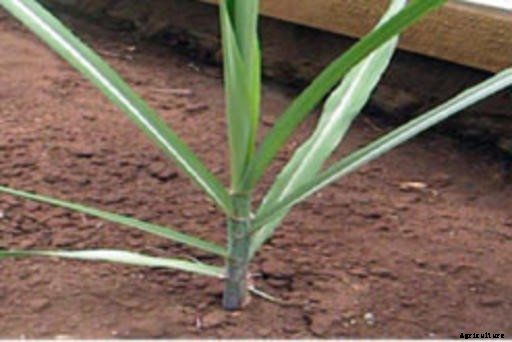
Sugar cane can be grown successfully on a great variety of soils. Typical cane soils however are heavy rather than light texture, clay loams and heavy alluvial soils are amongst the best, while the top soils possess high moisture retaining capacity. The sub soil should be porous and well drained. (Khoso)
Sugarcane is a deep-rooted crop and proper land preparation plays an important role in the development of cane root system, and achieving optimal growth of the crop. Land should be prepared by deep ploughing at least after every two years. The soil should be disked. Six to eight subsequent ploughings followed by planking are enough to achieve a good pulverized seedbed free of clods and weeds.
So that no more clots are present in the soil. The soil should not be more powdery too. If soil is clottier then seed may remain bare and that
will result in poor germination. On the other hand powdery soil may become compact and allow less seed germination.
It is very important that well-rotten farmyard manure (FYM) should be applied a month prior to land preparation. Press mud from the sugar industry is another excellent source of organic matter and nutrients.
.Green manuring may also serve the purpose.
There are two planting seasons: Rabi or fall sowing in September – November and spring sowing in February – March. Fall planting starts from the first week of September and continuous to mid-October in the Punjab and Sindh, while in the K.P.K. planting is done in October and November. Spring planting starts from mid-February and lasts until the end of March in the Punjab and Sindh. These planting times are strictly observed because late planting can reduce the yield by as much as 30 percent.
September planted crop usually produces 25 to 35 % higher yield. In Pakistan Planting time of sugarcane planting is usually carried out in autumn and spring seasons. Autumn planting is of high yield and high sugar recovery compared to spring planting. In fact, September planting gives very luxuriant growth, which is mostly vulnerable to lodging. The crop gives good appearance till June-July but is subject to lodging in July or even earlier if there are wind storms or excessive rains.
Appropriate seed rate and spacing are often ignored by farmers with the result that the optimum plant population which is the key factor in sugarcane production is not achieved in the field. The seed rate and spacing between rows differ with variety. Thick-cane cultivars like BL – 4, and PR – 1000 require a higher seed rate and more space between the rows than thin and medium-cane varieties. 80 – 90 maunds of stripped cane per acre for thick varieties and 60 – 70 maunds for medium to thin varieties are sufficient to produce a desired plant population about 60000 canes per acre.
Sets should be selected only from new cultivated immature crop as an over mature crop will have a large number of dry scale buds. In the case of dry scale buds it should be treated with lime solution. All sets should
be equal in length with 2-3 buds. Sets should be cut with a sharp tool sickle or axe.
Spacing between the rows should be 3 feet of thick varieties and 2 –2.5 feet for thin to medium varieties allows sufficient space for operations like intercultural and earthing up. It is also observed that planting sugarcane in furrows 4 feet apart in double row, spaced at 9 inches. It gives much better crop stand, and ultimately more yield than traditional methods. This method of sowing is called “2 in 1” means two sugarcane setts rows in a single trench with about 9 inches space between them.
Double-cut sets are placed end to end in furrows at a depth of 8 – 12 cm and covered with 5 – 6 cm soil. In the dry method immediate irrigation is essential and subsequent irrigations at short intervals.
Seed may be treated with hot water at 52 °C for 30 minutes and with fungicide. This will help in better germination and the control of many cane diseases.
Research on depth of soil cover over seed cane indicates that soil cover in excess of 4 inches can cause yield losses even if the excess is removed in the spring following planting. Heat-treated cane should be covered with 2 inches of packed soil. After the cane is up to a good stand and before freezing weather occurs, add an additional 2 inches of soil to protect from freeze damage. Do not cover heat-treated cane with more than 2 inches of packed soil at planting.
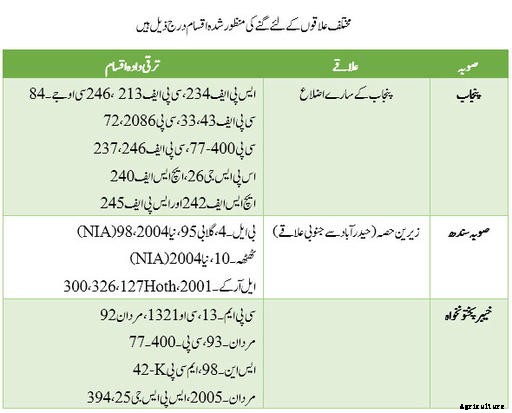
Use healthy seed of improved varieties of sugarcane. This can increase cane yield from 20 to 25 per cent. Sugarcane varieties recommended for various provinces are given below.
CP 77-400, CP 72-2086, CP 43-33, CPF-237, HSF 240, SPF-213, SPSG-26,
SPF 243, SPF 237, CPF 237, COJ-84.
BL – 4, BF – 129, HS – 2, Thatta – 10, PR–1000, CP 72–2086, L–113, L–116, NIA 98, SPSG – 26, HS – 4, HS – 12, L–126, CP–43-33, NIA–2004, NIA-2010, NIA-2011.
MCP – 421, CP 51 – 21, JN 88 –1, Mardan – 93, ABID – 96, SPSG – 344, CP
77-400, CP 44 – 101, L 62 – 96, SL – 98, Mardan – 92, Banu – 1.
Sugarcane is an exhaustive crop like wheat, rice, maize etc, that uptake huge amount of nutrients. It requires macro as well as micro nutrients.
Fertilizers are use in Pakistan is imbalanced, inadequate and improper. Most of the cane growers in the country use only nitrogenous fertilizers while others use an imbalanced combination of N and P. Use of K is almost neglected in cane crop. It is very important to use proper doses of balanced fertilizers to exploit the maximum yield potential of cane crop.
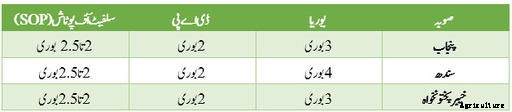
All phosphorus and potash should be applied at the time of planting. It is preferable that P and K may be applied in furrows where seed sets are to be placed. Rest of the nitrogenous fertilizer may be applied in 4 – 5 equal splits by fertigation system, during April, May and by mid June to February-March planted crop. In September – October cultivated crop, it will be beneficial if N is applied in 5 – 6 equal splits. In this case it may be applied during December, February, March, April, May and June. September planted crop may be given an additional dose of 20 to 40 kg N (one to two bags of urea) per acre.
Sugarcane being a giant crop producing huge quantity of biomass generally demands higher amounts of nutrient elements. At the same time the cost of chemical fertilizers has increased and there is a need to improve fertilizer use efficiency for more benefits. The best way of fertilizer application is “Fertigation”, where both water and fertilizers are delivered to crop simultaneously through center pivot irrigation system.
Earthing up is a practice followed to prevent lodging. Sugarcane usually lodges in August – September. It may even lodge in July if the cane crop is much healthier. Lodged cane caused losses e.g. reduction in yield, damage of mice, buds start germination, reduction in sugar recovery and hurdle in loading etc. lodged crop also become victim of frost and cannot be used as seed for next crop. Crop lodging might be due to many reason, i.e., cane variety, sowing time, sowing method, fertilizer application time, irrigation, rain, and storm are common. Earthing up is done at maximum tillering stage.
Reasons of sugarcane lodging
Sugarcane is a perennial crop and remains 3-4 years in the same field. Therefore, all types of weeds, seasonal, annual and perennial or broad leaves or narrow leaves grow in the field. These compete with crop for nutrients, space and light. Weed creates a favorable environment for disease and insect development.
Euphorbia granulata (Hazardani), Rumex obtusifolius (Jangli palik), Tribulus terrestris (Bakhra), Scirpus maritimus (Deela), Cynodon dactylon (Chabbar), Dactyloctenium aegyptium (Madhana), Cyperus rotundus (Morak – Kabah), Trianthema portulacastrum (Itsit), Digitaria sanguinalis (Moti khabal), Chenopodium album, Convolvulus arvensis L (Lehli/naro), Melilotus (Sinjhi) and Portulaca oleracea (Qulfa, Loonak).
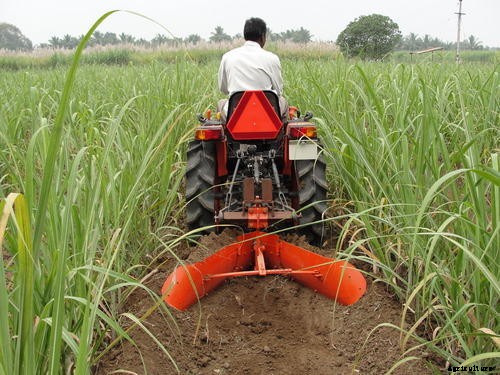
Fields are given a hoeing with help of khurpi (hand tool) or spade, after a month of sowing and the process is repeated frequently. Use the cultivator or local plough to destroy the weeds when the germination has been completed. After germination and tillering, (About 90 days after sowing) destroy the trenches by using cultivator or local plough. This method not only removes the weeds but also increases the sprouting and tillers and destroys insects and enhances aeration in the soil. Some growers make best use of this laborious operation by cultivation of second crop in between the sugarcane crop as a mixed crop.
Center Pivot irrigation system is most common in all over the world but in Pakistan it is introduced from few years. Center pivot irrigation systems are now introduced on large farms of country.
Sugar cane is a perennial crop and water requirements on an average varies from 47 – 63 inches for the spring crop and 80 – 98 inches for the autumn crop depending upon season, the fertility of soil, and the variety of cane. Autumn planting requires a higher quantity of water than spring planting. During the dry period, sufficient water should be applied at relatively short intervals to avoid moisture stress. When crop shows wilting it means big loss has been occurred for this to avoid from water stress.
The goal of an efficient irrigation scheduling program is to “provide knowledge on correct time and optimum quantity of water application to optimize crop yields with maximum water use efficiency and at the same time ensure minimum damage to the soil”. Thus,
Sugar cane crop should not be over irrigated because it leads to wastage of water, loss of Nitrogen by deep percolation serious deterioration of soil from water logging and salinity.
It is very important to take care of the irrigation requirements of sugarcane, particularly in summer months. Farmers must plan their acreage to be planted under cane crop according to the available water at their farm. The aim of sugar cane grower should be to get high yields year after without imparting soil productivity.
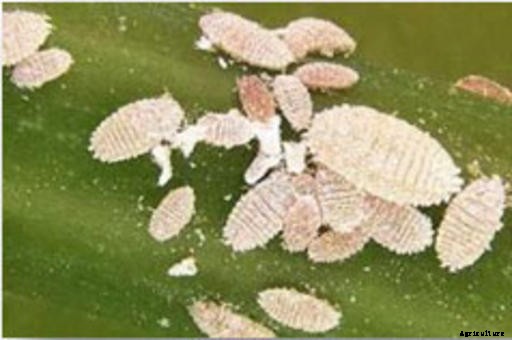
Insect pests play an important role in reducing the sugarcane yield. The most serious insect pests are sugarcane top borer, stem borer, Gurdaspur borer, army worm, white ant (feeding inside the cane and causes less germination). Pyrilla (Pyrilla is the most destructive foliage- sucking pest); whitefly, mealy bug and black bugs are also causing damage. These all can cause of yield reduction from 10 – 35% according the pest attack. In some cases maximum 80 – 85 percent reduction in crop yield can be due to high attack of insects.
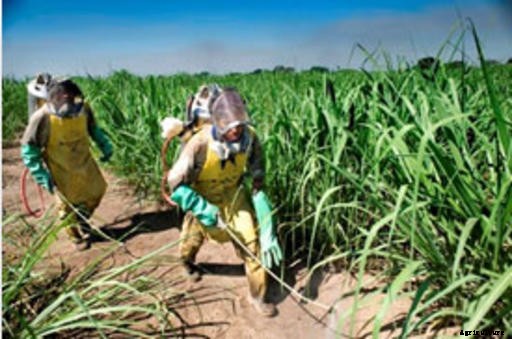
These losses in sugarcane can only be minimized by proper protection of the cane crop from insect pests with scientifically designed IPM Program throughout the year. Pesticides are applied as and when needed in combination with cultural practices, resistant varieties and introduction and conservation of natural enemies. Pesticides will continue to play an important role in the IPM Program. The primary difference, however, is that these products will be used selectively and judiciously.
Farmyard manure should always be used when it is fully rotten. This will reduce termite attack. Trash in the field should not be kept for longer time and it may be burnt. Dry shoots attacked by the bores must be pulled out and burnt. Always cut the crop as close to the ground as possible. Use of light traps will help controlling the spread of borers killing their adults. Earthing up during May-June will help in controlling Gurdaspur borer as the adults will not be able to come out of the ridges of the soil. In case of severe attack of any insect, do not keep the crop as ratoon.
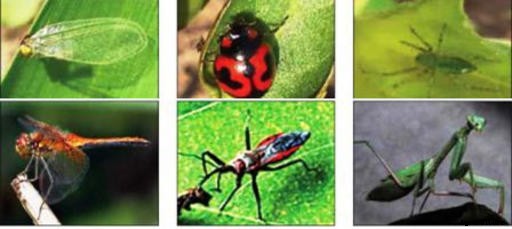
Besides using pesticides/insecticides, insects could also be controlled by biological measures. Cotesia flavips is an important larval parasitoid of sugarcane bores. Its female lays eggs inside the borer larva and after hatching; its larvae feed inside the borer larva. Adult parasitoid attack more borer larvae in the field. Trichogramma chilonis destroys the eggs of sugarcane borers. Its female lays eggs inside the eggs of borers. Parasitoid larvae feed in the host eggs, destroying them. Epi-pyropes destroy sugarcane Pyrilla. These parasitoids are mass multiplied in the laboratory and then released in the cane fields.
Mealy bug Army worm Pyrilla
Whip smut, caused by Ustilago scitaminea is a most common disease of sugar cane. The affected canes produce long, black whip-like and coiled or curved shoots, which are covered with a thin silvery membrane, containing masses of chlamydospores of the fungus. Infected plants should be removed from the field and brunt. Avoid ratooning of disease affected crop. (A.W Khoso)
For controlling sugarcane diseases, use healthy seed which is disease- free and preferably plant disease-resistant varieties. Treat the seed with fungicide/s before planting. The diseased plants from the field should be removed and either buried or burnt. Disease-free, good-quality seed increases yield by 10-15%.
The disease first appears as red bright lesions on the mid rib of leaves and shows itself as drooping and changing of color of upper leaves.
Withering of the leaves proceeds to downwards. Usually third or the fourth leaf from the top is affected and shows drying at the tip. The pith becomes red and later on brown. In severe cases, complete destruction of the stools is brought about. When the infected canes are spilt open, they gave out an alcoholic smell due to fermentation and show reddened areas.
Red Rot Disease Whip smut disease
If the ratoon crop is properly managed, it could give higher returns than the plant crop because of savings in certain field operations and inputs. It is important to remember that ratoon crop requires 30 to 40 per cent higher fertilizers than the newly planted crop. The end of January to beginning of March is the best time to keep the crop for ratooning. Cane from the fields to be kept for ratoon should be cut at ground level.
The sugar recovery in ratoon crop is also better and it matures earlier than the newly planted crop. However, remember that it has to be managed with extra efforts and care. Apply all the phosphorus and potash fertilizer plus one third of N during March. Plough the land in between the furrows to mix the fertilizer well in the soil and then irrigate the crop. Fill the gaps; control the weeds, insect pests and diseases properly. Rest of the nitrogenous fertilizer should be applied in two equal splits during April and May.
Stop irrigation 25 to 30 days before the harvest of crop and do not leave the harvested crop for long time in the field. In case it has to be kept for a prolonged period, it should be covered with trash. Different varieties planted may be harvested according to their maturity. Harvesting of early maturing varieties may be started during November, mid-season varieties during December and the late maturing varieties during January. The crop harvested during February – March gives good ratoon crop.
Harvesting is done when the crop has fully matured and ripened. Early varieties and ratoon crops are the first to be harvested. When the stem is close to the surface, great vigilance is required in order to cut the maximum portion of the stem, which is valuable both for its weight and sugar content. The harvested cane should be immediately hauled to the mill otherwise weight and sucrose losses may occur.


