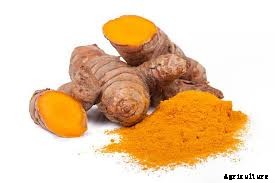
Uses of Turmeric:
- Used as a conditioner.
- Useful as a dye varied uses in drug and cosmetic industries.
- Used medicinally for external application and consumed as a stimulant.
Soil:
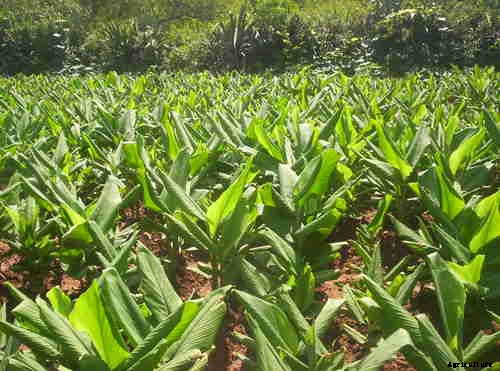
- Different kinds of soils such as sandy loam to clay loam or alluvial soils are suitable. Well-drained loamy soils are the best.
- Soil should be rich in organic matter and uniform in texture.
- Rich loamy soils having natural drainage and irrigation facilities are the best.
- Turmeric cannot withstand water stagnation or alkalinity.
Climate:
- Tropical crop, requiring warm and humid climate.
- Temperature range-246C to 28�C.
- Growth ceases when, temperature falls below 20�C, and hence early-planted turmeric gives good yield.
- Thrives well in localities with annual rainfall from 70 – 225 cm.
- Can be grown at an altitude of 1200 m.
Cultivation of Turmeric:
I) Seed Material:
a. Seed Selection:
- Seed of turmeric consists of rhizomes.
- Both mother and finger rhizomes are used.
- The fingers are cut into pieces, each 4-5 cm long with 1-2 buds. Mother rhizomes are planted as such or split into two, each having one sound bud.
- Mother rhizomes are preferred since they give 50% more yields than the finger rhizome and also give good growth.
- Large sized, plumy and healthy mother rhizomes at least 100 g in weight should be used.
b. Seed Rate:
- Varies according to type of planting material, spacing and weight of rhizomes.
- Mother rhizomes: 2000-2500 kg/ha.
- Finger rhizomes: 1500-2000 kg/ha.
- For Maharashtra: 2250 kg/ha.
- As an intercrop in fruit garden: 400 – 500 kg/ha.
c. Seed Treatment:
Rhizomes are treated with 50 Lindane powder and Bavistine (2 g/1) by dipping for 15-20 minutes for prevention of diseases and rhizomes fly during early period.
II) Preparation of Land:
- Starts immediately after harvest of previous crop or with/onset of early rains in plains.
- Land is ploughed 15-20 cm deep arid exposed to sun for one month. 2-3 crosswise harrowing are given.
- Temporary ridges are opened to prevent soil erosion on sloppy lands.
III) Systems of Planting:
- Flat Beds: Used under rainfed conditions where soils are light. Flat beds 1 m in width and-of suitable length varying according to the slope of land are prepared.
- Ridges and Furrows: Under irrigated-conditions where the land is leveled or plain and soils are heavy, planting is clone on ridges and furrows, opened at 75 cm distance and haying 3-3.5 m length. Broad ridges should having 90 -100 cm width and 3 – 6 m length depending on the slope.
Planting of Ginger:
a) Season of Planting: May to July depending on tract. In Maharashtra, second forth night of May is the best time of planting rhizomes.
Method of Planting:
- On Flat Beds: (25 x 2.5 cm) in each direction.
- On ridges and furrows: 40-60 x 25 cm.
- Rhizomes are planted at l/3rd height of ridge on broad ridge.
Manuring and Fertilization:
Turmeric is a heavy feeder crop.On the basis of experiments conducted at Turmeric Research Station, Recommended fertilizer dose is; 25-31 ton FYM, 120 kg N, 50 kg P205 and 50 kg K20/ha.
Time of Application:
Intercropping:
Mixed crops like chilli, onion, brinjal and maize can be taken. In Maharashtra, it is recommended to grown French bean as an intercrop.
Aftercare:
a) Mulching:
- Done when-planted on raised beds .
- 2-3 mulching, are given.
- 1st immediately after planting.
- 2nd and 3rd at an interval of 40 – 50 days.
b) Earthing up:
- To avoid exposure of developing underground rhizomes to sun due to soil erosion.
- Done with light digging, 2 – 2.5 months after planting.
c) Weeding:
- Pot is kept clean during first 4-6 weeks.
- Depending on intensity of weeds, 5-6 weeding are given.
Irrigations:
- First irrigation sis given before planting.
- Second is given just after planting.
- Subsequent irrigations are given at 7-10 days interval depending on soil.
- A total of 20-25 irrigations are given, during the life period of the crop.
Pests and Diseases of Turmeric
Pests of Turmeric:
Shoot Borer:
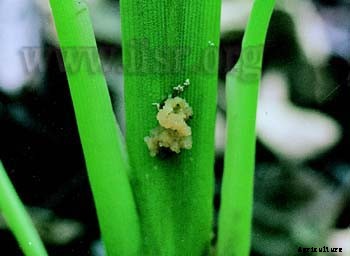
The caterpillar bores into rhizomes and feeds on it. Control: Spray 0.1 % Malathion.
Leaf Roller:
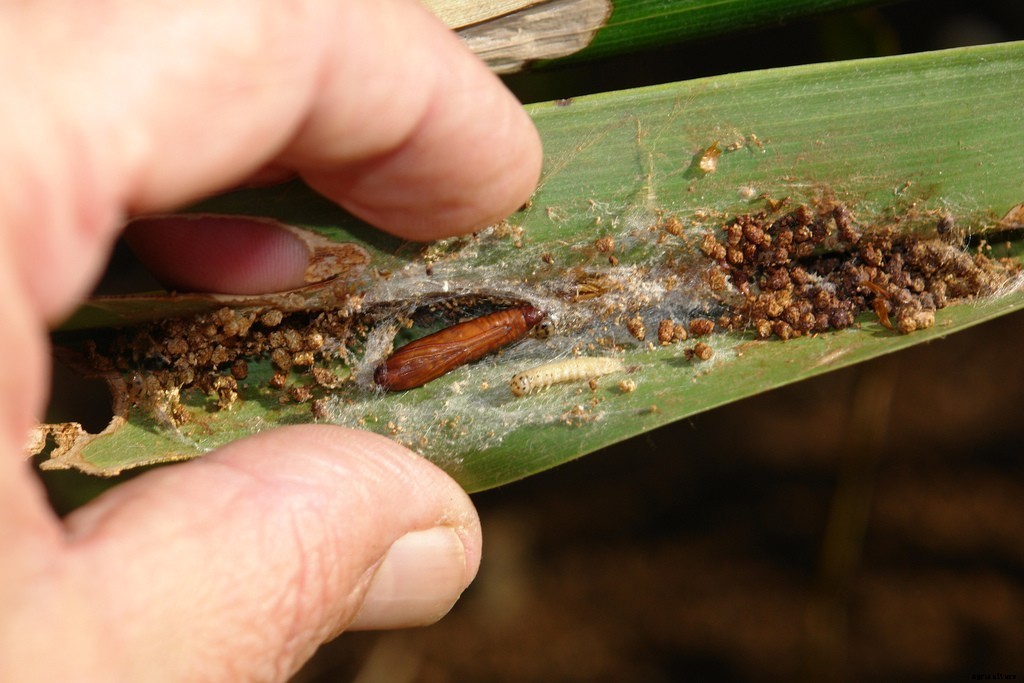
Caterpillar remains in leaf folds and feds within. Control: Spray 0.05 % Dimethoate.
Scale Insects:
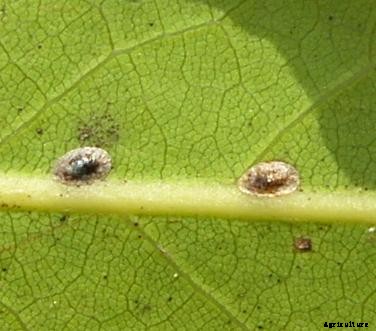
The scales, damage the rhizomes both in field and in storage Control: Dip seed rhizomes in 0.05 % Malathion or Dimethoate for 30 minutes before storage or planting.
Diseases of Turmeric:
Leaf Blotch:
Small oval, rectangular or irregular brown spots appear on either side of leaves and soon become dirty brown. Yield is reduced. Control: Spray 0.2 % Diethene M-45.
Leaf Spot:
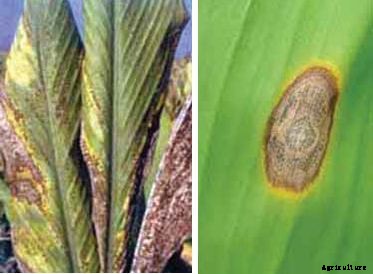
Brown spots of different size appear on the upper surface of young leaves. The spots are whitish or grayish in the center. Subsequently, the whole leaf gets covered and leaves dry up. The rhizomes do not develop well. Control: Spray 0.3 % Zineb or 1 % Bordeaux mixture.
Rhizome Rot:
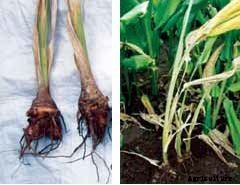
Leaves dry up starting from the margins. Collar region becomes soft, water soaked and the plants, collapse, Rhizome decay follows.
Control:
- Treat the seed rhizomes with 0.3 % Diethane M-45 for 30 minutes before sowing and also before storage.
- Under field conditions, drench the beds with 0.3 % Diethane M-45.
Harvesting:
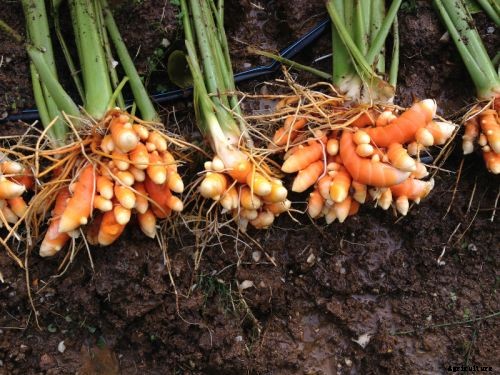
- Starts from Feb. and continues till April.
- Rhizomes are ready for harvest in 7-9 months after planting.
- Longa type – 9 months, Amada type – 8 months and Aromatica type – 7 months.
- State: Turmeric is harvested when leaves start yellowing and ultimately the stem dries down. The plants are-cut close to the ground.
- The crop is irrigated lightly for easy digging.
- Harvesting consists of digging of underground clumps of rhizomes with Pick axe or digging fork.
- Fingers are separated from mother rhizomes.
Yield:
- 250-300 q/ha for fresh rhizomes.
- Cured Produce: 20-25 % of fresh rhizome by weight.
Preservation of Seed:
- Rhizomes for seed are heaped in the shade of trees or in well ventilated sheds and covered with turmeric leaves.
- Sometimes the heap is plastered over with earth mixed with cow dung.
Quality of Finger:
- Should be free from chemichrome .
- Extraneous matter should be less than 2 %.
Quality of Powder:
- Chemichrome test should be negative .
- Total ash less than 9 % .
- Moisture less than 13 % .
Turmeric Oil:
A volatile oil is obtained by steam distillation of ground turmeric after 8-10 hours. The oil is pale yellow to orange yellow in colour. The aroma of oil is due to tumerone and artumerous.Turmeric oleoresin is obtained by solvent extraction method and is highly valued.


